









It feels like centuries since id Software's first-person shooter Quake required a math co-processor. Soon after the game's release, 3DFX launched the first-ever dedicated GPU, revolutionizing gaming visuals by turning pixelated polygons into smooth, three-dimensional shapes that appeared more realistic than ever. When Agia introduced the PhysX processor after the turn of the century, the visuals took on more of a realistic appearance by introducing physics, depicting the natural movements of objects, and how they interact with the environment. Now Caustic Graphics wants to take the next step into providing the ultimate experience with its dedicated ray-tracing processing system, the CausticRT.
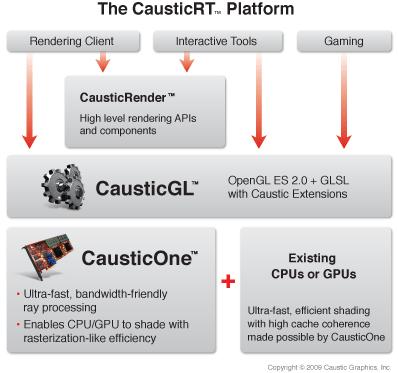
The new system's CausticOne ray-tracing processing unit(RTPU) isn't meant to replace the GPU. In fact, it's job is to enhance the graphics much like Agia's PhysX, however the CausticOne doesn't deal with physics in terms of movement, but rather where the incoherent light rays scatter in a particular scene. Typically, ray-tracing requires that the PC or Mac process the entire scene, not just the visible areas, eating up valuable memory and CPU processing. This usually takes a large chunk of time on a single machine, especially when rendering high-resolution scenes in programs like 3DS Max and Maya. In fact, Pixar and other CGI companies have dedicated "farms" in order to render those realistic movies in an acceptable timeframe. According to the company, the average render time today for a single ray-traced image at film resolution is over three hours.
However, the CausticRT system supposedly removes the immediate bulk of the ray-tracing calculations off the GPU and CPU, using what the company calls a "breakthrough algorithm" that addresses the rendering issue and organizes the incoherent rays into a data flow. Thus, the processor sends the ordered data to the GPU and CPU. Ultimately, the CausticRT system will render ray-traced scenery with rasterization-like efficiency, producing photo-realistic graphics 20 times faster than anything on the market today.
"CausticRT does not displace a GPU or CPU in a graphics system, rather it acts as a co-processor that traces rays and schedules the results in a manner that allows GPUs or CPUs to shade them as efficiently as they do with rasterization," said James McCombe, co-founder and CTO of Caustic Graphics. "We are working with an emerging developer community to create new or port their existing renderers and applications to Caustic so artists and designers can take advantage of the photorealism and visual effects that make ray-tracing so compelling over rasterization."

Unfortunately, the CausticRT platform isn't ready for the general public, costing around $4,000 for the CausticGL driver, the CausticOne processor and accelerator card, and one year of firmware and software updates. The company also said that developers may also purchase a one-year subscription for US $2,500 that includes support for up to 10 incidents. However, it may be possible that the general public will see the CausticRT platform in the not-too-distant-future, as the company suggested that game consoles could achieve film-quality run-time visuals using the system. Could this processor be included in the next generation of Xbox and PlayStation consoles? Perhaps so. And like Agia, it may be possible that the CausticRT system will become a part of the Nvidia--or AMD for that matter--collective.
Stay tuned for the official announcement of the CausticOne accelerator card this Wednesday.
