AMD Ryzen AI Max+ PRO 495 APU could arrive with 192GB of unified memory — leaked PassMark benchmarks suggest modest update over Strix Halo

AMD Strix Halo Ryzen AI Max
(Image credit: AMD)

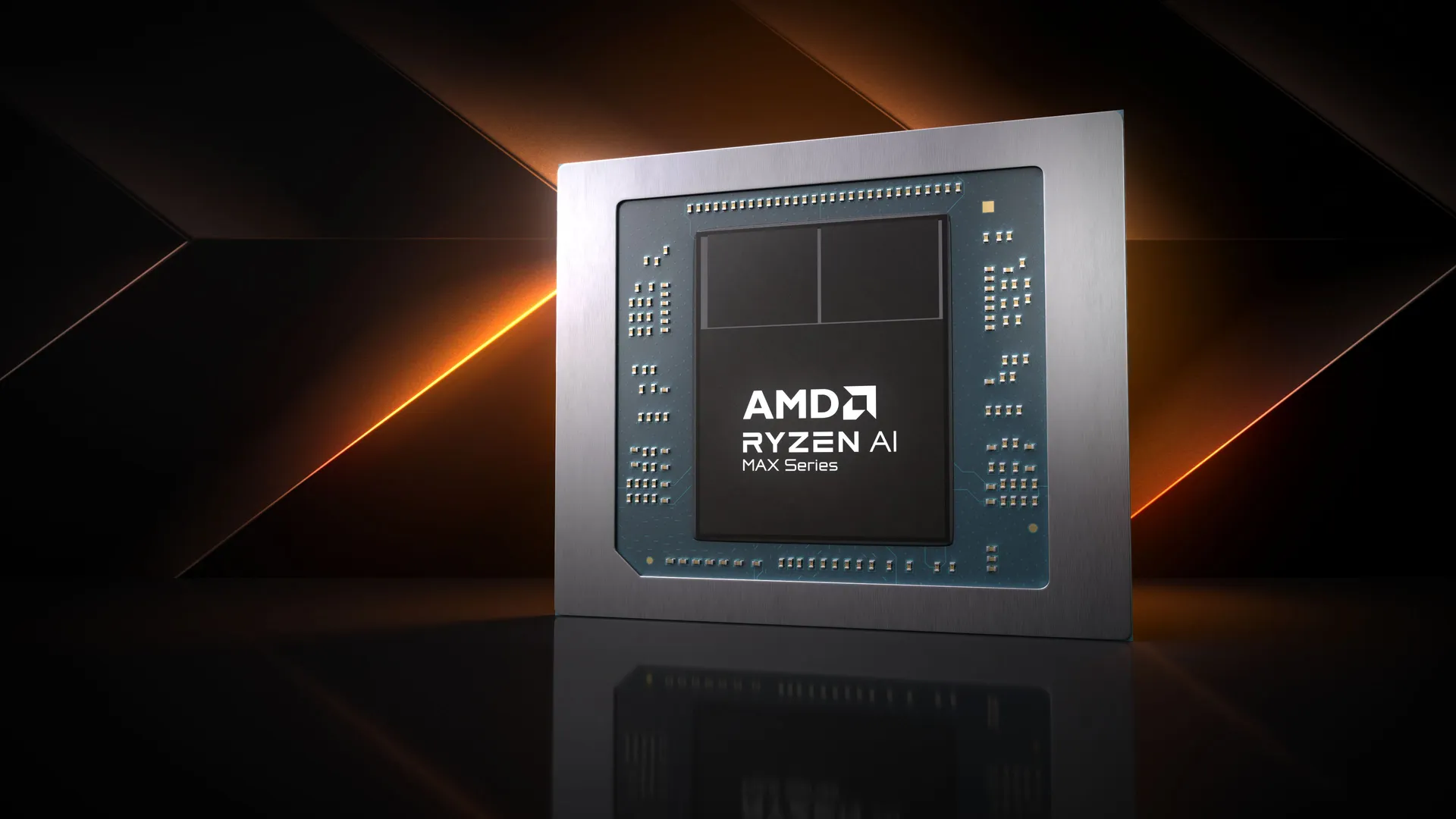
AMD is potentially working on introducing a new flagship APU as the Ryzen AI Max+ PRO 495 was recently listed on PassMark’s benchmark database. The unconfirmed chip is expected to be a part of the company’s upcoming “Gorgon Halo” lineup and a successor to the existing Strix Halo flagship, the Ryzen AI Max+ PRO 395. It is worth mentioning that the primary difference between the PRO and non-PRO variants is the target market. For instance, the existing Ryzen AI Max+ PRO 395 is meant for enterprise and business customers, while the standard Max+ 395 is aimed at high-performance consumers.

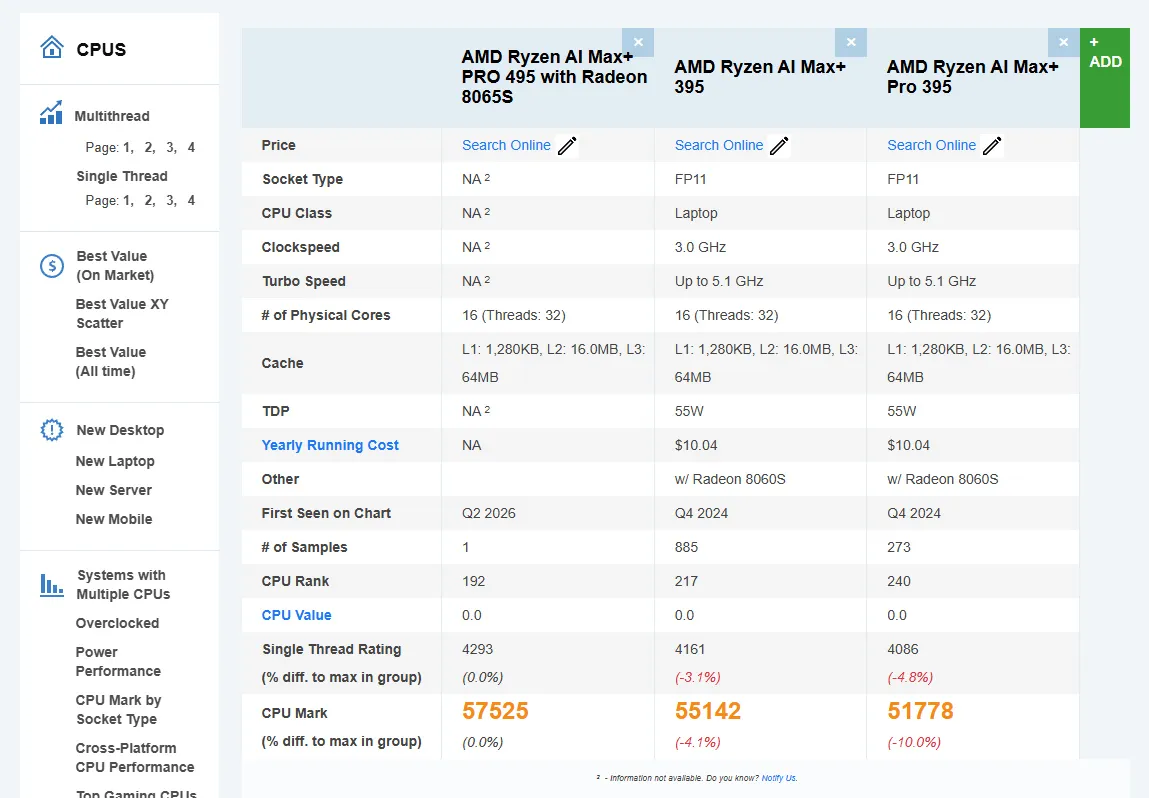
The listing suggests that this particular mobile APU will be more of a refresh featuring a similar 16-core and 32-thread configuration as the Ryzen AI Max+ 395/Max+ PRO 395. What does change is the unified memory capacity, which has increased from 128GB on the Max+ 395 to 192GB of LPDDR5X spread across eight 24GB SK hynix modules. It is surprising to see AMD adding more memory despite the ongoing RAMpocalypse, but the increased memory is a welcome addition that should help tasks that use large datasets like AI, machine learning, and content creation.
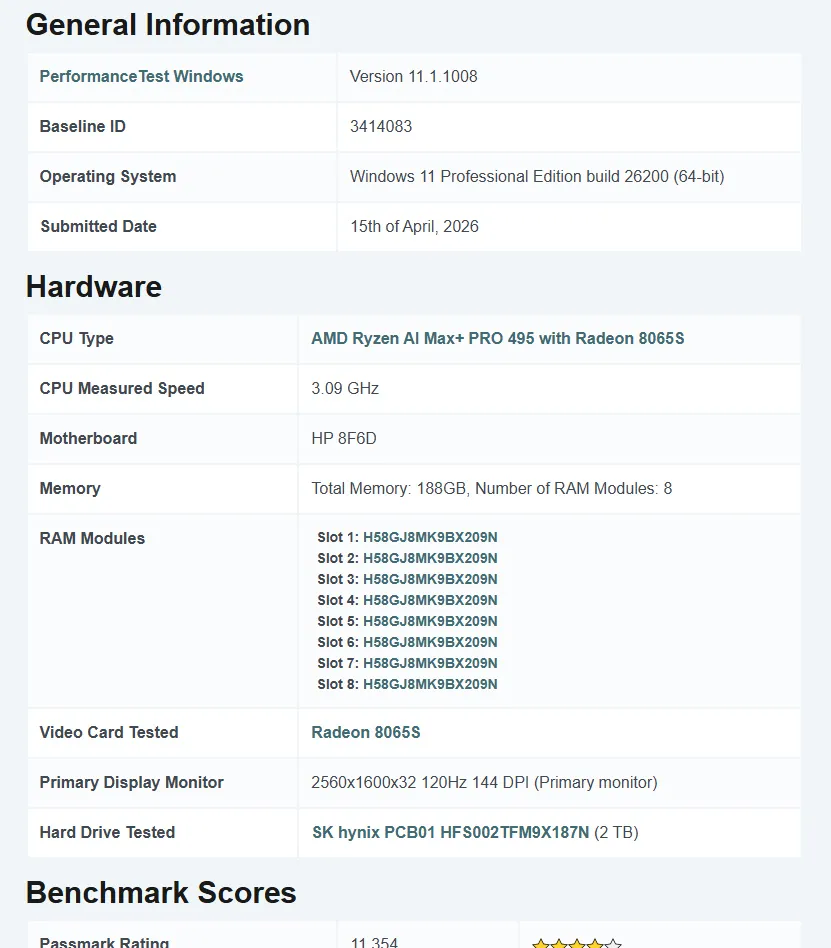
Another notable change is the integrated GPU solution, which is listed as the Radeon 8065S, which is expected to be a slightly higher clocked version of the current Radeon 8060S. The 8060S is currently one of the most powerful iGPU solutions capable of offering performance similar to and in some cases better than the Nvidia RTX 4060 laptop edition.

Latest Videos From

As for the performance, Passmark benchmark results aren't the most indicative of real-world performance, so take these results with a shovel full of salt. The Ryzen AI Max+ PRO 495 scored 57,525 points in CPU Mark and 4,293 points in single-thread. This makes the new chip 4.1% faster in multi-thread and 3.1% ahead in single-thread when compared to the Ryzen AI Max+ 395, which is listed at 55,163 points and 4,161 points respectively. However, this could be due to the run-to-run variability.

While AMD has yet to confirm the existence of the Ryzen AI Max+ PRO 495, the leaked specifications suggest a strategy similar to its recent APU updates. Much like the “Gorgon Point” Ryzen AI 400 series, which was introduced as a modest refresh over the “Strix Point” Ryzen AI 300 lineup, AMD may take a similar approach with the upcoming “Gorgon Halo” Ryzen AI Max+ 400 series, focusing on incremental improvements rather than an overhaul.

Google Preferred Source

Follow Tom's Hardware on Google News, or add us as a preferred source, to get our latest news, analysis, & reviews in your feeds.

TOPICS
Kunal Khullar
News Contributor

Kunal Khullar is a contributing writer at Tom’s Hardware.  He is a long time technology journalist and reviewer specializing in PC components and peripherals, and welcomes any and every question around building a PC.

  • usertests
    As far as we can tell, practically nothing is different between Strix Halo and Gorgon Halo, so for the 300-series chips already manufactured out there, you would think it would be possible to pair them with 192 GB of memory.

    You might conclude 24 GB is the largest 32-bit package being made. But based on this story, there are already 128-bit SOCAMM2 modules using 32-bit 64 GB LPDDR5X packages (16x 32 Gb dies). So it should be possible to make a 512 GB Strix/Gorgon Halo product. 16-layer packages are definitely more expensive to make per-gigabyte than 8-layer though.

    "Nobody needs 192-512 GB with a product this slow"

    And I don't need 64 GB in my trash system. But from what I'm hearing, mixture of experts (MoE) models could run faster than expected on Strix Halo, while benefiting from having their entire contents in the large memory pool.

    It may not be worth the $4k-5k a 192 GB Strix/Gorgon Halo box would probably cost, but "more memory better" remains technically true. Hopefully, everyone can have a cheap terabyte of memory by 2040.
    Reply
  • w_barath
    I'm so happy to see Tom's excellent deep understanding of the product's place in the market and the needs of that place in the market, taken into account in the thoughtful research invested into this article!

    The one metric that would significantly improve this Gorgon Halo over Strix Halo would be increased memory bandwidth.

    Great job reporting! 🌟
    Reply
  • usertests
    w_barath said:
    The one metric that would significantly improve this Gorgon Halo over Strix Halo would be increased memory bandwidth.
    It should have explicit 8533 MT/s support, instead of 8000 MT/s. There's your 6.6% improvement.
    Reply
  • w_barath
    usertests said:
    It should have explicit 8533 MT/s support, instead of 8000 MT/s. There's your 6.6% improvement.
    AOOSTAR MAX+ 395 and HP ZBook Ultra G1a have trusted source reviews stating they have 8533MT/s. A couple of them have recently retconn'd their articles to say 8000, which I assume is in response to pressure from AMD saying that 8000 is the official number.
    Reply
  • Notton
    I guess the next question is...
    Is the AMD memory controller robust enough to use 9600MT/s or 10700MT/s?

    8000MT/s wasn't impressive when Strix Halo was released.
    8533MT/s isn't impressive whenever Gorgon Halo releases.
    Reply
  • DS426
    I'm sure someone will be able to use more than 128 GB of shared RAM in their workloads.
    usertests said:
    ...
    And I don't need 64 GB in my trash system. But from what I'm hearing, mixture of experts (MoE) models could run faster than expected on Strix Halo, while benefiting from having their entire contents in the large memory pool.
    ...
    And longer contexts, and keeping more LLM's loaded into memory simultaneously (makes sense in some coding and agentic applications), agents working out into the horizon for longer, and even some combination of all of this. The new 192 GB mem limit is definitely usable, not just marketing and over-the-top halo product specs.

    Faster mem support would be nice, yes. We'll have to see when the final specs are announced.
    Reply
  • w_barath
    DS426 said:
    I'm sure someone will be able to use more than 128 GB of shared RAM in their workloads.

    And longer contexts, and keeping more LLM's loaded into memory simultaneously (makes sense in some coding and agentic applications), agents working out into the horizon for longer, and even some combination of all of this. The new 192 GB mem limit is definitely usable, not just marketing and over-the-top halo product specs.

    Faster mem support would be nice, yes. We'll have to see when the final specs are announced.
    The trend since early 2025 has actually been that there are more capable models using less RAM, but the memory bandwidth problem remains.

    Google has released their TurboQuant paper which is supposed to reduce the Key Value Cache memory bandwidth for the by a factor of 6 for the inference stage, with no significant loss of output quality. That should roughly double overall performance for most models which adopt it, but that doesn't solve the bottleneck, it just reduces its impact.

    I'm optimistic that this will be the year of competent (long horizon) and performant (>20 TPS) coding models with under 30GB VRAM residency. Qwen3.5-35B-A3B is a sparse MOE model that is nearly there already. When we cross this threshold, AI coding assistance will be truly democratized. That will lead to a 3-pronged leap. First, developer productivity. Second, a leap in AI development pace due to increased developer productivity. And third, as more developers realise the gifts of AI, the higher the proportion of developers and engineers who will turn their focus to improving the systems concepts themselves. You factor those things and the rate of growth will be step change quarterly.
    Reply
  • pcbulk
    AMD not only needs to up the memory size no matter the cost, they need to up the “channels” for speed because their current 4x vs Apple’s 16x is so far behind. Even Apple is cutting the ram size of their upcoming systems and meanwhile I’m holding back on my purchases because the ram size isn’t high enough. Get the desktop AI system ram size up near 2TB and then I release the funds for two units if they network together with datacenter speed ports.
    Reply