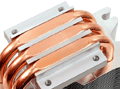
Remember when overclocking was all about getting more performance for less money? It's hard to do that when you're spending top dollar on premium heatsinks and fans. Today we round up six true value-oriented coolers that could help unleash hidden speed.
Our tests continuously show the benefits of overclocking on system performance, where a few simple adjustments often allow tweaked mainstream hardware to outperform even the most expensive factory-spec’d parts.
And yet, many buyers overclock in search of value rather than breakneck speed, and that value can vanish fairly quickly if you have to buy premium aftermarket heatsinks and fans to support ambitious overclocking efforts.
The good news for value-seekers is that today’s CPU air coolers perform so well that more expensive options are—in most cases—no longer needed. This editor has even found several instances where a big heat sink and fan beats a similarly-sized liquid-cooling configuration priced nearly twice as high.

While some air cooling components can be expensive, the majority should fit into all but the tightest budgets.

Of course, the cheapest way to go is using the cooler that comes with boxed retail processors. But those are often barely adequate for running the CPU at stock speed. That's why we're taking a look at the next level in CPU cooling: a group of six new $20-40 “universal” models that could help you turn just about any modern CPU into a performance monster.
| Value/Performance CPU Cooler Features | |||
|---|---|---|---|
| Corsair A50 | Deepcool Ice Matrix 400 | Gelid Tranquillo | |
| Top Height | 6.56" | 6.35" | 5.95" |
| Base Height | 1.57" | 1.90" | 1.15" |
| Center to Front | 2.18" | 1.87" | 2.35" |
| Number of Fans | 1 | 1 | 1 |
| Fan Size | 120 mm | 120 mm | 120 mm |
| PWM | No | Yes | Yes |
| Weight | 23 Ounces | 22 Ounces | 23 Ounces |
| AMD Orientation | Updraft | Cross flow | Updraft |
| Intel Sockets | 775, 1156, 1366 | 775, 1156, 1366 | 775, 1156, 1366 |
| Web Price | $38 | $38 | $35 |
| Value-Performance CPU Cooler Features | |||
|---|---|---|---|
| Rosewill RCX-ZAIO-92 | Xigmatek Gaia | Zalman CNPS10X Performa | |
| Top Height | 5.38" | 6.19" | 6.00" |
| Base Height | 1.56" | 1.40" | 1.50" |
| Center to Front | 2.25" | 2.07" | 2.25" |
| Number of Fans | 1 | 1 | 1 |
| Fan Size | 92 mm | 120 mm | 120 mm |
| PWM | Yes | Yes | Yes |
| Weight | 17 Ounces | 22 Ounces | 27 Ounces |
| AMD Orientation | Updraft | Cross flow | Both |
| Intel Sockets | 775, 1156, 1366 | 775, 1156, 1366 | 775, 1156, 1366 |
| Web Price | $20 | $30 | $35 |
Corsair is the only brand in today’s comparison to include a non-PWM fan with its package. Most enthusiast motherboards now support both PWM and voltage-based fan speed controls, but it’s a feature to keep in mind for the few motherboards that lack this capability.
Read the article before posting please.
http://www.tomshardware.com/reviews/lga-1156-heatsink,2535-4.html
That's why the same system was used for both tests. It's all mentioned in the article, too.
http://www.tomshardware.com/reviews/lga-1156-heatsink,2535-4.html
That's why the same system was used for both tests. It's all mentioned in the article, too.
Read the article before posting please.
- Heatpipe orientation .. I know all about capillary action but since I don't know of any manufacturer that advertises/places the type of wick they use on the box of the cooler, believing that all coolers are the same and therefor heatpipe orientation does not matter, is a bit idiotic. I know that on a open test bed with the motherboard sitting flat/horizontally the heatpipe orientation isn't relevant but inside a PC case it might be .. and here is my dilemma. Did some research about this, but other then forums and "i believe so" arguments I haven't found anything relevant on this subject. The thing is I was looking these past few weeks at reviews for arctic cooling's 13 on different websites and even though the test method (and room temp)is slightly different from one reviewer to the other, the temp values differ quite a bit which is normal but the biggest difference seams to stem from it's orientation in a pc case.
Main point of my rambling ... since this is probably one of the oldest tech websites out there, could you bust/prove this myth? Get a bunch of coolers from all price ranges (i have a feeling that cheaper coolers would turn up a bigger difference in values that the expensive ones) and place them est-west and north-south inside a closed pc case. Run a couple of tests and gives us the results.
PS: i know that case fans matter but since most pc cases now have a psu mounted at the bottom and there is a exhaust fan/grill at the top, you could use that as the "standard case" for this test.
Great article.
I wanted a comparison between the CM 212+ and Xigmatek Gaia.
I think i'm going for the Gaia for its easier installation and to use it in a 2-fan setup with a fan that i allready have and don't know where to use it.
It would be even better if you added the performance of the coolers that support 2-fan setups.
Sorry, but the Hyper 212+ is too old to be part of a "new for 2010" cooler roundup, but that's why the link was provided in the article and the response thread:
http://www.tomshardware.com/reviews/lga-1156-heatsink,2535-4.html
thnx again
funny
I can see this time you took your time editing it and the end result is excellent.
On an unrelated note ... any news on whether your "grumpiness" is improving or can I expect a "slap" for my cheeky comment ... heh heh.
Seriously, If this is the new standard required for the other reviewers then the rest (Bar Chris and Don) have some work to do mate.
Well done ... very well done.
Are you guys adding a "Coolers P/P rank" anytime soon? That would be so helpful 8)
Cheers!