Pirate RPG game is secretly looting your SSD lifespan — new Windrose patch promises smoother sailing and addresses excessive disk writing
Update ASAP so your SSD has some room to breathe.
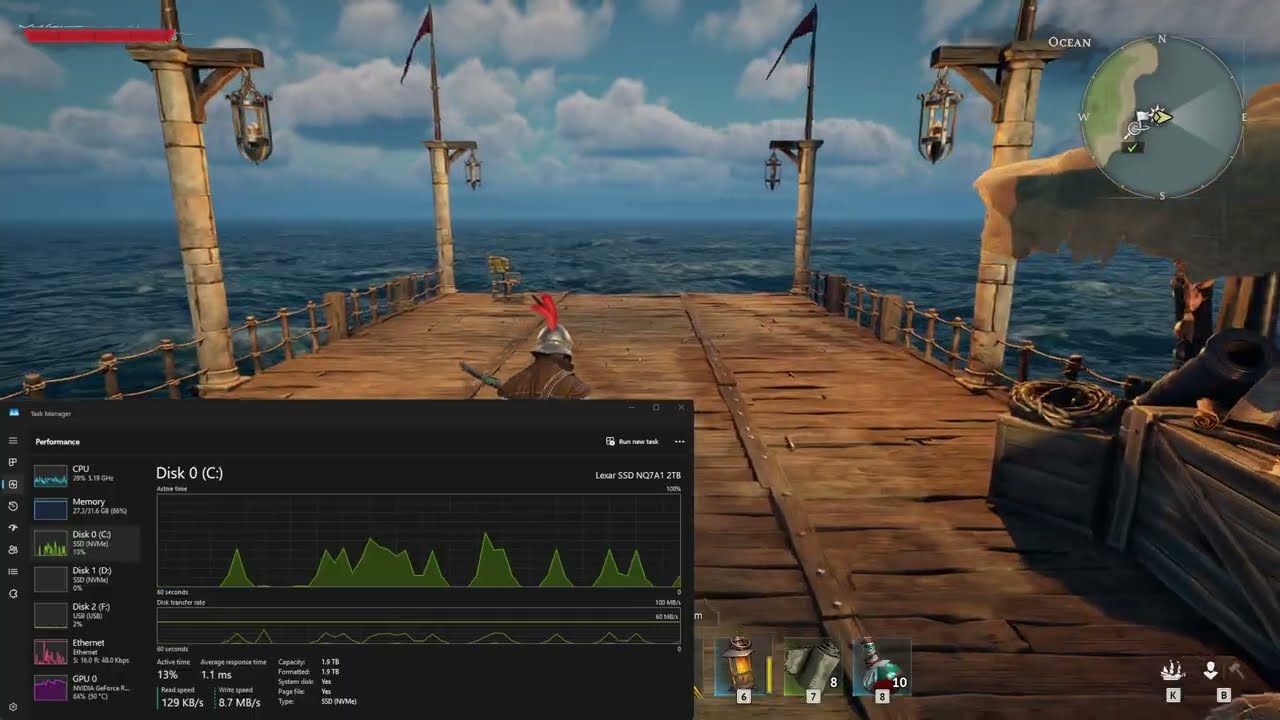
Windrose, an early access PvE survival game made by Kraken Express, has come under scrutiny for consuming an abnormal amount of disk I/O during gameplay that will scare even the best SSDs. Multiple users have reported this issue in forum posts, and at least one YouTuber, Pixel Operative, has complained about it, revealing that the game can write up to 108 GB per hour to your SSD due to optimization issues in how it saves data. The new patch has substantially decreased the disk usage.
Players have discovered that the game will read from and write to storage virtually nonstop at speeds of around 15 MB/s to 30 MB/s, depending on the player’s location and in-game movement. According to footage Pixel Operative shared, disk usage will spike up to 30 MB/s constantly when the player’s character is running around a base. This behavior worsens when piloting a ship. The only times the game won’t constantly write to its host drive are when the character is standing still on land or moving around areas of the map that don’t exhibit high SSD load.
If we do the math, 30 MB/s comes down to around 108GB per hour. A four-hour gaming session would result in 432GB written. The excessive writing will not endanger modern TLC SSDs. However, QLC drives or older, worn-out drives are at higher risk.

Article continues below
Pixel Operative also compared the game’s storage workload against two other titles, Enshrouded and Valheim, showing that Windrose consumes significantly more SSD resources than these two games. In 60-90 seconds, Windrose read 32GB and wrote 1.3GB from the drive. By contrast, Enshrouded, within the same timespan, read 7GB and wrote 695MB to the drive, while Valheim read 1GB and wrote 5MB to the drive.
Other users on various subreddits and Steam forums also reported abnormalities, including instances where the game reached up to 100% disk utilization and in-game disk usage consumed up to 30GB per hour. However, it's important to highlight that 100% disk utilization typically indicates active time or queue saturation, so it does not necessarily imply high MB/s throughput.
Enshrouded (~1.2MB Save File)I/O Read: 7,738,973,403 (~7GB)I/O Write: 695,285,313 (~695MB)I/O Other: 2,549,397 (~2.5MB)Significantly less I/O read/write overall without the constant ~30/MB/s rate that Windrose shows. pic.twitter.com/MNr9vORpyaApril 22, 2026
The game’s significant storage demand appears to be by design, not the result of a random bug. A technical analysis by NewMaxx/BoreCraft traced the behavior to Windrose's RocksDB-backed save system. The game appears to run at least three RocksDB databases, with the Worlds database using 22 column families behind a shared 1 MB max_total_wal_size. That very small WAL budget can force frequent memtable flushes and compactions, turning modest gameplay state changes into much larger physical write traffic. The evidence points to durability-oriented persistence tuning rather than corruption, but the analysis does not prove whether the configuration was an intentional developer choice or an overly conservative/default setup.
Luckily, the Kraken Express quickly deployed a patch to fix the issue. In the latest Patch notes for version 0.10.0.4, the developer has reduced the disk usage during gameplay. According to Pixel Operative's new findings, the game writes at between 10 MB/s and 16 MB/s. When the character is standing still, the write speeds drop below 1 MB/s. It represents a 60% to 75% improvement compared to the previous version of the game.
Get Tom's Hardware's best news and in-depth reviews, straight to your inbox.
If you're playing Windrose, make sure to update your game to the latest version. Your SSD will appreciate you for it. With skyrocketing prices for SSDs, you have to take extra care of your SSD, after all.

Follow Tom's Hardware on Google News, or add us as a preferred source, to get our latest news, analysis, & reviews in your feeds.

Aaron Klotz is a contributing writer for Tom’s Hardware, covering news related to computer hardware such as CPUs, and graphics cards.
-
Aurn That’s horrible. I don't have that game, but I would have quickly noticed the excessive writes, as I check multiple times a day how much has been written (I made a PowerShell command to help for that) and I try to minimise the wear on my SSD by using an HDD as much as possible (also redirecting writes with junctions and symbolic links for some stuff), and a RAM disk. But I wish I didn’t have to do that. I hate the limited endurance of SSDs ; to me, it’s the worst aspect of modern PCs. And it is something that hasn’t improved much, we have faster SSDs, but endurance is stagnatingReply -
USAFRet Reply
Have you ever had an SSD die from too many write cycles?Aurn said:That’s horrible. I don't have that game, but I would have quickly noticed the excessive writes, as I check multiple times a day how much has been written (I made a PowerShell command to help for that) and I try to minimise the wear on my SSD by using an HDD as much as possible (also redirecting writes with junctions and symbolic links for some stuff), and a RAM disk. But I wish I didn’t have to do that. I hate the limited endurance of SSDs ; to me, it’s the worst aspect of modern PCs. And it is something that hasn’t improved much, we have faster SSDs, but endurance is stagnating
Or even had an SSD go over the published TBW number?
I haven't. Been using SSD only for a decade, and not one has gone over that published TBW number.
Indeed, the 6x SSD in my current system don't total to the TBW number of the 1TB 980 Pro.
I did have an SSD die, but it was nowhere near that write cycle limit.
The "limited' write cycles is a thing. But that number is actually huge. -
CaptRiker Reply
I did actually have a nvme almost hit that dreaded endurance #. back in 2015 I put together a 5960x intel system, 32 gig memory, 2x 980 ti's in sli with a 1.2 tb intel 750 nvme ssd (gen 3 that did about 2.5 gig/sec reads).USAFRet said:Have you ever had an SSD die from too many write cycles?
Or even had an SSD go over the published TBW number?
I haven't. Been using SSD only for a decade, and not one has gone over that published TBW number.
Indeed, the 6x SSD in my current system don't total to the TBW number of the 1TB 980 Pro.
I did have an SSD die, but it was nowhere near that write cycle limit.
The "limited' write cycles is a thing. But that number is actually huge.
had a total endurance of 128tb. 5yrs in I noticed endurance was at 126 out of 128 tb lol.. so I went out and bought a cheap kinston 2tb gen 4 ssd and transfered over bit by bit from the old drive.. worked perfectly.
the asus rampage V extreme mobo was the 1st to use ddr4 memory and was first board to sport a single gen 3 nvme slot on the mobo.. since 80m nvme sticks were very puny storage wise back then, I went with the intel 750 in pci card form.. took years to get high capacity 80mm nvme sticks.
now my current system I've been sporting a T700 crucial gen 5 4tb windows 11 boot since nov' 2023.
122tb read, 121tb written.. at 97% health.. today's drives can last a long time if you don't have programs/apps that write excessively like this game did. -
USAFRet Reply
OK, yeah. A decade ago, endurance was small.CaptRiker said:I did actually have a nvme almost hit that dreaded endurance #. back in 2015 I put together a 5960x intel system, 32 gig memory, 2x 980 ti's in sli with a 1.2 tb intel 750 nvme ssd (gen 3 that did about 2.5 gig/sec reads).
had a total endurance of 128tb. 5yrs in I noticed endurance was at 126 out of 128 tb lol.. so I went out and bought a cheap kinston 2tb gen 4 ssd and transfered over bit by bit from the old drive.. worked perfectly.
the asus rampage V extreme mobo was the 1st to use ddr4 memory and was first board to sport a single gen 3 nvme slot on the mobo.. since 80m nvme sticks were very puny storage wise back then, I went with the intel 750 in pci card form.. took years to get high capacity 80mm nvme sticks.
now my current system I've been sporting a T700 crucial gen 5 4tb windows 11 boot since nov' 2023.
122tb read, 121tb written.. at 97% health.. today's drives can last a long time if you don't have programs/apps that write excessively like this game did.
But that drive did not die, right?
Current drives have MUCH more.
( I also have a drive from that era...1TB 660p, 2018)
I'm with you, though...that use by that game is far too much. -
PEnns ReplyUSAFRet said:Have you ever had an SSD die from too many write cycles?
Or even had an SSD go over the published TBW number?
I haven't. Been using SSD only for a decade, and not one has gone over that published TBW number.
Indeed, the 6x SSD in my current system don't total to the TBW number of the 1TB 980 Pro.
I did have an SSD die, but it was nowhere near that write cycle limit.
The "limited' write cycles is a thing. But that number is actually huge.
You obviously don't have QLC SSDs, but others do.
Just because it's "harmless to certain SSDs" doesn't mean it is OK to do non-stop writing to the SSD!
From article:"
"A four-hour gaming session would result in 432GB written. The excessive writing will not endanger modern TLC SSDs. However, QLC drives or older, worn-out drives are at higher risk."
That's one badly written game!! -
USAFRet Reply
Sigh...PEnns said:You obviously don't have QLC SSDs, but others do.
This type of comment always cracks me up.
I do, in fact, have a QLC NVMe drive. Intel 660p, in service since 2018.
(as noted in my previous coment)
It is my main photo drive.
https://www.storagereview.com/review/intel-ssd-660p-series-review
I addressed that in my previous comment.PEnns said:Just because it's "harmless to certain SSDs" doesn't mean it is OK to do non-stop writing to the SSD!
I think it sux as well. -
Maxxify Yeah, modern SSDs can survive a surprisingly large amount of writes. In most cases. This game definitely writes more than is ideal if you're someone who will be running a co-op instance or something for a lot of hours. I wouldn't recommend doing that on a QLC drive, especially if it's being used for other stuff like the OS. For the record, I have already tested the new patch against my existing data and they didn't take the RocksDB tuning approach (which is still open) but did a more sensible application-side fix. The reduction isn't as great as hoped in my test, but I need to do a longer run and a short trace to verify actual improvement. My analysis suggests the improvement will be better for longer sessions which is most likely where you'd bump up against endurance issues.Reply -
Starfal Reply
Yes, my laptop from 2020 went poof. The main /C SSD (the windows one) died because of that. It was going down from 90 to 80 to 70. Then i noticed that and started tracking it. Around 2022, it went down to 60 and 50. Around 2025? Died. I did copy all the data and stuff but yeah. It died eventually cus of too many write cycles.USAFRet said:Have you ever had an SSD die from too many write cycles?
Or even had an SSD go over the published TBW number?
I haven't. Been using SSD only for a decade, and not one has gone over that published TBW number.
Indeed, the 6x SSD in my current system don't total to the TBW number of the 1TB 980 Pro.
I did have an SSD die, but it was nowhere near that write cycle limit.
The "limited' write cycles is a thing. But that number is actually huge.
Yea, i do download games, finish them and delete them. I also copy movies, files and also record videos. Casually recording 1080p, low bitrate. Its not enough to kill an SSD but alas. My Samsung drive died in the end. It is a gaming laptop, so i often finish a game and went to download a new one. So yeah, these things can happen, and i aint even a super heavy user either. I know people that do alot more + 4K video recording + editing. Meh. I get your point but yeah. Its slow, but it happens. We are still stuck to 1-4TB drives too. I dare say 2 is the top now... so losing a 2TB drive from 2020 is not ideal in this market. -
USAFRet Reply
I've asked that question here many times, and I believe you are the only one that had a drive actually die from too many write cycles.Starfal said:Yes, my laptop from 2020 went poof. The main /C SSD (the windows one) died because of that. It was going down from 90 to 80 to 70. Then i noticed that and started tracking it. Around 2022, it went down to 60 and 50. Around 2025? Died. I did copy all the data and stuff but yeah. It died eventually cus of too many write cycles.
Yea, i do download games, finish them and delete them. I also copy movies, files and also record videos. Casually recording 1080p, low bitrate. Its not enough to kill an SSD but alas. My Samsung drive died in the end. It is a gaming laptop, so i often finish a game and went to download a new one. So yeah, these things can happen, and i aint even a super heavy user either. I know people that do alot more + 4K video recording + editing. Meh. I get your point but yeah. Its slow, but it happens. We are still stuck to 1-4TB drives too. I dare say 2 is the top now... so losing a 2TB drive from 2020 is not ideal in this market.
What make/model drive, and what was the TBW when it died? -
Klathra I was wondering how many hours of this game it would take to use up the endurance of a typical SSD.Reply
If we use a WD Blue SN5000 NVMe 1TB as a "typical" SDD, its endurance is 600 TBW.
If the game was writing 108 GB per hour that means the game would cause this particular SSD to wear out after 5555 hours or about 231 days of 24/7 gaming, assuming the SSD is able to reach its rated endurance.