- The Next Step, Hi-Speed USB 2.0
- IDE-RAID With Notebook Drives: Quick And Quiet
- The Storage Champions: ATA/100 IDE RAID Controllers From AMI,...
- Boot Lock and Hard Disk Selection System: The NickLock
- Backup Masters: Three Streamers at 10, 50 and 100 GB
- 2.2 GB Portable Discs: Castlewood's ORB Drive
- Fast and Inexpensive - Promise's FastTrak66 IDE RAID-Controller
- Bus Master DMA Drivers - Just an Illusion
- The Storage Guide
- Why are local computer stores full of idiot employees!?!?!?
- 4.0Ghz P4 now officially cancelled
- How to tell how many hard drives board supports??
- SATA -- 1 or 2 disk per IDE channel?
- VP6 very large hard drive
- Motherboard or hard drive problem
- I have never seen anything like this!!!
- Building my own
- Building a new system
- 1U server, no floppy, no CDROM, how to install OS?
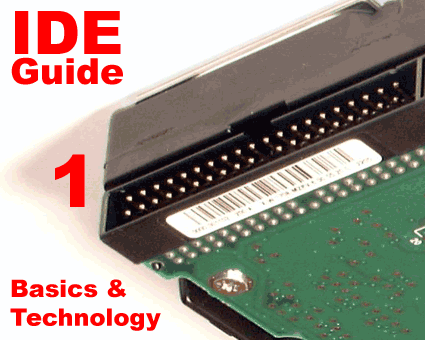
IDE Training Course, Part 1: A Detailed Look at the Basics and Technology : Introduction
Source: Tom's Hardware US – Keywords: ide, training
Syndication:
Introduction

When buying a computer, the two most important buzzwords are gigahertz and gigabyte - unfortunately, marketing strategists will quickly relegate other equally important factors to the back burner. But as we all know, a clock will run smoothly only if all the gear wheels turn with low friction.
In this specific case, friction refers to the storage subsystem or the hard drive of every single computer. It's not only its capacity but also its performance that determines whether the new high-end computer will actually be zippy, or whether it will feel more like a lame duck.
The reasoning behind fast hard drives has been discussed at length in numerous articles at Tom's Hardware Guide. From the simple data transfer to streaming in video cuts or hard disk recording up to the swap file for Windows and the time it takes to boot the system - the hard drive capacity simply can never be high enough. That's one of the reasons why more and more users connect two or more drives in what is called a RAID configuration (Redundant Array Of Independent Disk Drives). We'll provide detailed information on this subject in later parts of this series.

In this first part, we'll take a closer look at the IDE interface. Though the most common, it has attracted very little attention. We'll shed light on its history and the technical details, and examine how each standard performs.
- Next page IDE: Where It All Began