

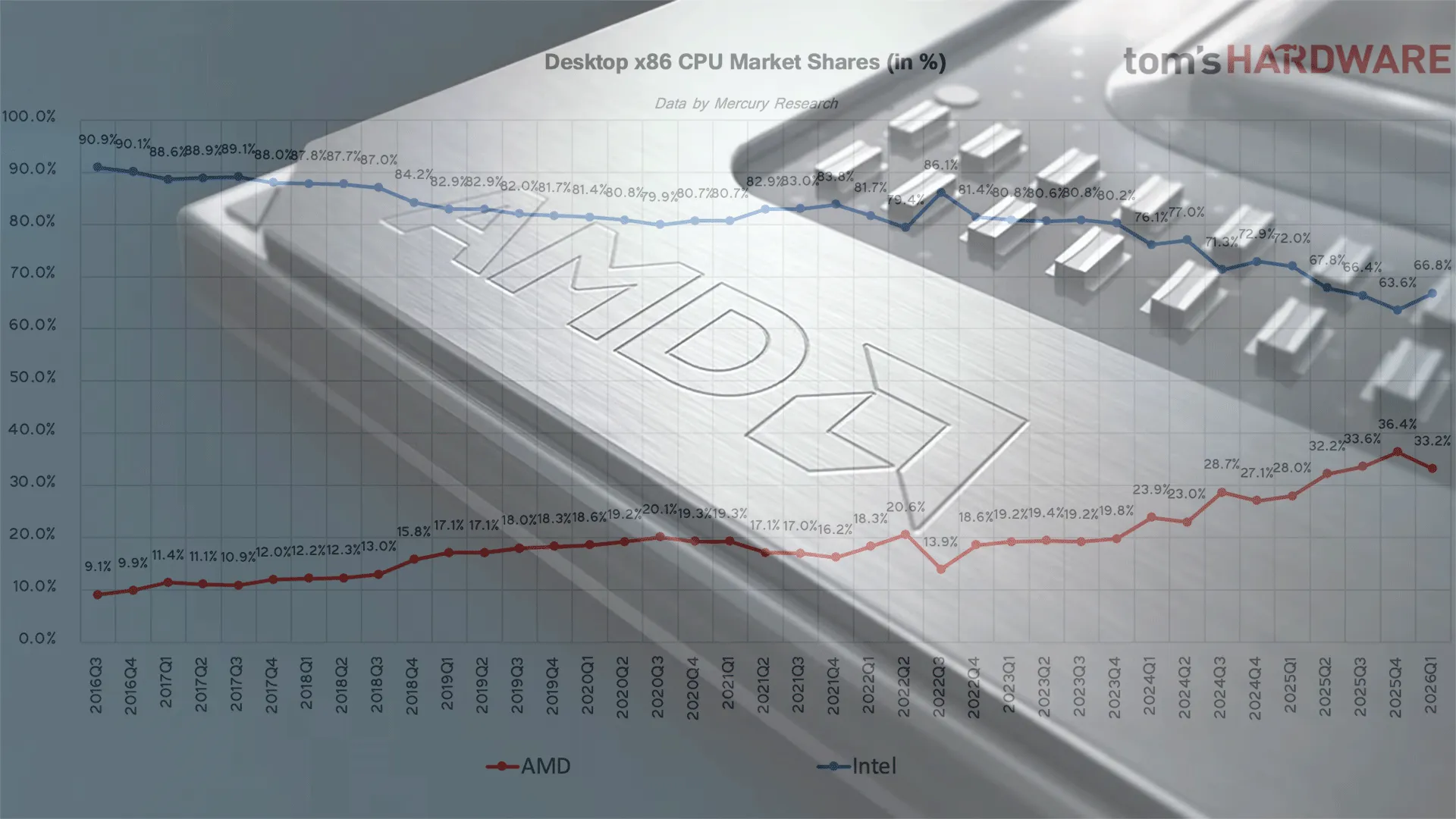
The first quarter of 2026 was quite favorable for AMD as the company managed to increase its unit share on the market of client systems and skyrocketed its share in servers past 33%, according to Mercury Research. In addition, the company's revenue shares set records across client and server market segments, so AMD now controls 38.1% of all x86 CPU market value and 46.2% of all x86 server CPU revenue share. Perhaps an alarming sign is that the company's desktop PC unit and revenue shares declined sequentially, though they are up year-over-year (YoY).
Consumer CPUs: AMD gains ground, but only modestly
In the consumer PC segment, AMD continued to gain ground in the first quarter of 2026 as its client CPU unit share rose to 29.6%, up slightly from 29.2% in Q4 2025 and up sharply from 24.1% the same quarter a year ago, according to data by Mercury Research.
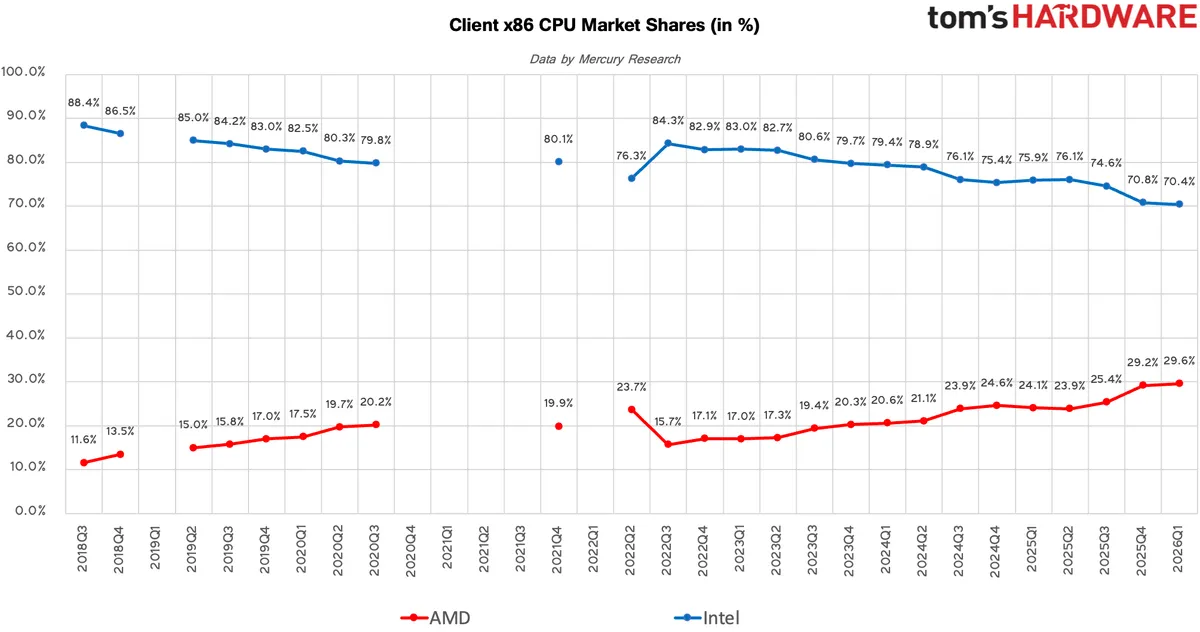
The quarter, however, showed a split between desktops and notebooks as Intel has managed to claw back 3.2% of the desktop PC market. Also, Intel remained the dominant supplier of client CPUs with a 70.4% share, though its position weakened from 75.9% in Q1 2025 as AMD did rather well in notebooks.

However, when it comes to the revenue side of things, AMD's position remained particularly strong. The company's client CPU revenue share reached 31.4%, slightly above the previous quarter and substantially higher than a year ago (26.6%), which perhaps reflects the company's continued strength in premium client processors. Nonetheless, Intel still controlled nearly 69% of client CPU revenue, which is a big deal. How things will unfold in the second half of the year — when Intel launches its Nova Lake processors for client systems that it pins a lot of hopes on — is something that remains to be seen.
Desktop CPUs: Market share comes, market share goes
In the desktop PC segment, AMD gave back a portion of the massive gains it made during the exceptionally strong holiday quarter, but still maintained a historically high position, so the decline can be considered as a correction, rather than a new trend.
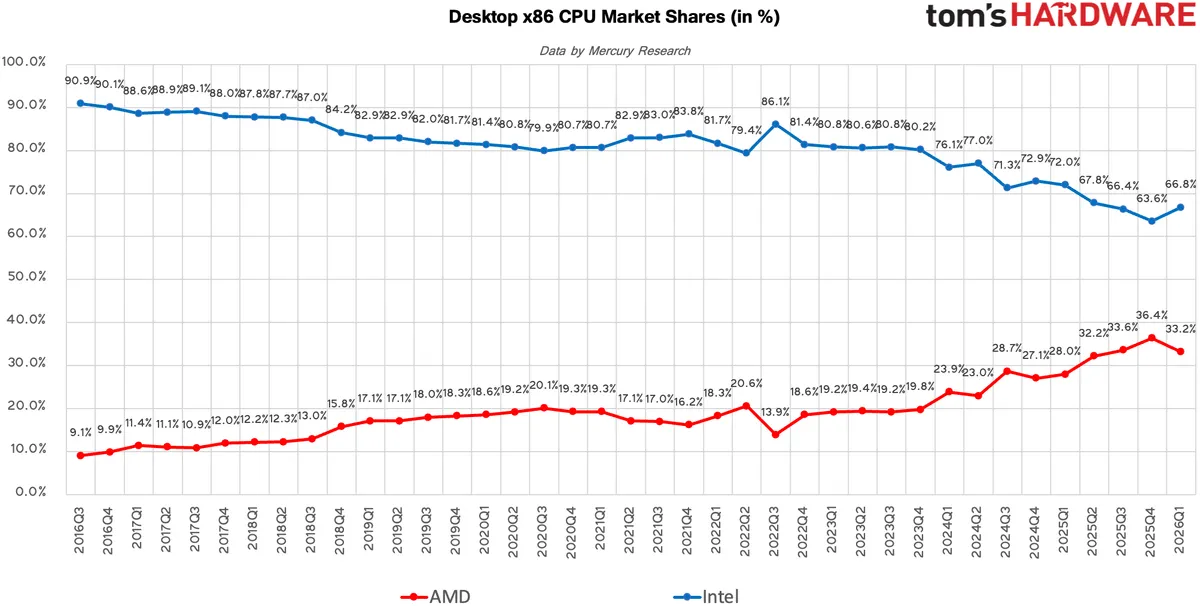
AMD's desktop CPU unit share stood at 33.2% in Q1 2026, down from the record 36.4% in Q4 2025, but well above the 28% recorded in the quarter a year earlier. Intel regained some ground sequentially and increased its desktop share to 66.8%, but remained far below its year-ago level of 72% as AMD continued to hold a much stronger position than it did in recent years.
On the revenue side, AMD remained strong despite the sequential share drip: the company's desktop CPU revenue share was 37.6%, down from the record quarter before, but still notable 3.2% higher than a year earlier. Intel continued to generate most desktop CPU revenue overall, but AMD's ability to maintain a high revenue share relative to its unit share shows the continued strength of premium Ryzen CPUs.
Mobile CPUs: Another record quarter
In the mobile PC segment, AMD delivered its strongest result ever as it managed to once again increase its share and set its highest share in laptops ever.
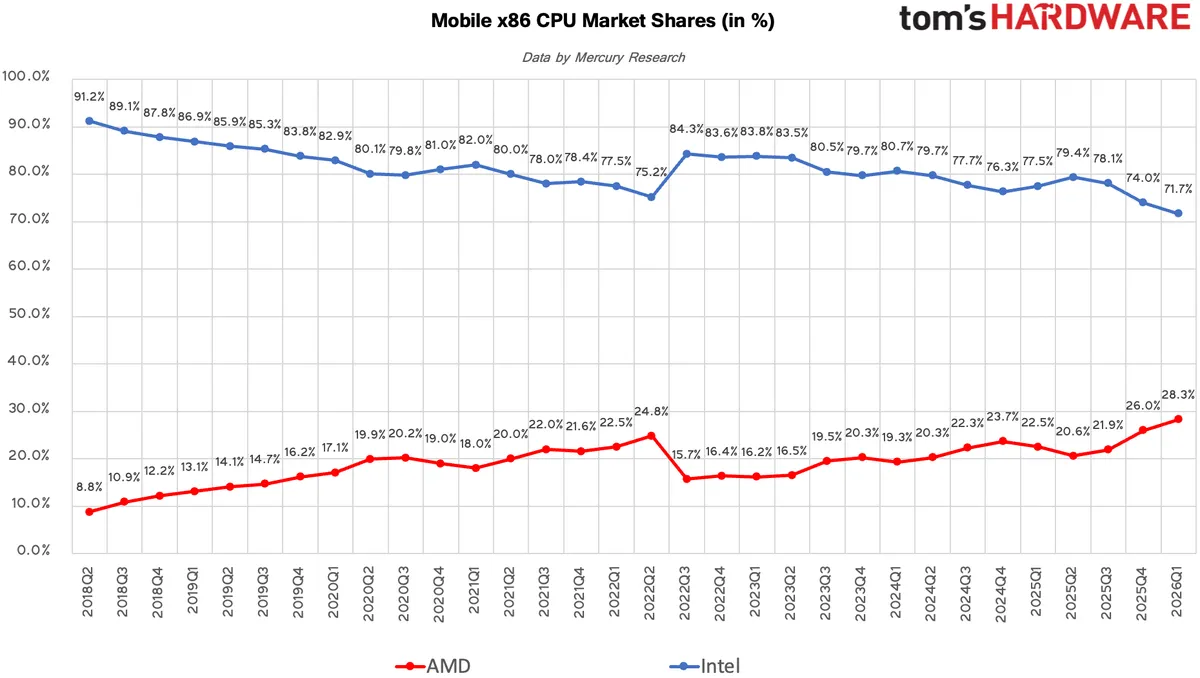
AMD's mobile CPU unit share climbed to 28.3% in Q1 2026, up from 26% in Q4 2025 and from 22.5% a year earlier, the best quarter ever for the company's mobile processors. For obvious reasons, Intel commanded the lion's share of the market — 71.7% — though its lead narrowed further as AMD increased its share by improving availability and expanding its footprint in segments (e.g., business and commercial notebooks) traditionally dominated by Intel.
As for revenue share, AMD's progress was even more impressive. The company’s mobile CPU revenue share rose to 28.9%, an increase from 24.9% in Q4 2025 and from 22.2% in Q1 2025, which reflects stronger sales of higher-value notebook processors. Intel continued to control the majority of notebook CPU revenue overall (71.7%, down from 77.5% in Q1 2025), but AMD's ability to approach 28.9% revenue share clearly indicates its increasing competitiveness in higher-margin premium laptops that historically favored Intel almost exclusively.
Server CPUs: Another breakthrough quarter
While the first quarter was good for AMD's mobile processors, it was exceptional for AMD's EPYC CPUs for servers. The company not only set a record in terms of unit share, but it has also managed to skyrocket its revenue share by 5% in a single quarter.
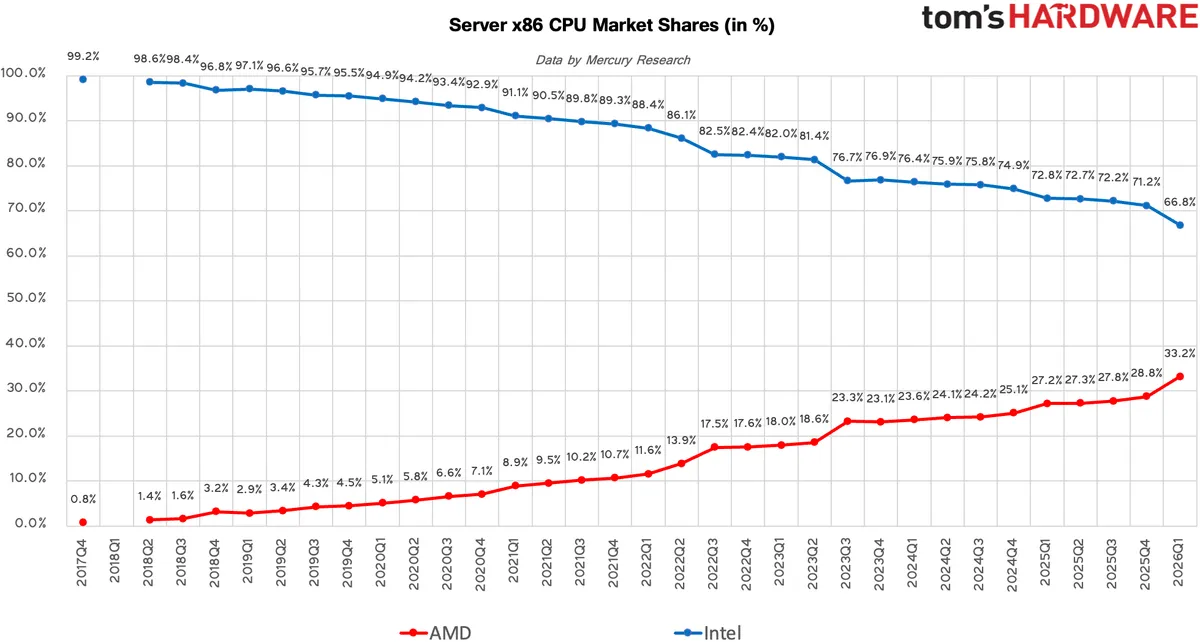
AMD's server processor unit share climbed to 33.2%, up from 28.8% in Q4 2025 and 27.2% a year earlier, the data by Mercury Research shows. Intel still shipped the majority of server processors with a 66.8% share, but its position weakened both sequentially and year-over-year as EPYC adoption continued to expand across hyperscale cloud providers, enterprise deployments, and AI/HPC infrastructure.
On the revenue side, AMD's performance was even more striking: the company's server CPU revenue share reached a record 46.2%, which means that AMD now commands nearly half of all x86 server CPU revenue while shipping roughly one-third of units. This gap between unit share and revenue share reflects significantly higher average selling prices of AMD's processors in general and the popularity of the company's high-core-count premium configurations. While Intel generated more server CPU revenue than AMD, ASPs of its Xeon products were lower compared to those of EPYCs, which is in line with market performance in prior quarters.
Summary
AMD started 2026 on a strong note: it expanded its share in both client and server CPUs and set new records for overall x86 CPU revenue share, according to Mercury Research.
The company posted particularly strong gains in notebooks and servers, where EPYC adoption pushed AMD’s server revenue share close to half of the entire x86 server market. While AMD's desktop CPU share declined sequentially after an exceptionally strong holiday quarter, it remained well above year-ago levels, so the strong momentum for the company continues.
In general, AMD continues to strengthen its positions in the most profitable parts of the x86 CPU market, while Intel retains shipment leadership but loses further ground in revenue share and premium segments.

Follow Tom's Hardware on Google News, or add us as a preferred source, to get our latest news, analysis, & reviews in your feeds.