




Sandisk brings back affordable storage to rescue buyers from the SSD crisis — new 320 and 520 SATA SSDs are ready to launch

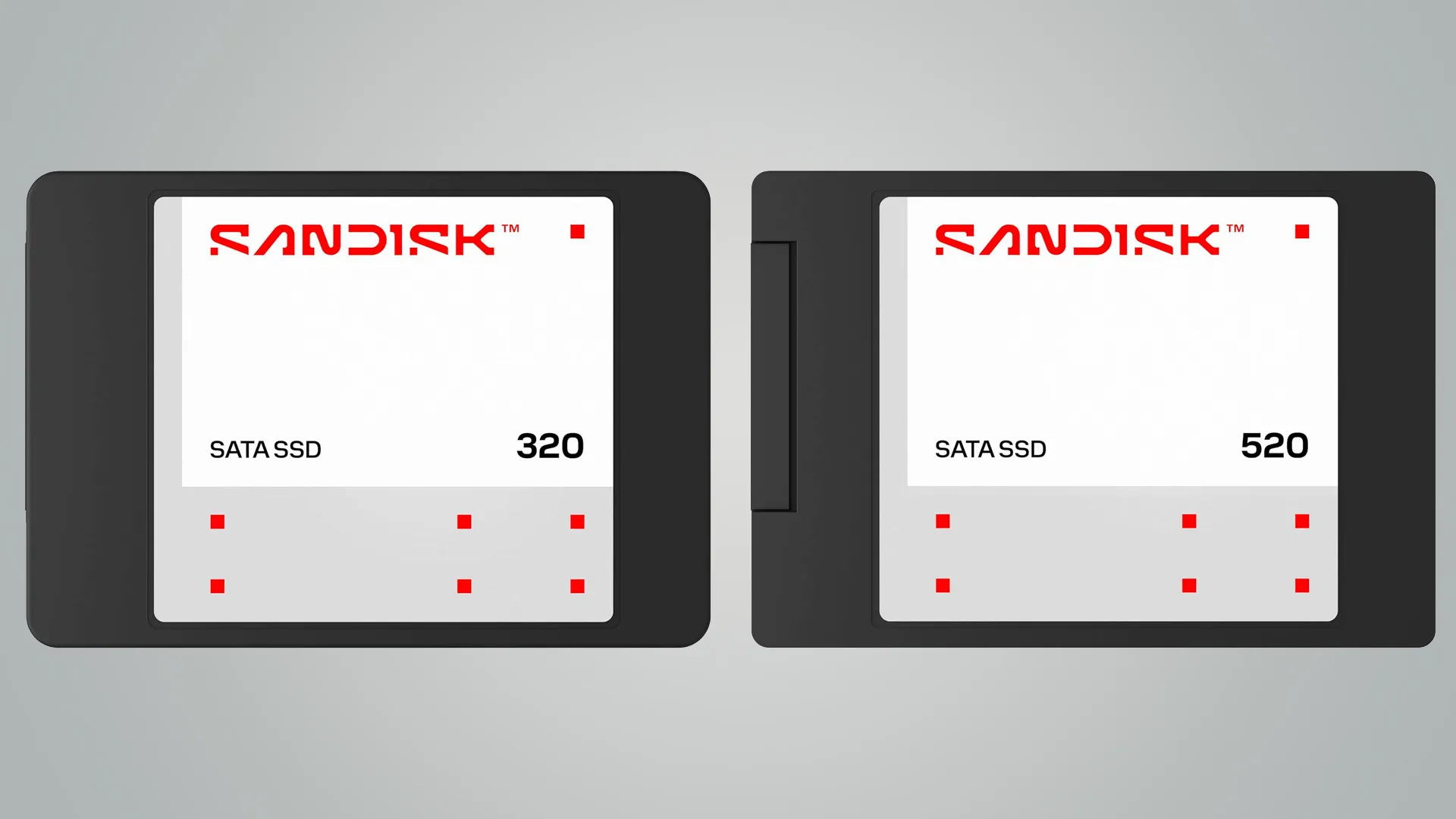
Sandisk 320 & Sandisk 520 SATA SSDs
(Image credit: Amazon UK)

Many will consider SATA old technology in the storage realm, but when things get tough, you can always rely on it, or at least, that's what Sandisk may think. The storage manufacturer is preparing to launch the Sandisk 320 and Sandisk 520 SATA SSDs soon. While pricing is still unknown, these new drives should be more accessible than M.2 NVMe drives, though you sacrifice some performance.

For many consumers, especially those upgrading older systems or seeking the more affordable storage option, SATA SSDs remain a viable choice. They're dependable, faster than regular hard drives, and more importantly, they don't break the bank. So, it shouldn't come as a complete shock that Sandisk would launch new SATA SSDs in 2026, especially since we're in the middle of a storage shortage. Samsung, for example, released an 8TB variant of the 870 Evo, a drive that came out half a decade ago. In its defense, the Samsung 870 Evo is still one of the best SSDs in the current market.

As spotted by hardware leaker momomo_us, Amazon U.K. has listed Sandisk's upcoming drives. At this stage, retail listings provide only limited specifications. However, as expected for SATA SSDs, both the Sandisk 320 and Sandisk 520 utilize the familiar 2.5-inch form factor with a slim 7mm profile. Sandisk's design choice offers great compatibility, particularly with the latest generation of ultrabooks and thin-and-light laptops that don't welcome 9.5mm drives.

Latest Videos From

Sandisk positions the 320 as the mainstream offering, with capacities ranging from 250GB to 2TB. The SSD delivers sequential read speeds of up to 545 MB/s and sequential write speeds of up to 525 MB/s. Meanwhile, the 520 caters to professionals, content creators, and prosumers. The drive checks in with a sequential read speed of 560 MB/s, 2.75% higher than the 320, but retains the same 525 MB/s sequential write speed.

Sandisk 320 and Sandisk 520 Specifications

Swipe to scroll horizontally

SSD

Capacity

Sequential Read (MB/s)

Sequential Write (MB/s)

Random Read (IOPS)

Random Write (IOPS)

Endurance (TBW)

Sandisk 520

500GB - 4TB

560

525

?

?

1,000 (4TB)

Sandisk 320

250GB - 2TB

545

525

?

?

?

The controller and NAND inside the Sandisk 320 and Sandisk 520 remain a mystery for now. Historically, Sandisk has sourced SATA SSD controllers from reputable third-party vendors, including Marvell, Silicon Motion, and SandForce. Until Sandisk officially unveils the drives, it’s anyone’s guess what hardware is driving the latest Sandisk SATA SSDs.

As for the NAND flash itself, current retailer listings suggest the use of Sandisk’s own 3D NAND technology. It’s important to keep expectations in check, though. Remember, we're talking about SATA SSDs, so the NAND will not be the latest and greatest. Most modern SATA drives use flash with 112 or 128 layers, unless you go down the legacy route, meaning 64 or 96 layers. Amazon U.K. listed the Sandisk 530 4TB with a 1,000 TBW rating.

SATA SSD prices have surged by 10% to 20% over the past year, due to ongoing storage shortages. So, we shouldn't expect the sensible pricing on the Sandisk 320 or Sandisk 520. For perspective, a 250GB SATA drive starts at $42; a 500GB drive costs at least $101. If you want a higher-capacity drive, expect to pay around $204 for a 1TB drive and up to $329 for a 4TB drive.

One Dutch retailer has listed the Sandisk 520 with an expected arrival date of June 3. If accurate, the listing strongly suggests that the official announcement is imminent.

Google Preferred Source

Follow Tom's Hardware on Google News, or add us as a preferred source, to get our latest news, analysis, & reviews in your feeds.

TOPICS
Zhiye Liu
News Editor, RAM Reviewer & SSD Technician

Zhiye Liu is a news editor, memory reviewer, and SSD tester at Tom’s Hardware. Although he loves everything that’s hardware, he has a soft spot for CPUs, GPUs, and RAM.

  • JeffreyP55
    Admin said:
    Sandisk prepares to launch 520 and 320 SATA SSDs with capacities up to 4TB.

    Sandisk brings back affordable storage to rescue buyers from the SSD crisis — new 320 and 520 SATA SSDs are ready to launch : Read more
    Another step backwards. AM5 ----> AM4. SSD m.2 NVMe ------> SSD SATA. I fart in general direction of the insanity of it all.
    Reply
  • Shiznizzle
    Using yet more electricity as well with the older standard. It takes more time.

    I have a SATA HDD as storage in my system but that tops out @ 180. Chip based storage will be better of course. Yeah its a downgrade for sure but lets see what they want for these things. Me thinks they wont be cheap and once again manufacturers are ripping is off with old tech that demands top tech dollar

    Looked up price history for a 2 TB Sata average price. Currently at the 430 dollar range for the average. They are out of their mind if they think i am paying in excess of 300 pounds for some SATA drive.

    I will start using my raspberry pi when things break.
    Reply
  • teckel12
    Spinning platter drives also work if you're desperate enough. And they're cheap (for now).
    Reply
  • Shaithis
    I would bet they wont be much cheaper than any other ssd of a similar capacity, to the point where they really wont be more affordable...

    Just keep hold of your money for a year or two, don't subscribe to any ai or compute services and everything goes back to normal.
    Reply
  • lacerna
    teckel12 said:
    Spinning platter drives also work if you're desperate enough. And they're cheap (for now).
    I don't believe you've purchased a HDD lately. I bought a box of 30 750GB 2.5" drives, all warrantied WD Black enterprise pulls, none of them are SMR. I bought them about three months ago, for ~$11/drive, thinking I'd put them in enclosures, for sales at my flea market booth, at $40-$50 (hadn't decided on price), loaded with free OS software & data*.

    I was unsure of the idea, since I can only offer a one-year warranty, and a 1TB SMR was $60 at the discount retailer. A week later, HDDs went up 10-20%, and continued climbing. Those same WD enterprise pulls are selling for $15+/drive now.

    I also bought a "recertified" Deskstar 8TB, pulled from an enterprise shelf, still in the mylar, w/a 1-year warranty. I paid $140, which seemed like a bit much. Turns out, they mislabeled the drive, as it's got a five-year warranty, making it worth $240 at the time. It's $300+ now.

    *I'm also offering the customers DVDs & CDs, with (some of) the data — for free — as well as cards with a URL for downloading any part of the "package" on the drives. Should be legitimate as "no purchase necessary" options.
    Reply
  • USAFRet
    teckel12 said:
    Spinning platter drives also work if you're desperate enough. And they're cheap (for now).
    The difference between HDD and (almost) any SSD type is huge.
    The difference between the various flavors of SSD...not so much.
    Reply
  • Notton
    2.5", 9.5mm Z-height, 4TB HDD does not exist.
    They're either 2TB & 9.5mm, or 4~6TB & 15mm.
    Where as SATA SSD does 4TB & 7mm.

    Not that I expect these drives to be cheap enough to make a SATA SSD NAS out of.

    Though the other part of the equation is... QNAP is the only one offering a 2.5" specific NAS.
    If you're asking why? Portability. There's a huge difference between NVMe, 2.5" and 3.5" NAS portability.
    Reply
  • USAFRet
    Notton said:
    Though the other part of the equation is... QNAP is the only one offering a 2.5" specific NAS.
    If you're asking why? Portability. There's a huge difference between NVMe, 2.5" and 3.5" NAS portability.
    A 2.5" SATA SSD fits just fine in a 3.5" slot in a QNAP.
    I have that exact config...a 480GB SanDisk SSD as the system drive, in a 4 bay TS-453a.
    Reply
  • Iceberg86300
    teckel12 said:
    Spinning platter drives also work if you're desperate enough. And they're cheap (for now).
    Where are you finding cheap HDD's?
    Shaithis said:
    I would bet they wont be much cheaper than any other ssd of a similar capacity, to the point where they really wont be more affordable...

    Just keep hold of your money for a year or two, don't subscribe to any ai or compute services and everything goes back to normal.
    More supply in times of great demand should, theoretically, bring prices down a bit.

    Not too excited about that endurance, though.

    I would not hold my breath for things to return to normal. AI may be a little iffy, but the need for compute isn't going anywhere & unless you're lucky with modest needs & a company that will pay the on prem premium for even a very very modest 3 node HPC, that online demand isn't going anywhere.

    But even if AI + online compute needs simply evaporated, what happens?

    I'd really hope for memory being Rerouted, but who knows. All that fab capacity could pivot into literally anything.

    As someone that can't afford to upgrade my quite old Gen 9 HPE server while looking at $300 Tesla P40s to get a ridiculously small amount of EOL/EOS compute capacity, I very very much hope I'm.wrong!!

    (I've been trying to beg/borrow/steal even an engineering sample of a workstation product that's 2-3 years old to start a business as a veteran that served this country for about 55 years, my entire adult life, and I literally just get laughed at. Really sucks!!)
    Reply
  • thewindmind
    The actual cost-effective solution right now is buying used enterprise SATA silicon. You can pick up four 480 or 512gb enterprise drives for $45/each, or around 180 dollars for 4 and stripe them using Windows Storage Spaces. Modern motherboard chipsets easily handle the 500megabytes/sec speed of each drive's controller, x 4 drives to hit 2000 megabytes per second bandwidth without hitting a DMI bottleneck. You get ~2tb of fast storage for ~$180.

    Because enterprise drives have dedicated DRAM and power-loss protection, they deliver a perfectly flat, unwavering read and write curve. You get massive, sustained throughput that budget NVMe or new consumer SATA drives simply cannot maintain.

    It means accepting the risk of a zero-redundancy striped array and treating it strictly as volatile scratch space. But for high-performance staging, strapping together used enterprise tanks is vastly superior to paying the current premium for enterprise NVMe or suffering through the cache throttling of budget consumer drives.
    Reply