









AMD leaves Linux FPGA users in the lurch with controversial Vivado licensing update — new tier model restricts future free versions to Windows
Users are not happy

AMD has been accused of 'bait-and-switch' tactics following changes to the licensing of Vivado on Linux. As reported by It's Foss, AMD has decided that Linux users of the Vivado chip design environment need to pay up or stick with an older version that will become unsupported soon.
For the uninitiated, Vivado is AMD's proprietary design suite used to program Field Programmable Gate Arrays (FPGAs). These special chips can be rewired via software to mimic nearly any kind of computer hardware. This makes them invaluable for simulations and design testing. If you are designing, simulating, or testing custom circuits for AI, aerospace, or advanced electronics, Vivado is the gateway to making that hardware actually work.
The core of the outrage stems from a change in Vivado's upcoming 2026.1 update. Previously, the free "Standard" tier supported both Windows and Linux. Under the new tiered model, the free "Basic" tier is restricted entirely to Windows. If you want to use Vivado natively on Linux, you'll be forced to step up to the "Core" tier, which demands an eye-watering $1,200 to $1,800 annual subscription.
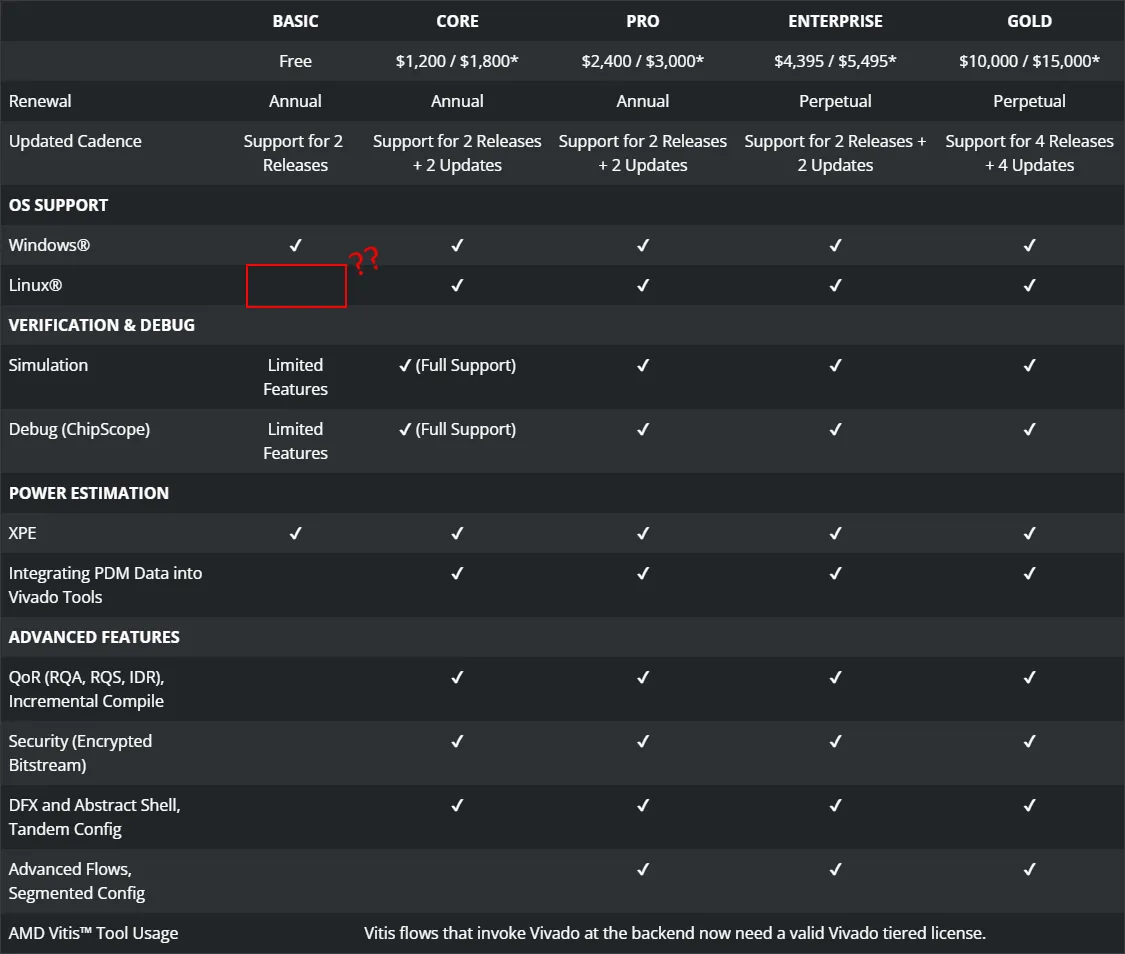
AMD's defense on its community forums has also not landed well. The company claimed that 70% of Vivado users are on Windows anyway, alienating the academic researchers, engineering students, and open-source hobbyists who heavily favor Linux-native environments and rely on free tools to learn the trade.
A forum representative for the company stated, "No one is stopping users (students, etc.) to continue using the current versions of Vivado (any Vivado version prior 2026.1)," and developing using the free Vivado ML Standard Edition, arguing that it was only if users decided to update that they'd need the license.
"I guess no one involved in this decision thought about the millions of hobbyists and amateurs like myself using Vivado for their hobby projects," one disgruntled user replied. Another noted that many users are already discussing moving to alternate platforms like Lattice and Altera due to these changes.
AMD's forum representative confirmed they were "collecting all the feedback received and passing on to the relevant team/marketing" at AMD, leaving the door ajar for a possible change to this policy down the line.
Get Tom's Hardware's best news and in-depth reviews, straight to your inbox.

Follow Tom's Hardware on Google News, or add us as a preferred source, to get our latest news, analysis, & reviews in your feeds.

Zak is a freelance contributor to Tom's Hardware with decades of PC benchmarking experience who has also written for HotHardware and The Tech Report. A modern-day Renaissance man, he may not be an expert on anything, but he knows just a little about nearly everything.
-
usertests ReplyAMD's defense on its community forums has also not landed well. The company claimed that 70% of Vivado users are on Windows anyway, alienating the academic researchers, engineering students, and open-source hobbyists who heavily favor Linux-native environments and rely on free tools to learn the trade.
That's a big Linux share, not the usual 1-5%.
AMD's forum representative confirmed they were "collecting all the feedback received and passing on to the relevant team/marketing" at AMD, leaving the door ajar for a possible change to this policy down the line.
That's how it works with AMD. You shout at them until they undo their latest dumb decision. -
gamerk316 Reply
While I am not in any way a Linux fanboy, the use of Linux in the aerospace industry (where Xilinx now AMD found its footing) has a much higher then average use of Linux.usertests said:That's a big Linux share, not the usual 1-5%. -
LordVile Reply
It’s used more in research due to increased performance on bespoke software. I dual booted Linux at university as it significantly sped up the molecular modelling software they used.usertests said:That's a big Linux share, not the usual 1-5%.
That's how it works with AMD. You shout at them until they undo their latest dumb decision. -
qxp Disappointing. It would be better to use open source tools, of course. Is the bitstream format still proprietary?Reply -
suryasans AMD is becoming another bad guy for Linux community. Well, it's a corporate greed as usual.Reply -
cp0x It's a bit weird how people feel entitled to get other people's work for free.Reply
This is a stupid and unnecessary change by AMD, but that doesn't negate the fact that it's still a bit weird that people feel entitled to get other people's work for free. -
JakobsenCph This is so off - FPGA and the free entry level stuff for the small FPGA from AMD - is the direct path for a career in digital design and chip design. And as the industry and AMD need our next generation to do chip design. I do not get the point.Reply
I have done chip design for 30 year - we use Linux for very obvious reasons - and the faster we get student on Linux the faster we get a new god chip designer.
I would never point any student in the direction of any of the onetime use vender lockin platforms.
We have much cheaper FPGA dev board like Tanknano 9k/20k that is fully supported by the Linux foundation back open source tools like Yosys and Nextpnr.