




Nvidia CEO Jensen Huang ‘nearly lost his composure’ when pressed on selling chips to China — ‘You’re not talking to someone who woke up a loser’
The Nvidia boss says that keeping Chinese AI researchers using the American tech stack is a good thing for the U.S.
Nvidia CEO Jensen Huang got into a heated debate during a recent podcast, during which he talked with Dwarkesh Patel about whether the U.S. should be selling chips to China. During part of the conversation, which you can see by expanding the tweet embedded below, Patel said he doesn’t know whether it’s actually good to give Chinese access to AI chips. Still, since he likes to play devil’s advocate during his interviews, where he takes an opposing stance to his guest, he asked the leather-clad chief of the world's largest AI chipmaker if doing so is a threat to American companies and national security.
Patel gave Anthropic’s Claude Mythos as an example for his argument, which apparently revealed “thousands of zero-day vulnerabilities” in “every major operating system and every major web browser.” He said that if China had access to the massive amounts of compute that Nvidia delivers, it could probably have used it to develop cyber-offensive capabilities that threaten the United States' security. Huang had a fairly nuanced response to this, but he also first pointed out that Mythos was trained on “fairly mundane capacity, and a fairly mundane amount of it."
"You’re not talking to someone who woke up a loser” - Jensen HuangJensen nearly lost his composure during a heated debate about selling chips to China, despite showing tremendous patience in response to the pushback. pic.twitter.com/A6F7RAXAghApril 16, 2026
You can expand the tweet above to see the meat of the tense exchange, which is about three minutes long.

Jensen says China already has access to a lot of compute power. Although Nvidia still makes the most advanced, most efficient chips, he argues that China can still create advanced AI models through sheer brute force, like Huawei’s AI CloudMatrix cluster. So, keeping the chipmaker out of the country would not stop its development of frontier AI models and would only result in Chinese AI being trained outside of the American tech stack.
“We want to make sure that all the AI developers in the world are developing on the American tech stack, and making the contributions, the advancements of AI — especially when it’s open source — available to the American ecosystem,” Huang said. “It would be extremely foolish to create two ecosystem: the open-source ecosystem, and it only runs on a foreign tech stack, and a closed ecosystem that runs on the American tech stack. I think that would be a horrible outcome for the United States.”
Another argument against selling advanced AI chips to China is that it will do the same thing the country did with iPhones and Tesla. While these two products are still leaders in their markets, many Chinese companies are now building products that can compete with them on price, features, and quality. This could also happen in the AI chip industry. If and when Chinese-made AI chips get the same capabilities as Nvidia’s latest offerings, couldn’t Chinese AI companies just easily switch over to a Chinese AI chip in the future, should it become available, or if Beijing forces them to?
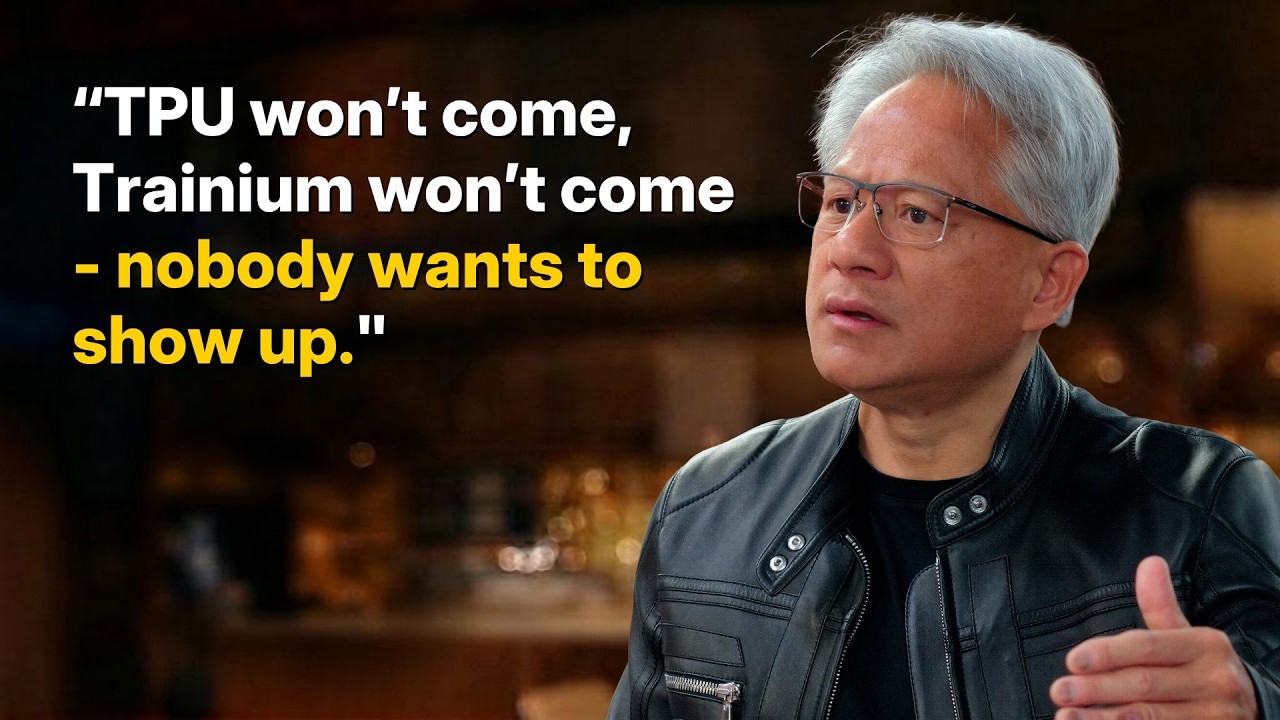
“We have to keep innovating and, as you probably know, our share is growing, not decreasing. The premise that even if we competed in China, that we’re going to lose that market anyways… You’re not talking to somebody who woke up a loser,” Huang said. “That loser attitude, that loser premise makes no sense to me.”
Get Tom's Hardware's best news and in-depth reviews, straight to your inbox.
He then went on to say that AI chips aren’t as simple as vehicles, where users can easily swap one brand for another daily. “Computing is not like that. There’s a reason why the x86 deal exists. There’s a reason why ARM is so sticky. These ecosystems are hard to replace; it costs an enormous amount of time and energy, and most people don’t want to do it. So, it’s our job to continue to nurture that ecosystem, to keep advancing the technology so that we can compete in the marketplace,” the Nvidia chief added.
“Conceding a marketplace based on the premise you described, I simply can’t acknowledge that. It makes no sense. Because I don’t think that the United States is a loser. Our industry is not a loser. That losing proposition, that losing mindset, makes no sense to me.”
The biggest point Jensen makes is that AI technology has five layers — energy, chips, infrastructure, models, and applications — and that none should be ignored just for the sake of one. He says, “Why are you causing one layer of the AI industry to lose an entire market so that you could benefit from another layer of the AI industry? There are five layers, and every single layer has to succeed. The layer that has to succeed most is actually the AI applications. Why are you so fixated on that AI model? That one company? For what reason?”
You can watch the complete podcast episode below.
Follow Tom's Hardware on Google News, or add us as a preferred source, to get our latest news, analysis, & reviews in your feeds.

Jowi Morales is a tech enthusiast with years of experience working in the industry. He’s been writing with several tech publications since 2021, where he’s been interested in tech hardware and consumer electronics.
-
wussupi83 Im not saying Jensen is wrong. But he stands to make so much money from selling to China that it's hard to ignore that massive conflict of interest hanging over his head.Reply -
Jabberwocky79 I actually think The 'ol Jacket has a point, but I can definitely see both sides of the argument. And when your argument is 'They're gonna do it anyway, so we might as well make money on it,' that's not a very high ground to take, morally-speaking.Reply
Jensen is Chinese, is he not? Any chance that his defensiveness could be, even slightly, due to feeling his culture is being discriminated? - Just a thought -
Pierce2623 Reply
Jensen is Taiwanese. Sure China claims Taiwan but Taiwan doesn’t consider themselves part of China. The funny part comes in when you realize Taiwan’s official name is Republic of China lol.Jabberwocky79 said:I actually think The 'ol Jacket has a point, but I can definitely see both sides of the argument. And when your argument is 'They're gonna do it anyway, so we might as well make money on it,' that's not a very high ground to take, morally-speaking.
Jensen is Chinese, is he not? Any chance that his defensiveness could be, even slightly, due to feeling his culture is being discriminated? - Just a thought -
Notton Jensen is from Taiwan, according to wikipedia.Reply
His success is part luck, riding off of crypto, NFT, and AI booms, but he's also good at marketing his products.
Unlike AMD, instead of adding a bunch of XXXXXs and copying other people's naming schemes, Nvidia makes a concerted effort to keep their products in the news cycle, as well as working with devs behind the scenes so games and apps work smoothly.
Playing both sides is just something businessmen do naturally.
You can google which companies worked with both sides during WW2 and the cold war, and you'll see it's not exactly a rare occurrence.
Coca-Cola and Fanta, for example.
Not to be a Ferengi or anything, but go look up the Rules of Acquisition. It makes perfect sense when you change your perspective. -
upsetkiller Reply
Contrary to what the American BS fed history the rest are sayingJabberwocky79 said:I actually think The 'ol Jacket has a point, but I can definitely see both sides of the argument. And when your argument is 'They're gonna do it anyway, so we might as well make money on it,' that's not a very high ground to take, morally-speaking.
Jensen is Chinese, is he not? Any chance that his defensiveness could be, even slightly, due to feeling his culture is being discriminated? - Just a thought
Jensen is indeed Chinese both ethnically and based on where he's from as a nationality. The island known as taiwan was always part of china and infact they actually call them selves the real china and claim all of mainland, meanwhile the nainland does the same. This divide was intentionally put there by the withdrawing British rule, as they have done all over the globe to sow long standing conflict in regions they previously ruled. -
Trake_17 I stopped trusting what this dude had to say when it became apparent that Ray Tracing was just a marketing gimmick to con people into subsidizing AI hardware development.Reply -
usertests I agree with the idea that restricting sales to China is pointless and counterproductive. It's especially true if you believe the AI stuff is overrated and overvalued.Reply
At this point though, it may be too late. -
Pierce2623 Reply
I know multiple Taiwanese people. They would say you’re full of crap. While Taiwan’s official name is technically still Republic of China, they don’t want to be associated with China at all or the reputation China has built. They definitely don’t claim that Taiwan is the “real China”. They’re actually all in on Taiwan being some sort of tech utopia where in the future Taiwanese people want have to do manual labor at all. I asked one of my workmates who would build their buildings and work in restaurants etc and he claimed that poor Chinese people from out in the country would be willing to defect to Taiwan to do their dirty work in exchange for a fast path to citizenship. Once I pointed out that still meant Taiwanese citizens doing manual labor, he just kind of shut down on the topic and changed the subject lol.upsetkiller said:Contrary to what the American BS fed history the rest are saying
Jensen is indeed Chinese both ethnically and based on where he's from as a nationality. The island known as taiwan was always part of china and infact they actually call them selves the real china and claim all of mainland, meanwhile the nainland does the same. This divide was intentionally put there by the withdrawing British rule, as they have done all over the globe to sow long standing conflict in regions they previously ruled. -
Zaranthos The guy wants to make more money, it's as simple as that. I would think to some degree he would have a little more trepidation of China winning the AI race considering his Taiwan and USA roots. Do I think banning China from getting Nvidia chips helps or even works, no because China gets them anyway despite their two-faced posturing about not wanting or needing them. On the one hand China wants to promote their own tech and claim they don't want or need foreign tech, on the other hand they smuggle it in because they know they can't win without it. Kind of absurdly entertaining to watch really.Reply
