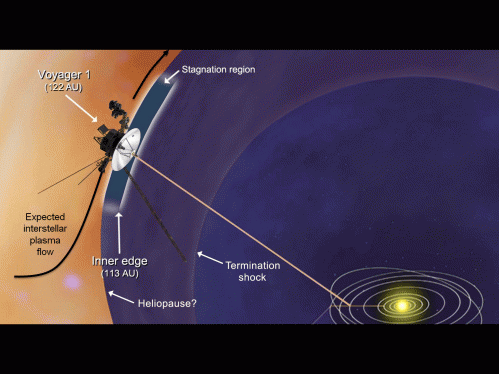
There are countless other projects happening, such as the first man made space craft that will reach interstellar space, more than 10 billion miles from home.
NASA said that the Voyager 1 spacecraft, which was launched in 1977, has entered "a new region at the far reaches of our solar system that scientists feel is the final area the spacecraft has to cross before reaching interstellar space." The excitement around Voyager subsided in 1990 when it took a "family portrait" of our Solar System and in 1998, when it became Pioneer 10 as the most distant man-made object from Earth. Voyager 1 is estimated to have enough power to communicate with Earth until at least 2025, 48 years after its launch.
It was not until 2004 when Voyager 1 crossed into the heliosheath and interest in the spacecraft, which carries a famous golden record with stored photos of Earth, music samples, and spoken greetings, got traction again. NASA says Voyager 1 is now in a region referred to as "magnetic highway for charged particles".

"Although Voyager 1 still is inside the sun's environment, we now can taste what it's like on the outside because the particles are zipping in and out on this magnetic highway," said Edward Stone, Voyager project scientist based at the California Institute of Technology, Pasadena. "We believe this is the last leg of our journey to interstellar space. Our best guess is it's likely just a few months to a couple years away. The new region isn't what we expected, but we've come to expect the unexpected from Voyager."
Voyager 1 and its sister space craft Voyager 2 are not expected to reach the vicinity of another star within 40,000 years.
