- Lo-Cost Duel: Duron 1100 vs. Celeron 1200
- Last Passing Maneuver: Tualatin 1266 With 512 kB Versus Athlon And P4
- Hot Spot: How Modern Processors Cope With Heat Emergencies
- Hot Microprocessor News
- Intel Beats AMD To 2 GHz
- AMD's Duron Reaches The Giga Hertz Barrier
- HOT! An Early Look At The New Pentium III (Tualatin or Coppermine-T?)
- AMD's Athlon 1400 and Duron 950
- The First Palomino: AMD Releases Mobile Athlon 4
- Intel Pentium 4 1.7 GHz: More Power For Less Money
- All Aboard the Failcopter: Don't use Ruiz in your Advertising
- Anand does Nehalem!!!
- Just got The Phenom 9850Be today!!!
- Is Phenom the worst CPU launch of all time?
- GPU dead? I think not!!!!
- what is more important FSB or Multi?
- Q9450 or Q6600
- Overclocking the 8800 GTS
- Overclocking FSB and RAM - How much does it matter?
- AMD HTT
Source: Tom's Hardware US – Keywords: performance, matters
Topics: Build Your Own, INTEL
Syndication:
Clock Speeds
Today AMD introduces AthlonXP processors at 1333, 1400, 1467 and 1533 MHz, all using a FSB clock of 133/266 MHz. AMD doesn't want to see or hear MHz-numbers anymore though, so what we are actually presented with today is AthlonXP 1500+, AthlonXP 1600+, AthlonXP 1700+ and AthlonXP 1800+. AMD calls the number with the '+' at the end behind the 'AthlonXP' name 'model numbers ', as Tom's Hardware already reported more than two months ago.
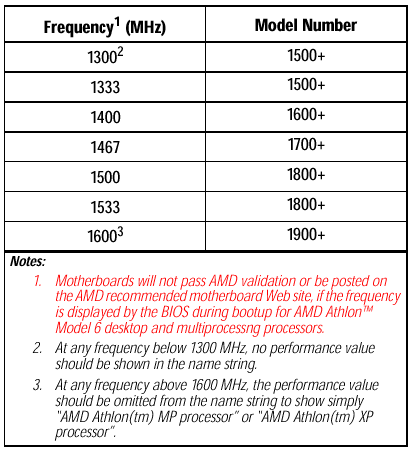
How seriously AMD is taking this 'Model Number' issue, is shown in the picture above. The BIOS of a motherboard that is supposed to get approval from AMD is not allowed to display the actual clock frequency, but only the model number! WindowsXP reports both, the 'model number' as well as the actual clock frequency, as you can see in the picture of a German WindowsXP below.
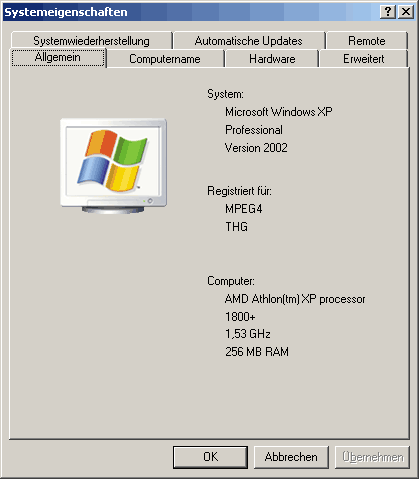
AMD has got to be consistent, and that's all it is by trying to keep the display of actual clock frequencies of AthlonXP at a minimum.

- Previous page New Packaging
- Next page Benchmarks