Why you can trust Tom's Hardware
Our expert reviewers spend hours testing and comparing products and services so you can choose the best for you. Find out more about how we test.
PBO Performance and maximum noise levels
We’re going to start this benchmark section by focusing on a traditional maximum performance test, with the CPU cooler’s fans allowed to reach their fastest speeds, for the best cooling possible.
Turning on PBO allows AMD’s Ryzen 9 9950X3D to stretch its legs to an extent, and all air coolers I have tested with PBO enabled using MSI’s X870E Carbon Wifi motherboard reach the maximum CPU temperature of 95 degrees C (203 F) and thermally throttle, to a small extent.
(Image credit: Tom's Hardware)
Most of the coolers in this comparison are dual-tower, with two fans. As such, it isn’t a surprise that the single-tower Freezer 36S is outperformed by most of the competition here. What is interesting is that despite being only a single-tower, single-fan air cooler, it still manages to perform very closely to the larger heatsinks – falling only 6W behind DeepCool’s AK620 G2.
To give a wider variety of comparison examples, I’ve included some data of the same tests from our last AMD Ryzen 9 9950X3D cooling test bench. But keep in mind these results aren’t 100% comparable, due to a different case and fans being used.
Arctic’s Freezer 36S performs rather well for a single-tower cooler, and part of the reason for that is the included fan – which features speeds of up to 3000RPM, about 50% faster than most fans included on consumer CPU coolers. These faster top speeds come at the cost of noise levels, though, with the 36S reaching 47.4 dBA.
(Image credit: Tom's Hardware)
200W thermal benchmarks
For the next thermal test, I leave the motherboard settings at their defaults, which results in a power limit of about 200W when running Cinebench R23.
(Image credit: Tom's Hardware)
With a “stock” power profile enabled, Arctic’s latest single-tower air cooler averages 54.3 ΔC (76.5C/169.7F) – less than 2 degrees C from the best result we have from dual-tower air coolers.
150W + GPU thermal results, noise levels
Our next test runs Cinebench on the CPU with a 150W power limit, while also running Furmark on MSI’s RTX 4070 Ti Super Ventus 3x OC. This causes the GPU to consume ~295W of power. This test is designed to emulate the thermals of games, which primarily stress the CPU and GPU.
Stay On the Cutting Edge: Get the Tom's Hardware Newsletter
Get Tom's Hardware's best news and in-depth reviews, straight to your inbox.
(Image credit: Tom's Hardware)
All of the air coolers here perform similarly, with a range of just 2.7 degrees C between the best dual-tower air cooler and the worst-performing result. Let’s take a look at the noise levels now, as that will be more important to most users in this scenario.
(Image credit: Tom's Hardware)
I measured 42.4 dBA from Arctic’s Freezer 36S with a Pyle PSP25 soundmeter. This isn’t exactly what I would call “loud,” but it certainly ain’t quiet, either. If you’re particular about noise levels, you might want to implement a custom fan curve.
Noise-normalized testing
Most testing is performed with the cooler tied to the default fan curve of our MSI X870E Carbon motherboard, but some of y’all prefer to see tests when the noise levels of coolers are equalized. This is especially important to those of you who prefer silent computers.
This next test has the CPU cooler noise-normalized to 38.9 dBA, with PBO enabled for the Ryzen 9 9950X3D CPU. Our results have it near the bottom of the list, which makes sense considering that it’s only a single-tower, single-fan cooler.
(Image credit: Tom's Hardware)
With this review, we have another noise-normalized benchmark, measuring the amount of time the cooler is able to keep AMD’s Ryzen 9 9950X3D under its peak temperature (TJ Max) of 95 degrees C while running Cinebench R23 multi-core, all while the fan is noise-normalized to 38.9 dBA.
(Image credit: Tom's Hardware)
Karhu DDR5 RAM thermals testing!
Your CPU cooler does not operate in isolation. It has an impact on not just your CPU’s temperatures, but also the other components in your build, like your RAM and GPU. To that end, I’ve run the Karhu RAM stress test. This places a load of ~153W on the CPU and ensures system RAM (DDR5 in my case) is fully stable. In this type of scenario, most AIOs tend to produce worse results than air coolers.
The results here are extremely interesting. I had expected DDR5 temperatures to be worse than dual-tower air coolers, but both Arctic’s Freezer 36S and DeepCool’s AK400 G2 single-tower air coolers performed better than all traditional results – being outperformed only by Silverstone’s IceMyst Pro 360 when equipped with VRM fans.
(Image credit: Tom's Hardware)
Conclusion
(Image credit: Tom's Hardware)
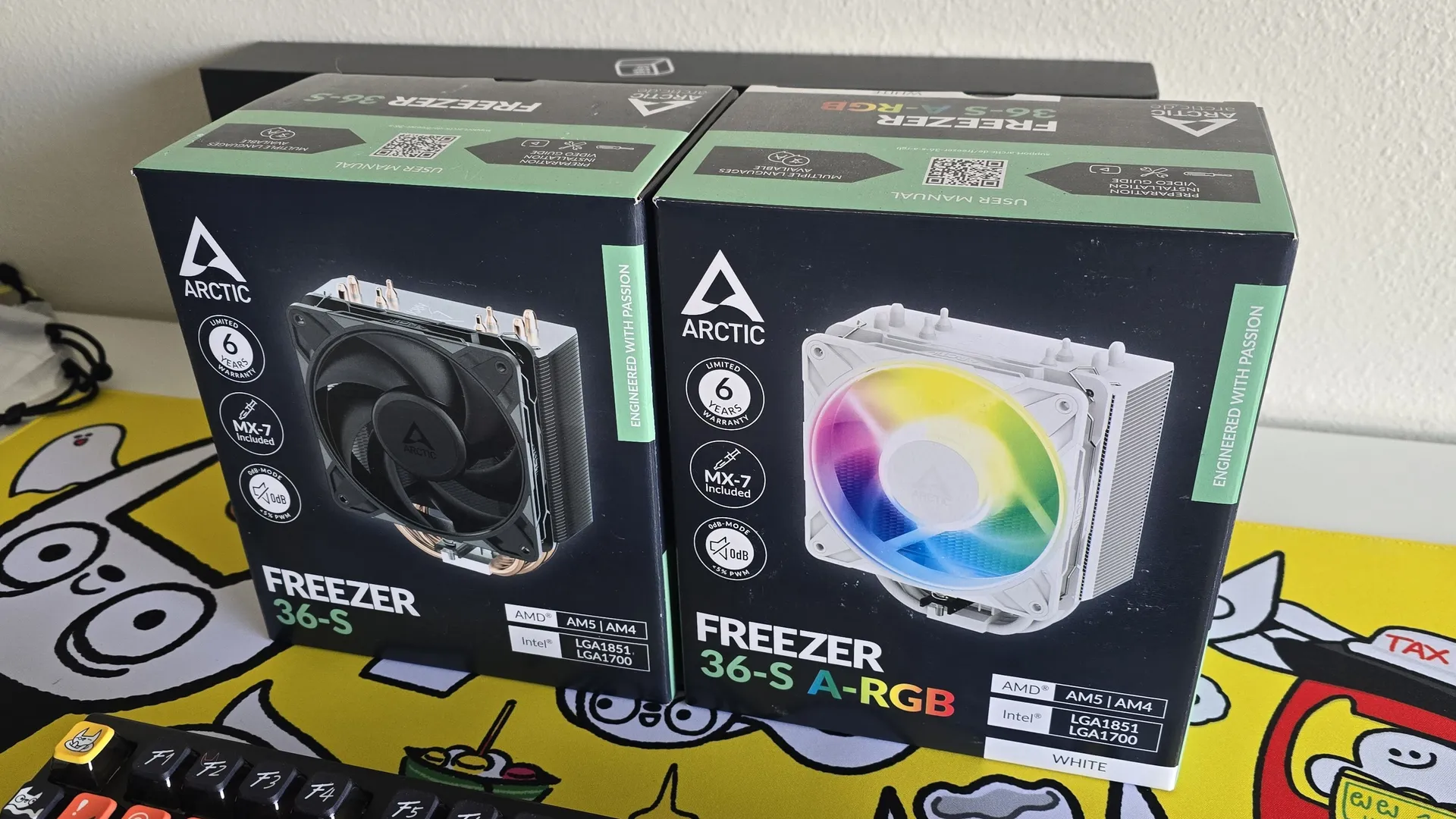
Arctic’s Freezer 36S punches above its weight and price class, offering performance comparable to many dual-tower air coolers with only one fan paired to a single-tower heatsink – all with a price starting at just $28.49. It’s not the quietest cooler, and it requires installing a contact frame for Intel systems (which makes it a poor fit for novice builders), but if you aren’t trying to overclock and you don’t want to overspend on cooling to get something a bit quieter, it’s worth considering.