Cooler Master is bringing active cooling to DDR5 RAM, promising up to 15-degree temperature drops — 'MasterDIMM' combines G.SKILL memory with a built-in fan, kits run up to 128GB

Cooler Master active cooling
(Image credit: Cooler Master)

If you thought DDR5 was already too expensive right now, Cooler Master and G.Skill have a surprise in store for you. The two manufacturers are partnering up to make "MasterDIMM" — a new line of DDR5 memory kits that come with active cooling and a promise of temperatures that are up to 15 degrees cooler than conventional RAM. These sticks feature a thick heatsink with a fan built-in to emulate a blower-style cooler you see in some GPUs. There are no pricing or availability details yet, but it's not hard to imagine these kits, made for "demanding next-gen systems," will be even pricier than regular DDR5.

MasterDIMM will be properly shown off at Computex 2026 in just a few days, so expect more information then. For now, we know that these are high-end UDIMMs (desktop) that will push the envelope for DDR5 RAM in terms of style. The design of these sticks is very classy, sporting a black and gold aesthetic with part of the copper heatsink visible on the front, along with the fan on the other end. Naturally, they're a little larger than regular DIMM's, so motherboard compatibility remains to be seen.

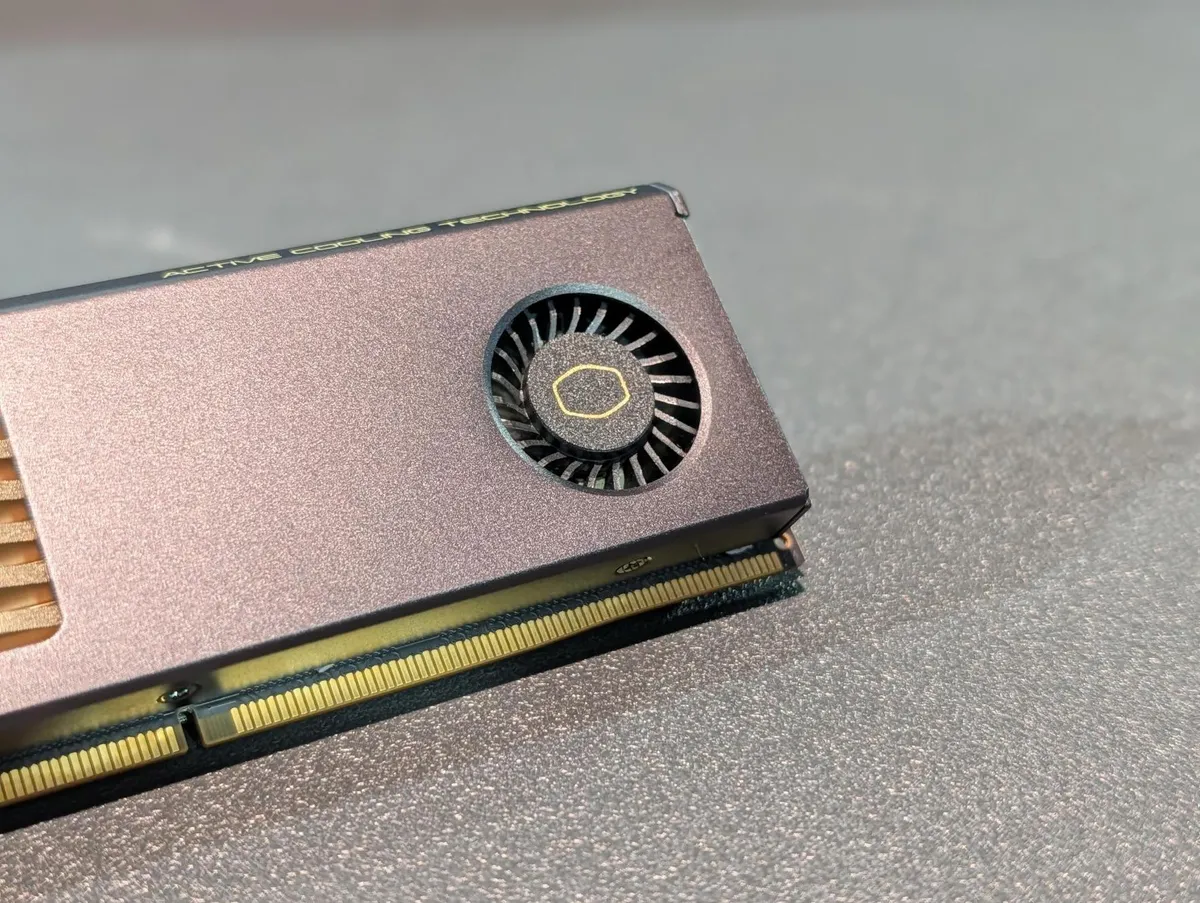
There are two RGB strips running along the top, also flanked by gold accents, and the whole thing looks oddly similar to a fancy M.2 SSD. The RAM itself is made by G.Skill, while the heatsink is designed by Cooler Master. MasterDIMM will offer speeds up to 6,000 MT/s at CL26 latency with AMD EXPO, or up to 8.400 MT/s on Intel platforms via XMP 3.0. Capacities will scale up to 128GB at the top-end through 64GBx2 configs.

Latest Videos From

The companies claim the fan inside is whisper-quiet, delivering optimal cooling at just 35 decibels. That's the same noise level as a library. The heatsink and fan combo can drop temperatures by up to 15 degrees Celsius, which would be a remarkable improvement if proven true in testing. Keep in mind that DDR5 RAM, in general, is already rated for operation at up to 95°C, but it stays between 70-80°C in most cases.

Now, this is not the first time someone has put a massive cooler, or even two fans, on some RAM, but it's the most mainstream version of such a combination yet. Both G.Skill and Cooler Master are huge names in the PC hardware industry, so it'll be interesting to see how well this product does. Of course, that depends on pricing, and DDR5 prices are still out of control despite some semblance of the AI boom slowing down as of late.

More than a decade ago, Corsair tried to actively cool memory with its Vengeance Airflow modules, and vendors have tried to fit their DIMMs with creative heatsinks forever. Last year, we even tested a Silverstone AIO that could attach optional fans to itself to cool your memory and SSD.

Google Preferred Source

Follow Tom's Hardware on Google News, or add us as a preferred source, to get our latest news, analysis, & reviews in your feeds.

Hassam Nasir
Contributing Writer

Hassam Nasir is a die-hard hardware enthusiast with years of experience as a tech editor and writer, focusing on detailed CPU comparisons and general hardware news. When he’s not working, you’ll find him bending tubes for his ever-evolving custom water-loop gaming rig or benchmarking the latest CPUs and GPUs just for fun.

  • Dr3ams
    Another fan to collect dust...
    Reply
  • TechieTwo
    Designed for those with too much money. :)
    Reply
  • Notton
    Arguably better than dummy DIMMs in your A1/B1 slots of ATX mobos with 4 dimm slots.
    Undoubtedly wouldn't fit in server style mobos or mITX.
    Probably even some OC mobos like the MSI Z790Mpower, etc. could never fit these.

    From the looks of the slot key, the fan blows air to the top edge of the mobo on desktop style mobos.
    Reply
  • eichwana
    My RAM is water cooled. My ddr4 2600 could hit 3800+
    If this fan could assist with those kinds of overclocks it’ll be picked by those wanting those clocks
    Reply
  • chaz_music
    The lower temperatures will lower the CMOS leakage current in the DRAM cells. That in turn COULD allow you to lengthen the refresh cycle time, which would definitely improve the system response due to less system pauses during DRAM refresh. But you have to be willing to tamper with refresh cycle timing, just like with overclocking adjustments.

    Maybe the memory makers should think about not dumping extra heat into the DRAM package from the RGB LEDs and driver circuits. Just a thought for those trying to increase their system performance. Adding bling usually does not help the performance. Putting LEDs and displays in the CPU cooler is along the same line. Adding a ~10W LCD display and its driver circuitry on the CPU cooler can't be helping the CPU cooling effectiveness.
    Reply
  • thestryker
    chaz_music said:
    Maybe the memory makers should think about not dumping extra heat into the DRAM package from the RGB LEDs and driver circuits.
    The majority of video cards dumping heat right into the DRAM is a bigger problem than anything memory makers are doing. This has been a problem for years, but it's a bigger one with DDR5 than DDR4 due to the PMIC and higher clocks.

    Don't get me wrong I absolutely agree regarding LEDs on DRAM (and the bad heatspreaders that come along with them). I have DRAM with no LEDs and good heatspreaders which still dropped 10C from having a couple of 80mm fans mounted over them (and I don't have a flow through video card) though.
    Reply
  • BillyBuerger
    That tiny fan on there looks like when chipsets has tiny heat sinks with tiny fans. Since it already appears to be too wide for a full set and needing space between the RAM, you could just fit a larger passive heat sink that actually has room to breath from normal case airflow and not having to rely on bad fans. And just because the sound output level is low, tiny fans like that tend to be higher pitched and more noticeable even when the numbers are not high.
    Reply
  • hwertz
    I mean I guess. The cost of doing this would have been unthinkable last year when (at least for DDR4) it was down toward $1 a GB. At todays prices? Why not, with current pricing that fan's a drop in the bucket.
    Reply
  • HyperMatrix
    15C drop isn’t bad but it’s not crazy. Though that may be calculated at xmp profile settings. Possibly more of a drop if you raise voltage. My ram is at 1.59V and never even hits 30C with water cooling. The modules only uses like 5-6W so doesn’t generate insane amounts of heat. Any type of active cooling should provide a massive benefit. And a lot more conveniently than doing a block/loop for ram.
    Reply
  • daviddtran
    Why do you even need to clock your memory so high that it needs active cooling? How much performance increase are you seeing in your use case to justify this shenanigans? I've been able to keep my timings the same and go 10-20% higher frequency without seeing much increase in temperature.
    Reply