Why you can trust Tom's Hardware Our expert reviewers spend hours testing and comparing products and services so you can choose the best for you. Find out more about how we test.
If all you want is the TL;DR, here you go: the RX 9070 GRE delivers a 120 FPS average at 1080p across our 11-game raster-only test suite and an 86.6 FPS average at 1440p. That puts it in a solid position to enable high-refresh-rate gaming for the two most popular monitor resolutions among PC gamers, and it's a nice boost over lower-midrange products like the RX 9060 XT 16GB and RTX 5060 Ti 16GB.

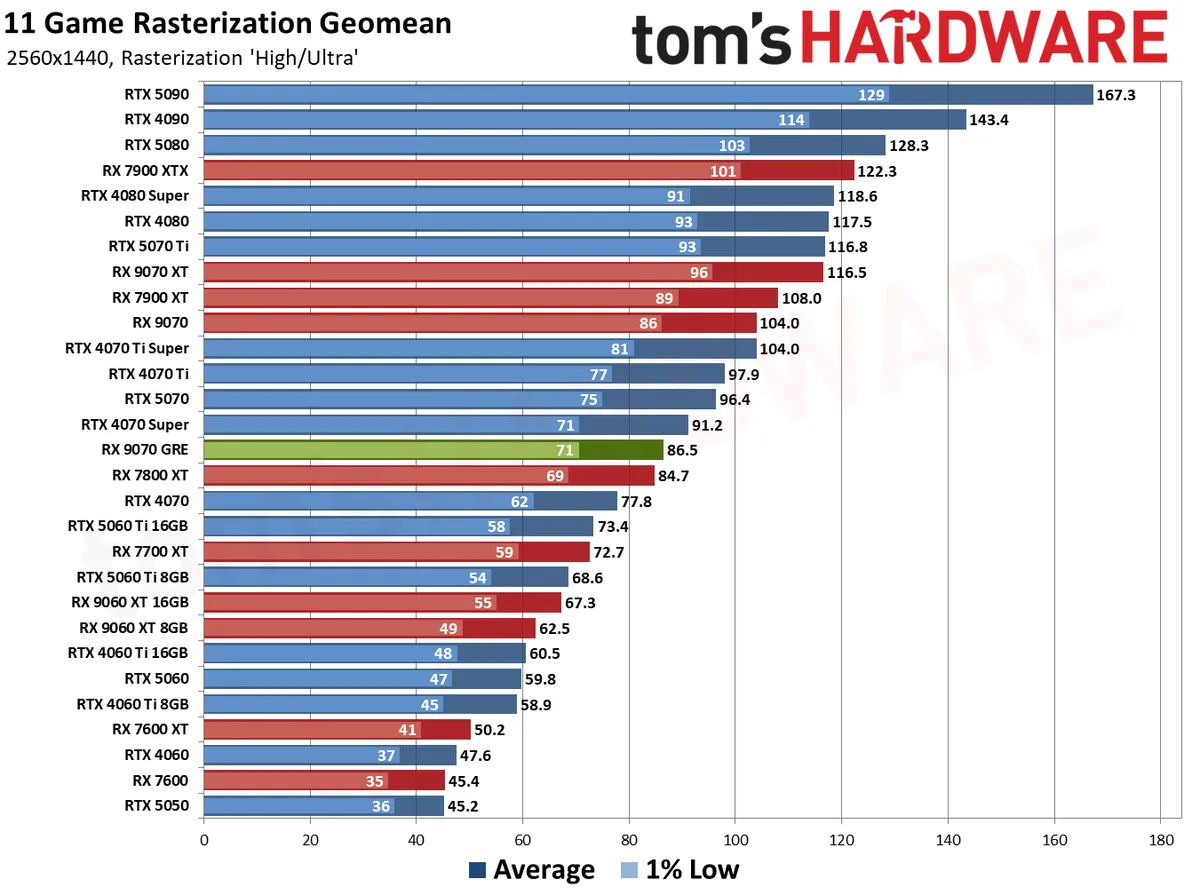


But overall raster performance falls short of a 60 FPS average at 4K, which remains the turf of the RTX 5070, RX 9070, RX 9070 XT, and RX 5070 Ti at a minimum. For a truly midrange product, though, that's an OK tradeoff for the GRE, as 4K monitors are still far less common than 1440p screens. And if you can deploy FSR 4, you can still upscale your way to a fast and high-quality 4K experience.
Read on for per-game results. We'll largely let these numbers speak for themselves except where a given game requires particular elaboration.
Black Myth Wukong
Why it's here: a stunning showcase for PC graphics
What it stresses: Compute, VRAM, RT (when enabled)


Black Myth Wukong is a gorgeous example of what’s possible from Unreal Engine 5, but it places heavy, heavy demands on graphics cards in exchange. This title has a free benchmark tool, but to ensure we get all the updates that Game Science has made to this game since launch, we picked up the full version and devised our own benchmark sequence.
Alan Wake II
Why it's here: One of the richest AAA feasts for the eyes on PC
What it stresses: Compute, VRAM, RT (when enabled)


Counter-Strike 2
Why it's here: over a million active players can't be wrong
What it stresses: Compute, driver overhead at high frame rates


Counter-Strike 2 needs no introduction as one of the most popular esports titles out there. In general, GeForce cards really seem to struggle with 1% lows in this title. Radeons do a better job of delivering both the high average frame rates and 1% lows that we want for a smooth gaming experience. But frame rates are so high in general that you're unlikely to notice any dips in performance.
Arc Raiders
Why it's here: One of 2026's most popular games, powered by UE5
What it stresses: Compute


Arc Raiders shows one of the widest performance divergences between GeForces and Radeons of any game in recent memory. The 9070 GRE barely outperforms the 5060 Ti in this title, and both it and the 9070 are outpaced by the RTX 5070.
We weren't aware of how large this divergence was before we set out to perform our 2026 GPU Hierachy testing, but given how popular Arc Raiders is, you should know about it before buying a Radeon.
Fortnite
Why it's here: It's Fortnite
What it stresses: Compute


Fortnite may have a reputation as a potato game, but make no mistake: this is an Unreal Engine 5 showcase through and through, and it can deliver stunning visuals in between the heated skirmishes of its pop-culture-blending brawls.
Radeons deliver an especially strong showing in Fortnite at 1080p and 1440p. The 9070 GRE even goes neck-and neck with the RTX 5070 until we reach 4K.
Apex Legends
Why it's here: Unique engine, giant player base
What it stresses: Compute


Apex Legends is another wildly popular esports title that needs no introduction. It normally has a 144 FPS cap, but you can disable it with a launch option to reach a 300 FPS ceiling.
In this full-range testing, many of our cards hit Apex's 300 FPS cap at 1080p. Unless you enjoy leaving large parts of your pricey GPU unused, you really should step up to 1440p at a minimum and possibly even 4K, where the 9070 GRE and many other cards can still deliver esports-friendly frame rates with better image quality.
Marvel Rivals
Why it's here: another hugely popular free-to-play title
What it stresses: Compute


Marvel Rivals is another popular free-to-play game that might have a reputation as a bit of a potato title. Unlike other games in our suite that share its UE5 foundation, Rivals doesn’t require a superhero of a graphics card to hit high frame rates. The 9070 GRE turns in a fine performance
Clair Obscur: Expedition 33
Why it's here: One of the most acclaimed games in recent memory
What it stresses: Compute


Clair Obscur: Expedition 33 has stunning Unreal Engine 5-powered visuals. Since it keeps VRAM usage in check even on 8GB cards, its performance is mostly defined by how much compute horsepower you can throw at it.
Marvel's Spider-Man 2
Why it's here: A newer PlayStation port
What it stresses: Compute, VRAM, RT (if enabled)


Marvel's Spider-Man 2 is a representative PlayStation port. Like many games in this vein, it really wants both strong compute resources and plenty of VRAM from a GPU to hit high frame rates, especially with RT enabled.
But for rasterization, 12GB is enough VRAM to allow the RX 9070 GRE to turn in over 100 FPS on average at 1080p and almost 80 FPS at 1440p, so it's a great foundation for swift and smooth gaming under those conditions.
Stalker 2
Why it's here: A visually stunning revival of a classic PC franchise
What it stresses: Compute, VRAM (to some degree)


Stalker 2 is another beast of a UE5 game, so much so that while the RX 9070 GRE manages over a 60 FPS average at 1080p, it falls short at 1440p. You'd probably want to dial in upscaling or dial settings back to high for a good 1440p experience here.
Cyberpunk 2077
Why it's here: One of the biggest PC releases of all time
What it stresses: Compute, VRAM, RT (when enabled)


Cyberpunk 2077 remains a beast of a title even this long after its introduction, at least once you get above 1080p. True to its mission, the 9070 GRE turns in high frame rates at 1080p and a solid 60 FPS average at 1440p.
- MORE: Best Graphics Cards
- MORE: GPU Benchmarks and Hierarchy
- MORE: All Graphics Content