









Tom's Hardware Verdict
The Samsung 860 Pro 1TB serves a shrinking market that's overshadowed by faster NVMe-based products. If you are tethered to the SATA bus and need the best in every category, the 860 Pro 1TB delivers. The 860 Pro is also the first NAS-rated prosumer SSD and it should work well in RAID. The EVO series tends to be more reasonably priced and has better performance in general applications, which keeps the 860 Pro firmly in the professional user category.
Pros
- +
Highest SATA performance for sustained workloads
- +
Highest endurance
- +
Consistent performance
- +
Excellent software package
Cons
- -
Extremely high cost
Why you can trust Tom's Hardware Our expert reviewers spend hours testing and comparing products and services so you can choose the best for you. Find out more about how we test.
Features & Specifications
Samsung's 850 Pro is already the fastest SATA SSD for professional workloads on the market, so raising the bar with the 860 Pro isn't an easy task. Samsung breathed new life into its Pro lineup with its new MJX controller paired with a new 64-layer 3D flash. The company claims the combination gives the 860 Pro increased speed, compatibility, reliability, and capacity.
Samsung's professional line of SATA SSDs may be fast, but they fell out of favor with enthusiasts back when the company released the 850 series. The 850 Pro came to market six months before the 850 EVO, but the EVO ended up dominating the consumer market for three years because it was less expensive and provided better performance in general applications. That confined the 850 Pro to the high-performance market.
In the meantime, we moved on to higher performance products as PCIe and NVMe SSDs trickled in. The 850 Pro soldiered on, unchallenged by SATA SSDs that only recently began to challenge the EVO in mainstream applications. Now Samsung plans to use the 860 Pro to fill the gap between the new 860 EVO and entry-level NVMe SSDs.
The laptop market has embraced SSDs, but they are still woefully absent from most pre-built desktop PCs. Many of those desktop systems can run professional applications, and those apps run best on systems with consistent storage performance. Unfortunately, most workstations still ship with a mechanical hard drive. In fact, the last full system tested we tested in the storage lab used a small SSD for a boot drive and a high-capacity HDD to store multimedia data. Those types of systems are a natural target for Samsung's new hefty Pro series.
For the last year, we've talked about how the NAND manufacturers, led by Samsung, were shifting focus over to 3-bit per cell (TLC) memory. In the second half of 2017 Samsung even showed us a technology roadmap that didn't mention any 2-bit per cell (MLC) memory after 2017. Samsung must have had fun playing along with the other NAND manufacturers. Now that the other fabs have also removed MLC from their roadmaps, Samsung decided to let the world know that it has new SSDs powered by 64-layer MLC flash.
Specifications

Samsung's 860 Pro and EVO families span from 256GB up to 4TB. We'll focus on the 860 Pro because that's what we have in the lab, but we'll follow up with 860 EVO testing soon.
Samsung improved the Pro's top-line specifications slightly, but most of the gains come at low queue depths (not shown in the table above). The 860 Pro is one of the few SSDs that pushes up to 11,000 random read IOPS at a queue depth (QD) of 1. Samsung also improved sequential performance at low queue depths, but the biggest gains come between QD2 and QD4.
Get Tom's Hardware's best news and in-depth reviews, straight to your inbox.
Samsung claims 560/530MB/s of sequential read/write throughput for all capacities. Random performance is also the same regardless of capacity at 100,000/90,000 random read/write IOPS.
Features
Samsung outfitted the 860 series with a new MJX controller that supports low-power DDR4 memory, so it obviously has a new integrated memory controller. Samsung isn't sharing specifics, but we suspect the company built the MJX controller on a smaller lithography that enables lower power consumption, cooler operation, and reduced manufacturing costs.
Samsung announced the production of fourth-gen V-NAND memory last year and claimed 64-layer NAND is 30% more energy efficient than its 48-layer predecessor. Samsung accomplished the feat by reducing the input voltage from 3.3 volts to just 2.5 volts. Samsung also claimed it had reduced the program time to 500 microseconds, which is 1.5X faster than the previous generation.
Out of the box, the 860 series will support hardware encryption with TCG Opal and Microsoft's eDrive. Samsung's other retail products have also had hardware encryption, but occasionally the company enables the feature through firmware updates after the SSDs are already on the market.
The firmware for the 860 Pro we're testing is early, but it is stable and mature enough for review purposes. We measured lower peak active and idle power consumption than the previous generation drive, but the 860 Pro appears to take longer to complete background activities. That increases the overall power consumption. Samsung says the 860 Pro will hit shelves this month, so the retail drives may ship with the RVM01B6Q firmware we tested.
In the past, Samsung's SATA SSDs couldn't execute queued TRIM commands in a Linux environment. The company fixed the issue in the 860 series. The 860 Pro is also the first consumer SSD advertised for use in a NAS environment. We don't expect Samsung to make the NAS capabilities a big marketing point and mainstream users will not see this as a big step forward. NAS manufacturers have slowly integrated SSD-specific features into some flash-focused systems, but they typically recommend expensive enterprise SSDs for lower-cost all-flash arrays. The 860 Pro with its increased endurance and Linux-optimized features will give system administrators a lower-cost option to fill the drive sleds.
Pricing, Warranty & Endurance
| 860 Pro 2.5"64-Layer 3D MLC | 256GB | $139.99 |
|---|---|---|
| 512GB | $249.99 | |
| 1TB | $479.99 | |
| 2TB | $949.99 | |
| 4TB | $1,899.99 | |
| 860 EVO 2.5"64-Layer 3D TLC | 250GB | $94.99 |
| 500GB | $169.99 | |
| 1TB | $329.99 | |
| 2TB | $649.99 | |
| 4TB | $1,399.99 | |
| 860 EVO M.2 (SATA)64-Layer 3D TLC | 250GB | $94.99 |
| 500GB | $169.99 | |
| 1TB | $329.99 | |
| 2TB | $649.99 | |
| 860 EVO mSATA64-Layer 3D TLC | 250GB | $94.99 |
| 500GB | $169.99 | |
| 1TB | $329.99 |
We can't discuss the 860 Pro without comparing it to the new 850 EVO. The two product lines essentially compete against one another.
The 860 Pro is expensive. The two most popular SSD capacities are 512GB and 1TB. The Pro models retail for $249.99 and $479.99, respectively, but the 860 EVO retails for just $169.99 (512GB) and $329.99 (1TB).
For the first time in five years, a Samsung SSD is not the elephant in the room. Instead, Crucial's MX500 that sells for $135.99 (512GB) and $259.99 (1TB) is the biggest competitor.
| Capacity Class | 256GB | 512GB | 1TB | 2TB | 4TB |
| 860 Pro (New) | 300 TBW | 600 TBW | 1,200 TBW | 2,400 TBW | 4,800 TBW |
| 850 Pro | 150 TBW | 300 TBW | 300 TBW | 450 TBW | 600 TBW |
| 860 EVO (New) | 150 TBW | 300 TBW | 600 TBW | 1,200 TBW | 2,400 TBW |
| 850 EVO | 75 TBW | 150 TBW | 150 TBW | 300 TBW | 300 TBW |
| Crucial MX500 | 100 TBW | 180 TBW | 360 TBW | 700 TBW | x |
| WD Blue 3D /SD Ultra 3D | 100 TBW | 200 TBW | 400 TBW | 500 TBW | x |
The 860 Pro's shocking price comes with an equally shocking endurance rating. We've known for several years that Samsung artificially lowers its endurance ratings for warranty purposes. Unlike Intel's consumer SSDs, Samsung's drives will continue to operate even after you've exhausted the warrantied endurance. The only thing you lose after the drive passes the threshold is the ability to RMA the drive. Some independent third-party tests show that Samsung's previous-gen SSDs can absorb more than one petabyte of writes.
We only listed the most relevant consumer SATA SSDs in the chart above. For the first time in years, Samsung is working to retake the lead rather than just leapfrogging another Samsung SSD. Samsung's MSRPs show that the company is not ready to compete with the MX500 in the pricing department, but instead the company plans to use endurance to make up the difference. The entire 860 series ships with an enterprise-class endurance rating, but the new Pro series offers twice the endurance of the new EVO. The EVO's endurance is even enough for some read-centric enterprise workloads. We can foresee both models used in data centers, which might cause some early availability issues.
Both new models ship with a five-year warranty. The 850 Pro shipped with a ten-year warranty, but that was a reaction to SanDisk's ten-year warranty for the Extreme PRO SSD, which came to market just a month before the 850 Pro. Samsung later released the 950 and 960 Pro series with a five-year warranty, so the 860 series just continues the status quo.
Software
Samsung's Magician is one of the best software packages available. Predictably, the latest update adds support for the new 860 series. Samsung's Data Migration Tool also works with this series. Between the two software packages, you have every tool to test, configure and optimize the drives.
Packaging


The red on the package seems a little more vibrant on the 860 Pro, but the packaging is similar to the previous models. Inside we found the drive and a paper manual with some general warranty details.
A Closer Look


View Original

View Original

View Original

View Original

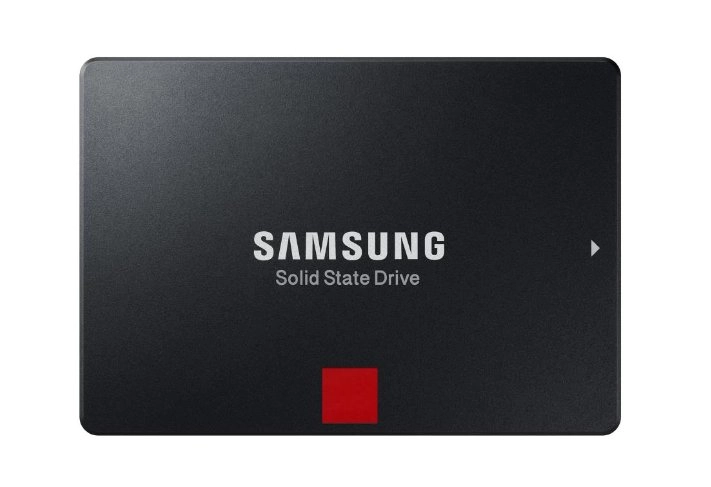
Other than a slight change to the red tint on the square, the new 860 Pro looks identical to the previous generation. The drive comes in a 7mm 2.5" form factor that's been standard for several years now. The Pro series only comes in this form factor. The PSID, which you use for the encryption software, is printed on the label.
Internals


View Original

View Original

View Original

View Original

View Original

Samsung didn't use the Package-on-Package (PoP) controller design for the 860 Pro. The controller and DRAM are in separate packages, presumably to reduce manufacturing costs. The circuit board is large enough to accommodate the 1TB components. The company likely uses the same PCB for the 2TB and 4TB capacities. We found the controller without a thermal pad inside the drive.
MORE: Best SSDs
MORE: How We Test HDDs And SSDs
MORE: All SSD Content

Chris Ramseyer was a senior contributing editor for Tom's Hardware. He tested and reviewed consumer storage.
-
mikewinddale "The 860 Pro's shocking price comes with an equally shocking endurance rating."Reply
I'm still wondering what the secret sauce is in my Kingston KC400 SSD, which has an 800 TBW rating for the 512 GB drive (0.87 DWPD) (https://www.kingston.com/datasheets/SKC400S37_us.pdf). Controller is Phison 3110 (S10), and I'm not sure about the flash, but I think it's MLC. There are very few online reviews of this drive, so I don't know if its insane endurance comes at the expense of performance, or what. Closest I can find is an online review of the controller: http://www.tomshardware.com/reviews/toshiba-tlc-mlc-micron-mlc-phison-s10,4190.html -
diagrafeas "Samsung should release a new 970 NVMe SSD with 64-layer NAND and the Phoenix controller in April. That means we won't have to wait very long to see if Samsung will satiate the enthusiast community with a high-performance MLC SSD that costs less than Intel's Optane SSD 900P."Reply
Thought that 970 was kept for BGA SSD. The new range should be 980 EVO/PRO.
Don't compare with Optane. Completely different technology and user base. -
gasaraki Not worth it really. If you look at the MX500, the performance is right under the new 960 Pro but at a much lower price point.Reply -
2Be_or_Not2Be Reply20626494 said:Not worth it really. If you look at the MX500, the performance is right under the new 960 Pro but at a much lower price point.
I think it matters when your specific use case is one that involves a lot of constant writes where you can would hit TBW limits. So high I/O servers (like databases, heavy-traffic file servers, virtual hosts w/high-activity guests) could definitely use the higher endurance. Not all servers, of course - a mostly read-only web server wouldn't necessarily need the higher endurance rating. -
Martell1977 I not a fan of the size naming convention. I have a 850 EVO 512gb, but the real size is 465gb. Would be nice if in these reviews you listed actual storage size. It is a shame that there isn't a standard that prevent vendors from naming a drive 1 size but delivering another.Reply -
cryoburner Reply
There is a standard that nearly all storage devices have followed for decades, using standard SI prefixes...20627705 said:I not a fan of the size naming convention. I have a 850 EVO 512gb, but the real size is 465gb. Would be nice if in these reviews you listed actual storage size. It is a shame that there isn't a standard that prevent vendors from naming a drive 1 size but delivering another.
1 gigabyte = 1,000 megabytes = 1,000,000 kilobytes = 1,000,000,000 bytes
Windows, on the other hand, reports what are actually gibibytes (GiB), where...
1 gibibyte = 1,024 mebibytes = 1,048,576 kibibytes = 1,073,741,824 bytes
As a result, 512 GB equals approximately 477 GiB. The 850 Evo is actually advertised as a 500 GB drive though, which works out to about 466 GiB. So, the drive's stated capacity is just as described, it's just that Windows is reporting drive capacities and file sizes using what are actually binary prefixed units, when the OS should arguably be using the same units that drive manufacturers have been using to describe their storage devices for decades. -
docswag Reply
I just wanted to add on this a little. On the ssd itself there is 512 GiB of storage. However, the ssd uses some of that for over provisioning. Most ssd manufacturers use the amount that the GB to GiB conversion gives for over provisioning, so the ssd only makes 477 GiB (512 GB) of flash available to the OS and uses the rest for over provisioning, so you technically have 512 GiB of flash but you can only use 512 GB.20628253 said:
There is a standard that nearly all storage devices have followed for decades, using standard SI prefixes...20627705 said:I not a fan of the size naming convention. I have a 850 EVO 512gb, but the real size is 465gb. Would be nice if in these reviews you listed actual storage size. It is a shame that there isn't a standard that prevent vendors from naming a drive 1 size but delivering another.
1 gigabyte = 1,000 megabytes = 1,000,000 kilobytes = 1,000,000,000 bytes
Windows, on the other hand, reports what are actually gibibytes (GiB), where...
1 gibibyte = 1,024 mebibytes = 1,048,576 kibibytes = 1,073,741,824 bytes
As a result, 512 GB equals approximately 477 GiB. The 850 Evo is actually advertised as a 500 GB drive though, which works out to about 466 GiB. So, the drive's stated capacity is just as described, it's just that Windows is reporting drive capacities and file sizes using what are actually binary prefixed units, when the OS should arguably be using the same units that drive manufacturers have been using to describe their storage devices for decades.
I'm pretty sure that's how it is on the ssds with capacity as an exact power of 2 (e.g. 512gb). With the 850 Evo in reality you have 512 GiB and you can only access 500 GB. 9.1% of the nand is used for over provisioning. -
DookieDraws The 860 EVO M.2 is showing incorrect drive sizes. Should be GB, not TB. But hey, 500TB for only $169? Sounds good to me! :)Reply
250TB $94.99
500TB $169.99 -
gamebrigada Reply20626395 said:"The 860 Pro's shocking price comes with an equally shocking endurance rating."
I'm still wondering what the secret sauce is in my Kingston KC400 SSD, which has an 800 TBW rating for the 512 GB drive (0.87 DWPD) (https://www.kingston.com/datasheets/SKC400S37_us.pdf). Controller is Phison 3110 (S10), and I'm not sure about the flash, but I think it's MLC. There are very few online reviews of this drive, so I don't know if its insane endurance comes at the expense of performance, or what. Closest I can find is an online review of the controller: http://www.tomshardware.com/reviews/toshiba-tlc-mlc-micron-mlc-phison-s10,4190.html
Kingston almost exclusively uses Toshiba NAND.
The KC series is Kingstons business class drive, and at 66 cents per gig, is competing against Samsungs PM863 series drives, which have a rating of 1.3 DWPD. Those samsung drives are however pretty hard to come by on the open market, and generally much more available at about the same price as the KC series often much cheaper if you make an arrangement with a VAR. The SM863 series have an even larger endurance rating of 3.6 DWPD albeit at a slightly higher price. Kingston has very little presence on the enterprise/SMB markets, so they sell the drives everywhere. Samsung's drives are heavily bought up by HP/Dell/Lenovo for Workstation/Server/Storage uses. Those customers have so much control over that market, that several times a year you actually can't buy the drives because they are entirely sold out.
However, the Kingston drives have no place in the enterprise market and have little adoption because of how little control kingston has over the specs in the long term. There have been several occasions where Kingston changed spec mid-production without a model number difference where the changes produced huge performance deficits against earlier models. This is inexcusable in enterprise where these drives run in RAID configs, and a different drive in an array will cause all sorts of havoc. This is why enterprise customers always go with manufacturers such as Samsung/Toshiba/Intel that have a lot of control over the specs and don't rely on buying components on the open market. Kingston is very similar to what OCZ used to be back in the day and face the same challenges.
As for the magic sauce that is high endurance ratings? The endurance rating for SSD's is pretty much a made up number for general minimum expectations of the drive by the manufacturer. Its more of a statistical guess from testing. For Samsung, the enterprise drives differ from the 8*0 PRO series in a couple ways. They have super-capacitors that allow the drives to finish writing cache to nand and safely shut down in case of power failure. They are also heavily over-provisioned, which allows them to maintain the healthy amount of storage even when things start to go sideways. Samsung under-rates their drives, and there are a series of individual testers that for grins do endurance testing on the samsung drives to come up with comical numbers. The Samsung 840 Pro 250GB drive lasted 2.4PB of writes, which equates to 5.26 DWPD for 5 years. Since then, Samsungs drives have only become more resilient. The 850 Pro 256GB drive lasted a whopping 9.1PB of writes, which equates to 19.47 DWPD. It will be a couple years before we see an experiment like that end with the 860 series drives. -
DerekA_C so sick of Samsung finding new ways to keep ssd at a F***ing ridiculous price there clearly has not been a shortage in the tech NOT once it is a damn lie look at the GPU market now that is a real shortage where it actually says sold out constantly last 6 months I've never seen any ssd from any company say world wide shortage sold out hmmm....Reply