Then Along Came Doom
Doom was released upon an unsuspecting world on December 10, 1993 and sold over a million copies, even though most of it was available as shareware. What was so good about Doom? In Doom, the two principle traditions of gaming, dungeon text adventure and graphic shooter, were combined, and they were combined well. Indeed, no one had seen the like done before with 256 colors, 320 by 200 display, and a hopping 66 MHz 486 with 4 megaBytes of RAM. And so began the cult of the Graphics and Soundcard, where the latest simply wasn't fast enough. But what was even better about Doom was that it was multi-player. You could either play against computer-generated foes, or skip them all together and play networked deathmatch. Moreover, it worked and worked well. The Lan Party began.
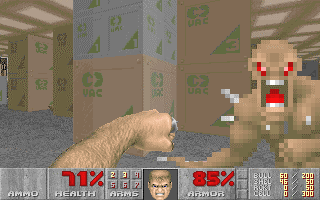
Doom: That was then (1993)
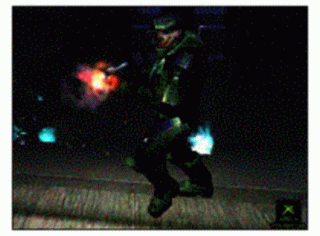
Halo: This is Now (2001)

Doom basically created a paradigm shift in the way gaming was played. Free blades (with reduced levels) got you hooked, better blades you were willing to pay for kept you begging for more, and suddenly a market for add-in sound and graphics cards opened up. People were willing to pay and pay and pay for the handles! Doom begot Quake , and Quake begot Max Payne and Halo ; suddenly, there was a huge market for graphics and sound cards - cards ostensibly manufactured to improve the gaming experience, but whose uses were more widespread.
"Games lubricate the body and the mind."
-Benjamin Franklin
A huge capital influx came into these very specialized chip manufacturers. From 3Dfx with the Voodoo, that arguably got everything going, to Yamaha. There were nearly 50 manufacturers of 3d graphics products in 1997. Now, realistically, there are only three - being, of course, ATI, NVIDIA, and Intel. Bit players include Matrox, Trident, SiS, ST Microelectronics and Via. In the first quarter of 1998, the majority of the market (71%) was dominated by a multitude of suppliers other than ATI and NVIDIA. During the third quarter of 2001, less than four years later, ATI, NVIDIA, and Intel make up 76% of the total desktop graphics chip market.
At the same time that most graphics chip companies were being squeezed out, the size of the overall market was growing at a fantastic rate. Not only is the pie split between fewer players, but the size of the pie is substantially larger, as shown by the chart below. In 1998, an estimated 115 million desktop graphics chips were shipped, compared to almost 170 million chips for 2001. By 2005, this number is expected to close in on 300 million graphics chips.