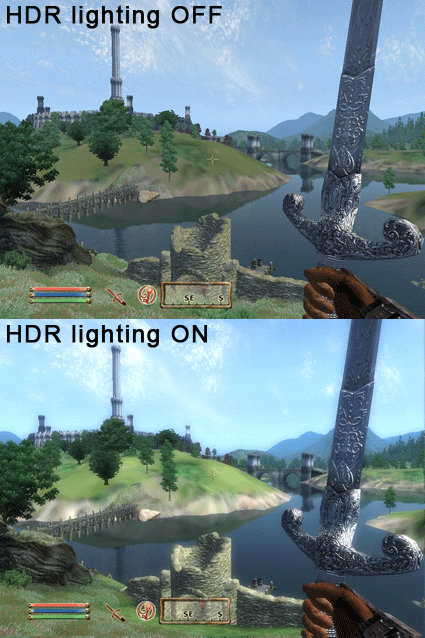
HDR Lighting & OpenEXR HDR
HDR stands for "High Dynamic Range." A video game with HDR lighting has the ability to display a much more realistic image than a game without HDR, and not all graphics cards are able to display HDR graphics.
Before DirectX 9 compliant graphics processors, graphics cards have been severely limited as far as the range of lighting precision they could calculate. All lighting up to this point had to be calculated to 8-bit (or 256) integer levels.
Once true DirectX 9 class graphics processors arrived, graphics cards had the ability to render a high range of lighting precision at a full 24 bit, or about 16.7 million levels.

With 16.7 Million levels of brightness and the increased computational power that DirectX 9 / Shader Model 2.0 compatible graphics cards brought to the table, HDR lighting in PC games became possible. HDR Lighting is a complex concept to describe, and it has to be seen in motion to be truly appreciated. A simplified explanation is that HDR lighting allows increased contrast (darker darks and brighter lights), while at the same time increasing the amount of lighting detail displayed in both the dark and bright areas. A video game that features HDR appears to have much more life-like lighting and depth compared to a game without HDR.
Graphics processors that comply with the latest Pixel Shader 3.0 specification allow for even more lighting precision (32 bit), and also have the capability to use floating-point precision blending. This means that all SM 3.0 graphics cards are capable of supporting a specific method of HDR called "OpenEXR," which is a specification developed for the movie industry.
Some games, which support only the OpenEXR method of HDR, do not support HDR on Shader Model 2.0 graphics cards. However, games supporting non-OpenEXR methods will work with any DirectX 9 graphics processor. For example, the PC game Oblivion sports OpenEXR HDR, and will only display this feature on new graphics cards, which support the Shader model 3.0 specification - Nvidia's GeForce 6800 or ATI's Radeon X1800 are examples. Games that are based on the Half-Life 2 3D engine such as Counter-Strike: Source and the upcoming Half-Life 2: Aftermath will allow HDR to be displayed with older DirectX 9 graphics cards that only support Pixel Shader 2.0. The GeForce 5 series or ATI's Radeon 9500 are examples here.
Finally, it should be noted that all forms of HDR require tremendous computational power and can bring all but the most powerful graphics processors and computer systems to a crawl. If you want to play the newest HDR-enabled games, high-performance graphics hardware is a must.