Surface Temperature: A Cool Affair
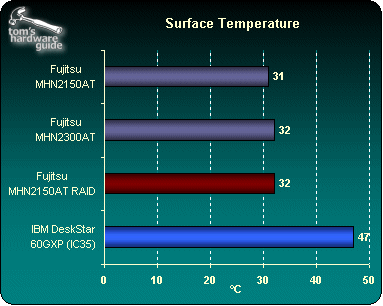
This is one of the great characteristics of notebook drives - they do not become hot at all. Thanks to the slow rotation speed of 4,200 rpm, the surface temperature of the 2.5" drives clearly remains below 40°C. Also, 2.5" drives only require a fractional amount of the power that is consumed by desktop drives. Spinning up the medium sometimes requires more than 35 Watts in standard hard drives, while notebook models can live with 15 Watts.
Conclusion: Great Performance With 2.5" Drives
The benchmark results are quite clear: only two 2.5" drives are able to outperform a modern desktop drive in terms of transfer performance - and without the high temperatures and obnoxious noise! Using three or more drives will take up the full bandwidth of any IDE RAID controller without increasing the noise level. This is an ideal configuration for users that want a computer which is both fast and quiet. Take, for example, the multitude of home servers that are connected to the Internet via DSL or ADSL - typically, these computers are situated in bedrooms or living rooms. Here, a quiet PC is invaluable.
This could be a way for notebook manufacturers to add value to their top models. What about a notebook that runs two 2.5" drives in an array (likely RAID 1) by default? Or imagine a docking station that comes with a second hard drive that automatically updates the data, resulting in excellent data security and significantly enhanced read performance. Ideas abound in this area.

As is often the case in life, the best things have their price - and this also applies to our 2.5" RAID array. In addition to the cost of the RAID controller, you will have to obtain two notebook drives that start at approx. $120 for a 20 GB model. Two drives will cost you at least $240, which is roughly the price for a single 80 GB or 100 GB desktop drive. And finally, consider the fact that a quiet drive is only useful if other components in your system are not overwhelmingly loud.
