Update 3: GeIL Retest Was Smooth
Having fixed the issues with our test systems, we repeated the stress testing of the GeIL DIMMs over the Easter weekend. We extended the run time to span four days, since Friday and Monday were public holidays for the guys in our Munich test labs. The retail bought memory crashed at a maximum clock speed of 465 MHz, which corresponds to DDR2-930. This also equals the maximum clock speed that we reached with GeIL's review samples. A DDR2-667 DIMM going up to DDR2-942 is impressive.

This is the last screenshot that was taken with the retail memory...
The retail memory achieved a clock speed of 471.35 MHz (DDR2-943), which is exactly the speed that we also reached with the review sample.


... and it is almost identical with the last still image of the review sample screen.
Our Omega measuring system tracks component temperatures during the stress test. Some of our readers noticed a temperature discrepancy between the retail bought memory and the samples we had received from GeIL. The reason for this discrepancy can be found in the fact that the thermal diodes are not placed at the exact same position on the DIMMs. In addition, environmental conditions may be slightly different between one test system and the other.

The maximum temperature for the retail memory was 36.96°C (98.53°F)

We placed a thermal diode onto the memory review sample. It showed a maximum temperature of 42.97°C (109.35°F).
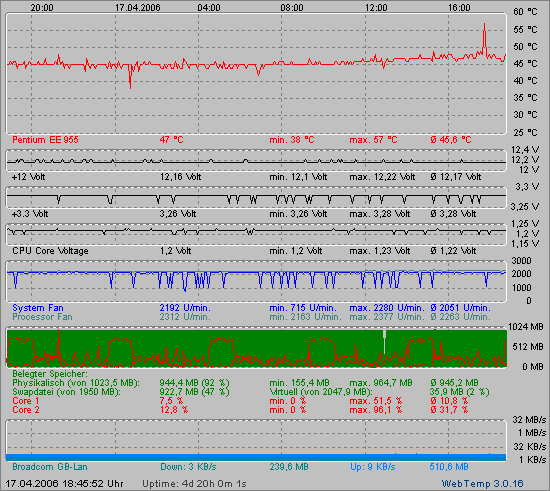
This is the stress test system statistic for the retail bought memory.
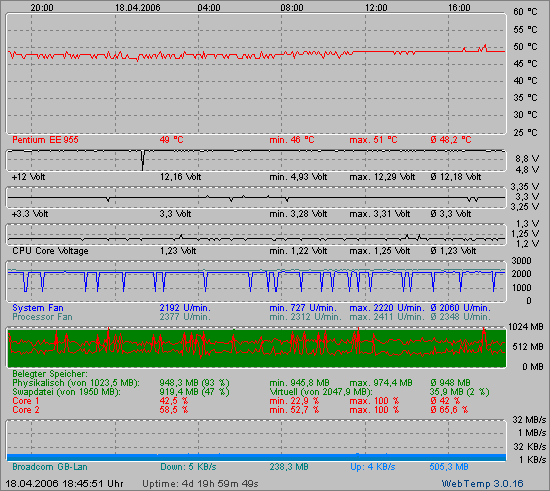
This statistic is for the review sample memory.