Join for quick access. Enter your email below and we'll send confirmation plus sign you up to our newsletter.
By submitting your information, you confirm you are aged 16 or over,
have read our
Privacy Policy
and agree to the
Terms & Conditions. Geographical rules apply.
Stay On the Cutting Edge: Get the Tom's Hardware Newsletter
Get Tom's Hardware's best news and in-depth reviews, straight to your inbox.
You are now subscribed
Your newsletter sign-up was successful
Join the club
Get full access to premium articles, exclusive features and a growing list of member rewards.
An account already exists for this email address, please log in.
GPU overclocker uses chilled car antifreeze and pond pump to push Intel card to sub-zero temps, sets world record — 'TrashBench' sets GPU benchmark record at -17C, gains 16% more performance
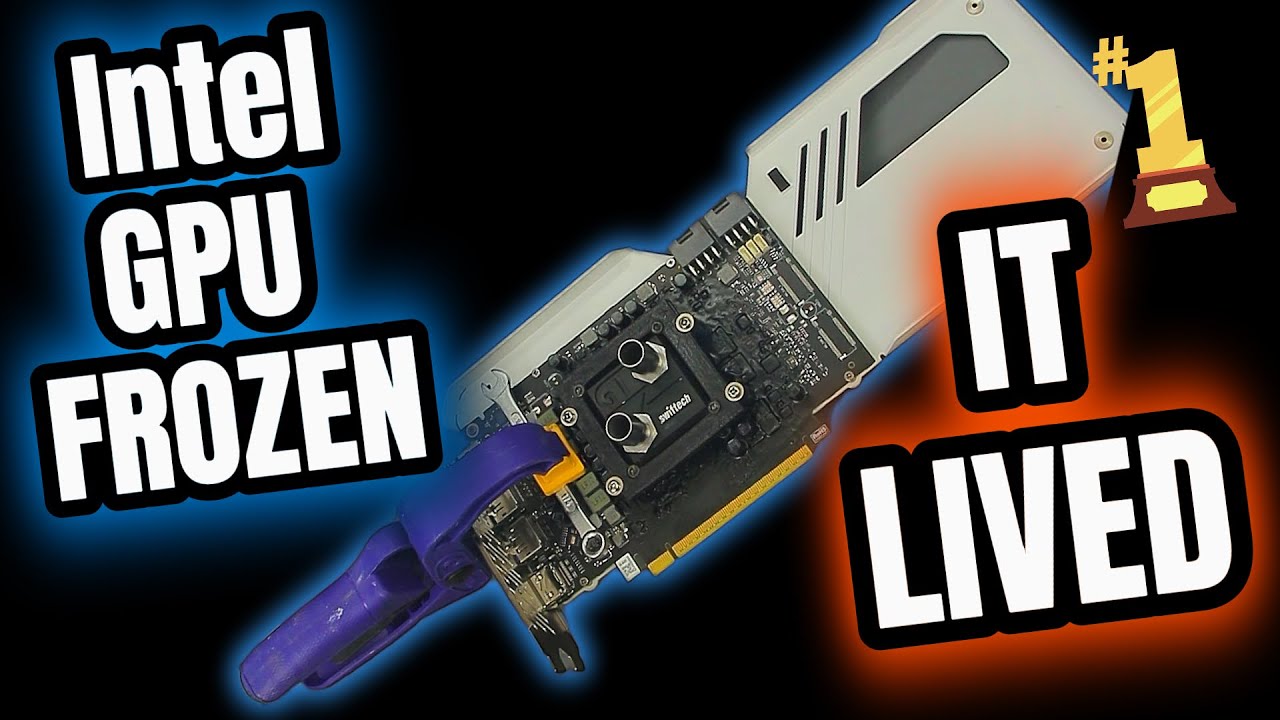
GPU overclocker TrashBench set a world overclocking record on an Intel Arc B580 GPU with a relatively simple setup. Instead of employing exotic solutions like liquid nitrogen, used by other overclockers to hit world records, he instead slapped on a pond pump and filled the custom loop with a 50/50 glycol mix of vehicle antifreeze that had been pre-chilled in a freezer. To his surprise, the GPU hit an incredible -17 degrees Celsius (that’s 1.4 degrees Fahrenheit), allowing him to push the performance of Intel’s top-of-the-line consumer GPU. According to the YouTube video, the car-coolant-chilled graphics card achieved a 3DMark Time Spy score of 16,631 — some 12% higher than a stock GPU, breaking the world record for the B580.
The mods TrashBench made to the GPU were rather simple, with the most complicated part being 3D-printing a custom mount to secure the water block. Trashbench notes that antifreeze remains liquid until roughly -25C, and he chilled the liquid in his freezer, which took it down to -17C. From there, he ran a couple of flexible tubes into an open cooler containing the pre-chilled glycol mix and turned on the pump to circulate it, allowing the graphics card to reach sub-zero temperatures.
I Froze Intel’s B580 GPU. It Should’ve Died. - YouTube
He also tested the Intel Arc B580 in its stock configuration, with the card hitting 2,850 MHz on air cooling alone. This delivered an average of 54, 158, and 107 FPS for Monster Hunter Wilds, Forza Horizon 5, and Cyberpunk 2077, respectively. But with the GPU running on sub-zero cooling, it achieved 3,316 MHz — some 446 MHz over stock performance or a 16.4% higher clock speed. Unfortunately, because the coolant eventually warmed up during testing, TrashBench wasn’t able to maximize its performance, but even so, the card still hit 69, 174, and 120 FPS in the three titles, giving it an average of 16% more FPS.
(Image credit: TrashBench / YouTube)
TrashBench's results show that with just air OC, the B580 achieved 3200 MHz, with the card hitting 60 FPS on Monster Hunter Wilds, 119 FPS on Cyberpunk 2077, and 172 FPS on Forza Horizon 5 at 1080p High settings. Although extreme cooling still seems to offer more FPS, it wasn't a huge gain over what you get without any of the hardware modifications.
Jowi Morales is a tech enthusiast with years of experience working in the industry. He’s been writing with several tech publications since 2021, where he’s been interested in tech hardware and consumer electronics.
This does not surprise me as antifreeze is designed to carry temp. Liquid nitrogen will get the die colder than hell but I bet it can not hold it there as effectively. Unless the unit is pressurized, a bubble of atmosphere is going to form on the die preventing liquid contact of the nitrogen (over time). antifreeze will not boil to gas going across a die.thoughts?
Raw antifreeze stays liquid well beyond -25°C. 50/50 blend that we mostly use here in finland can go about -36°C before it starts to freeze. Glycol is a crappy liquid to transfer heat, but there is very little alternatives for daily use. There's also some added anti rust and chemicals to prevent aluminium oxidation inside the engine.