









Ancient 3dfx Voodoo2 graphics card coaxed into working in modern AMD Ryzen 9 9900X-powered Windows 11 system — 12MB relic from 1998 successfully runs Quake 2 but crumbles in SLI configuration
It is great to see legendary old hardware that is still able to work in the latest PC systems.

It is great to see legendary old hardware that is still able to work in the latest PC builds. A prime example of old mingling with new in a magical way was provided by Omores on YouTube a few days ago. The TechTuber managed to coax their ancient Creative 3dfx Voodoo2 12MB graphics card to work in their cutting-edge AMD Ryzen 9 9900X-powered Windows 11 PC.
This is no simple feat. Nevertheless, you can see that Omores got a 1998 vintage 3D accelerator, using services written for a 1996 OS, with an experimental 64-bit driver from 2006, to run on a PC using an OS from 2011, powered by a processor from 2024.
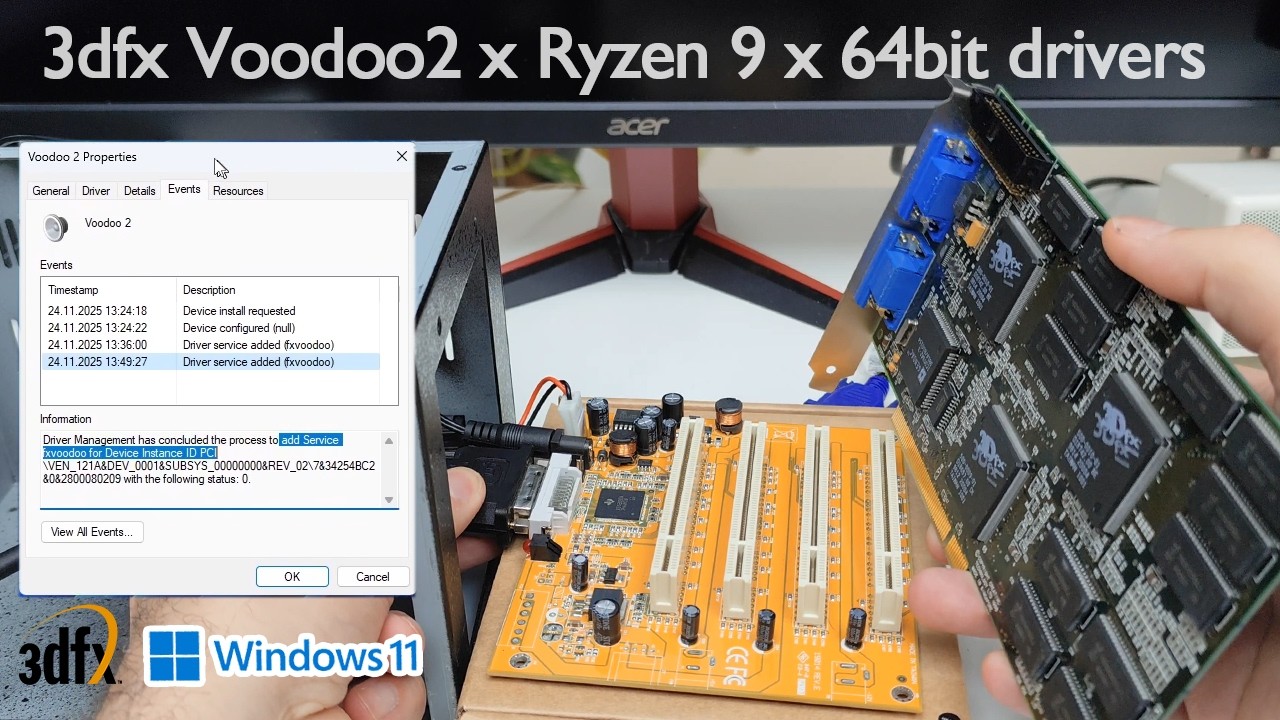
To kick off the above video, Omores pitched a simple question. Could a classic Voodoo2 graphics card work with modern hardware, and on Windows 11? “Sounds impossible,” because of the 64-bit driver necessity of Microsoft’s newest OS, the TechTuber openly pondered.
Omores then explained that he would be looking specifically at the Voodoo2, as the original Voodoo trips up with processors faster than 1.0 GHz, while the Voodoo2 doesn’t suffer any such limitations. Thus, mused the intrepid old-meets-new experimenter, a combination of the right drivers and a working PCI to PCIe connection should get the iconic 3dfx card and one of AMD’s latest and greatest platforms playing nicely together.
Instead of jumping in the deep end, Omores took viewers on a journey with this tech tale of May to September. After introducing the hardware solution that could physically get a 1998 3D accelerator hooked up to a modern AM5 motherboard system (a StarTech PCI-E to PCI enclosure), it was time to check OS/software compatibility.
First off, the unmatched hardware combo was shown working with Windows 98 installed on the system. This confirmed, with reference drivers, that the hardware side of the equation was fine. Further confirmation that this disparate hardware concoction posed no issues came from benchmarking in games/apps like Quake 2 and 3D Mark 2001 SE.
Next, Omores moved to Win 10 32-bit, the last 32-bit OS release from Microsoft. An enthusiast community developed 32-bit driver for the 3dfx was used here, and it worked well.
Get Tom's Hardware's best news and in-depth reviews, straight to your inbox.
Moving to Windows 10 64-bit would be more complicated. However, Omores explained that in 2006 a dev called Ryan Nun (AKA Colourless) published an experimental 3dfx Glide Project for x64 – based on research into original Win NT (1996) drivers. These new kernel drivers worked for Omores on a Win10 64-bit install, with a fix that was made for XP systems.
The TechTuber saw no real reason why Windows 11 shouldn’t work the same way after driver signature enforcement was removed. But, of course, things weren’t so simple. Surprisingly, a change of PCI slot cleared an early hiccup, getting the system to the same easily fixed error point where the Win 10 64-bit stalled (the Mapmem error).

“We now have a 3D accelerator from 1998, using a driver that relies on services written for Windows NT from 1996, successfully running in Windows 11 23H2,” wryly observed Omores. We’d add that the CPU was a powerful, ultra-modern one, from 2024.
Perhaps the TechTuber was pushing his luck by trying to run two Voodoo2s in SLI on the same system, next. Indeed, using his second Voodoo2, a Joytech Apollo 3D Fast II 12MB, which isn’t a perfect glitch-free runner, caused this delicately teetering concoction of hardware to topple in Windows 11.

Follow Tom's Hardware on Google News, or add us as a preferred source, to get our latest news, analysis, & reviews in your feeds.

Mark Tyson is a news editor at Tom's Hardware. He enjoys covering the full breadth of PC tech; from business and semiconductor design to products approaching the edge of reason.
-
Inflammableuser Ancient? Buddy, I'm not even 40 and I played with Voodoo2 cards when they were current. Antiques are defined as >99 years old. The word you're looking for is "vintage." Come on Mark, you're my age or older. Really dope, though.Reply -
Smuty Reply
Well it's ancient in general terms. But we are looking at computer tech, which is even more then ancient then. It's pretty much prehistoric. I wonder if I could find my prehistoric Voodoo 1 in the attic.Inflammableuser said:Ancient? Buddy, I'm not even 40 and I played with Voodoo2 cards when they were current. Antiques are defined as >99 years old. The word you're looking for is "vintage." Come on Mark, you're my age or older. Really dope, though. -
Inflammableuser Reply
28 years old. Computers existed 50 years before 1998. How is 28 years old "prehistoric" when computer technology existed 78 years ago?Smuty said:Well it's ancient in general terms. But we are looking at computer tech, which is even more then ancient then. It's pretty much prehistoric. I wonder if I could find my prehistoric Voodoo 1 in the attic.