Vintage 3dfx Voodoo 2 cards may inevitably fail due to pyroelectric capacitors — retrocomputing channel investigates and recommends preventive maintenance

heating up a capacitor
(Image credit: Bits und Bolts Youtube)

The 3Dfx Voodoo 2 and the Nvidia Riva TNT were the pinnacles of the early era of 3D graphics. Both were released in 1998, and while I owned the latter, the Voodoo 2 was the faster of the two, despite the inconvenience of requiring an existing 2D graphics card. The Voodoo 2 is naturally memorable, and it's a regular presence in retro PC builds. As the YouTube channel Bits und Bolts (Bits) found out, the cards' capacitors can and will fail in time due to the rarely discussed pyroelectric effect.

In a lengthy video, Bits diagnoses why one of his Voodoo 2 cards is intermittently failing with graphical corruption, with no apparent pattern other than the issues appearing after a short time of use. After much digging, he figures out that the problem seems related to the card's power-delivery circuitry by inspecting how resistance changed at the component that converts 5 V to 3.3 V.
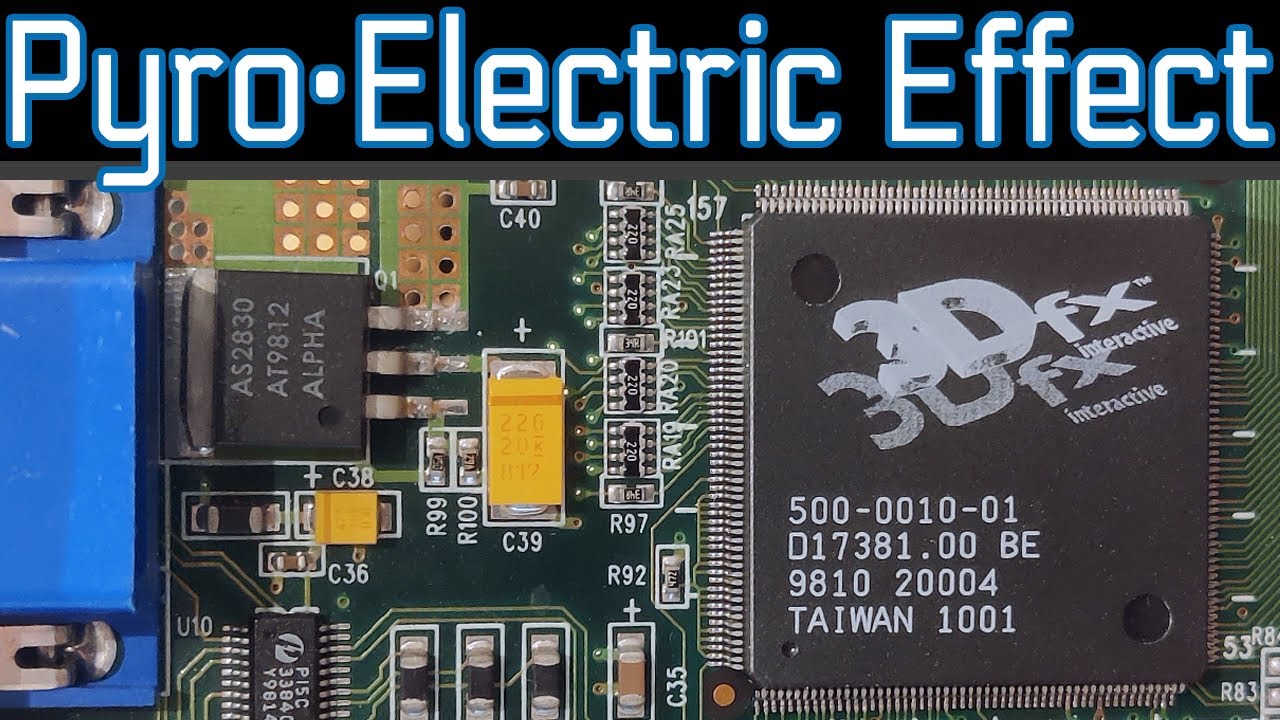
Voodoo2 Cards Are Dying! Do This Before It's Too Late! - YouTube Voodoo2 Cards Are Dying! Do This Before It's Too Late! - YouTube
Watch On

That led him on to figuring out that one or more of the capacitors in the power circuitry was a bit off. The parts in question are the small rectangular capacitors that you see scattered by the hundreds in any modern PCB, and they are usually a pain in the neck to diagnose. After a quick inspection with a thermal camera, Bits spotted a few that lit up and replaced them.

Unfortunately, they were not the only ones, and having to measure the circuit and each potential (pun intended) capacitor got old really quickly. So, after some research, he came up with a much faster method: point a heat gun at each capacitor along the path and see how the circuit reacts.

This method arose from the pyroelectric effect, a property of materials that causes their electrical properties to change as they heat up and cool down. Broadly speaking, a component within spec will have limited to no reaction, but capacitors do age. In the case of the Voodoo 2, they'll result in intermittent, hard-to-reproduce failures.

Bits goes on to point out that if you own a Voodoo 2 card, it's a good idea to do some preventive maintenance on it and replace capacitors along the power circuitry beforehand to avoid hours of diagnostics later — it's not a matter of if the capacitors will fail, simply when. It can be argued that this could also be done for most vintage electronics.

Google Preferred Source

Follow Tom's Hardware on Google News, or add us as a preferred source, to get our latest news, analysis, & reviews in your feeds.

Bruno Ferreira
Contributor

Bruno Ferreira is a contributing writer for Tom's Hardware. He has decades of experience with PC hardware and assorted sundries, alongside a career as a developer. He's obsessed with detail and has a tendency to ramble on the topics he loves. When not doing that, he's usually playing games, or at live music shows and festivals.

  • chaz_music
    It seems someone did an AI search on ceramic capacitor failure modes. A large part of my engineering work is to troubleshoot failures and I have never heard of the term pyroelectric failure before, although there is a piezoelectric effect that ceramics can have that makes them "sing". I even just did a search on the cap reliability sites and got no hits for that. If this is a true term, I would be interested in a source to research myself.

    Ceramic caps usually fail and get hot when cracked, which is usually caused by poor manufacturing. During assembly, the PCB and parts are to be preheated correctly before going through the IR oven process. Doing this step wrong leaves the parts with high mechanical stress across the part body after cool down, which slowly cracks the brittle passive parts. Ceramic caps are very brittle, so over time, ceramic caps start to break, creating internal low resistance shunt paths. And then they get hot.

    The larger the part, the more likely they will crack due to thermal stress. So the larger caps will break first. This is such a common and huge problem that some cap manufacturers have developed cap terminals that have "soft" structures to alleviate the mechanical stress. The PCB association IPC gives very good guidance on making sure this does not happen.
    Reply
  • ezst036
    This video was extremely fascinating.
    Reply
  • rmzalbar
    This article fails to understand its own subject material. Pyroelectric isn't a failure mode, it's the effect used to diagnostically detect the failure.

    If you broke your leg, your leg isn't failing due to "radiological bones." Rather, X-rays simply help reveal the fracture that is the actual failure.
    Reply
  • wakuwaku
    It's not a matter of if; rather when.
    Exactly. This is the problem that will eventually affect all Tom's people. There is no if, there is only when. They ALL seem to embarrass themselves over and over and over again with their extremely subpar articles that clearly uses AI to try and present professionalism, but end up backfiring.

    For goodness sake, people at Tom's
    Read the readers comments and fix yourselves. If not please, please quit. We readers deserve better than the same ol AI slop you guys are feeding us as every other site on this WWW right now.
    Reply
  • BFG-9000
    Apparently if you want articles without AI slop, they are in the section reserved for Tom's Hardware Premium members now.
    Reply