Nvidia Dawn and Dusk demo PC resurfaces alongside its original FX 5950 Ultra graphics card — state-of-the-art dream machine made gamers' hearts race in 2004

An enchanting artifact dating back to when Nvidia was firmly a gaming-first company has resurfaced on social media. Its reappearance is giving many seasoned PC enthusiasts pangs of nostalgia. Redditor Inclusive_3Dprinting has shown off a very nicely preserved Dawn and Dusk demo PC (circa 2004), resplendent with its original digital fairy artwork. Accompanying it, but not currently installed, is the original brass I/O bracketed GeForce FX5950 Ultra graphics card with pixie green heatspreader that powered the famous demo.

Some pictures of my Nvidia Dawn and Dusk demo machine + Brass FX5950 Ultra from r/pcmasterrace

“I took this home from work around 2005. It has a looping demo of Dawn and Dusk and a few other demos,” wrote the lucky Redditor. “It currently has a 7800 AGP inside it but I still have the original FX5950 Ultra. For some reason the card has a brass I/O plate, and a brass top rail decoration,” they explained. Then, to refresh the time-worn craniums of those who remember the nVidia Dusk Demo when it was a technical tour de force, Inclusive_3Dprinting shared the video below in breathtaking HD 720p.
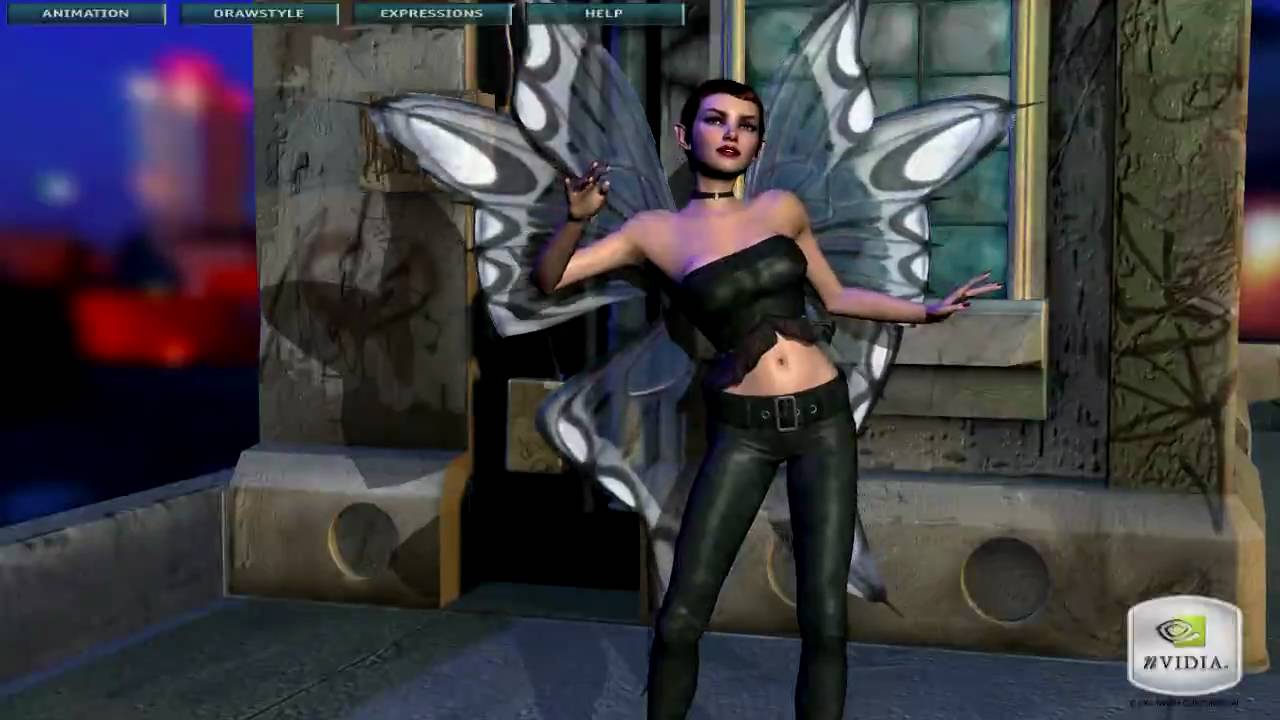
nVidia Dusk Demo (HD) - YouTube nVidia Dusk Demo (HD) - YouTube
Watch On

If you want a deeper trip down memory lane, Tom’s Hardware featured the Gigabyte GeForce FX 5950 Ultra graphics card back in January 2004. It looks identical to the sample that Inclusive_3Dprinting shows sitting beside their demo system, except for our review model’s white metal I/O bracket.

As we mentioned back in 2004, this card, featuring the Nvidia NV38 GPU with 256MB DDR RAM on a 256-bit bus, was built to make the most of the then-cutting-edge DirectX 9 API. It was bundled with titles from the Tomb Raider and Rainbow Six franchises to show off its capabilities.

Those wishing to test out the old Dusk demo, featuring Dawn’s racy twin sister, can still test it on their choice of hardware thanks to the Internet Archive preserving access to this 83.4MB demo. The Dusk demo showcased true-to-life skin and hair visuals, delivering the most realistic human-like real-time character animations of the era on consumer hardware.

At some period, lost in the sands of time, the Redditor swapped out the FX 5950 Ultra in favor of a GeForce 7800GS, which we reviewed in February 2006. It has remained with this upgrade ever since, but thankfully the original brass bracket card wasn’t lost to time.

Google Preferred Source

Follow Tom's Hardware on Google News, or add us as a preferred source, to get our latest news, analysis, & reviews in your feeds.

TOPICS
Mark Tyson
News Editor

Mark Tyson is a news editor at Tom's Hardware. He enjoys covering the full breadth of PC tech; from business and semiconductor design to products approaching the edge of reason.

  • gamerk316
    Ha, fun times. Those of us on a budget had to live with the FX5500 instead :/

    Although tbf, coming from a GeForce 2 MX 400, I thought it was the bomb at the time.
    Reply
  • M0rtis
    Oooh my first personal PC (non family common PC) had a Leadtek FX 5600. It worked pretty well but died in a year and a half only to be replaced by an ATI Radeon 9800 Pro which also only lasted long enough for my first playthrough of Oblivion. Knowing what I know now, maybe my shitty PSU was killing them off early.
    Reply
  • Notton
    If you want to see the other faces of the PC.
    I can't believe Shuttle still hosts these images.
    https://archive.shuttle.eu/2004/en/print_sn45g_duskndawn.htm
    Ah, that's nostalgic. The legendary? Shuttle SN45G.
    I never realized or may have forgotten they sold special editions of that case.

    nforce 1/2 were the chipsets that set AMD free from the death grip VIA KT266/333/400 chipsets had. You could reliably run them and suffer far fewer crashes, especially when overclocking. I think it was nforce2 which was one of the first where FSB could be run asynchronus to CPU clocks, making overclocking easier. As if that wasn't enough, you no longer needed a lead pencil to short some contacts on the CPU substrate for a fully unlocked CPU clock multipler.
    The sound quality, while no match for a soundblaster, was a huge improvement for onboard. The Nvidia drivers and software were far superior compared to VIA.
    SATA was just introduced, and you no longer had to play cable-origami with IDE ribbon cables for your HDD (Though SATA optical remained a rare beast for a while longer). Braided and detachable cables were not a thing that came stock, but the mod scene was just picking up on neatly organizing cables.
    RGB was not called RGB. Instead it was a single color neon CFL tube running off of a 15kVAC inverter integrated into a manual fan speed controller.
    There was no tempered glass, instead it was all transparent plastic... (If you want to see what that looked like... they show up in the movie Stealth (2005))

    Geforce FX5950 was the fix for the infamous "Dust Buster" FX5800 Ultra.
    Both nvidia cards couldn't quite keep up to the ATI 9800 XT and 9700 Pro, respectively, at which point nvidia pulled some image quality optimizations shenanigans to try and win back the crown.
    Reply
  • KryptonQuark
    Pure vibes of Nostalgia ! ! !
    Reply
  • call101010
    Notton said:
    If you want to see the other faces of the PC.
    I can't believe Shuttle still hosts these images.
    https://archive.shuttle.eu/2004/en/print_sn45g_duskndawn.htm
    Ah, that's nostalgic. The legendary? Shuttle SN45G.
    I never realized or may have forgotten they sold special editions of that case.

    nforce 1/2 were the chipsets that set AMD free from the death grip VIA KT266/333/400 chipsets had. You could reliably run them and suffer far fewer crashes, especially when overclocking. I think it was nforce2 which was one of the first where FSB could be run asynchronus to CPU clocks, making overclocking easier. As if that wasn't enough, you no longer needed a lead pencil to short some contacts on the CPU substrate for a fully unlocked CPU clock multipler.
    The sound quality, while no match for a soundblaster, was a huge improvement for onboard. The Nvidia drivers and software were far superior compared to VIA.
    SATA was just introduced, and you no longer had to play cable-origami with IDE ribbon cables for your HDD (Though SATA optical remained a rare beast for a while longer). Braided and detachable cables were not a thing that came stock, but the mod scene was just picking up on neatly organizing cables.
    RGB was not called RGB. Instead it was a single color neon CFL tube running off of a 15kVAC inverter integrated into a manual fan speed controller.
    There was no tempered glass, instead it was all transparent plastic... (If you want to see what that looked like... they show up in the movie Stealth (2005))

    Geforce FX5950 was the fix for the infamous "Dust Buster" FX5800 Ultra.
    Both nvidia cards couldn't quite keep up to the ATI 9800 XT and 9700 Pro, respectively, at which point nvidia pulled some image quality optimizations shenanigans to try and win back the crown.
    I had ATI 9500 modded to become 9700 pro !!!
    Reply