After going in-depth on its Panther Lake series CPUs late last year, Intel is finally ready to start rolling them out. At CES 2026, the company announced 14 SKUs to kick off the Core Ultra Series 3 generation, including three SKUs that have the new X9 or X7 designation to note a larger included GPU with 12 Xe3 cores (read our deep dive on the Xe3 graphics architecture).
Intel already revealed the top-line specs for the Panther Lake range in October, but now we have a more comprehensive breakdown of all of the options that will be available later this month. Intel says that Panther Lake systems will be available to preorder tomorrow, January 6, with global availability starting on January 27 and continuing throughout the first half of the year.


If you missed our deep dive on Panther Lake in October, it’s the first range of chips from Intel to use its highly-publicized 18A process. This node brings two innovations that Intel has been talking about for years at this point; gate-all-around (GAA) transistors and a backside power delivery network called PowerVia. The compute tile for Panther Lake chips is built on 18A with a mixture of up to three core types. The compute tile comes with up to four Cougar Cove performance cores, up to eight Darkmont efficiency cores, and up to four low-power Darkmont efficiency cores. Those low-power cores live on what Intel calls a “low-power island,” isolating them from the relatively power-hungry P-cores to improve efficiency on low-lift workloads.
Article continues belowIntel has used this low-power island since it introduced its first disaggregated mobile chips with Meteor Lake, but it wasn’t until Lunar Lake that it brought forth a further “low-power” designation for those cores. Like Lunar Lake, the low-power island in Panther Lake has its own power rail. As we saw in the previous generation, that leads to better battery life, as the chip doesn’t need to tap the main cluster of P-cores and E-cores as often.
Intel hasn’t provided a swath of benchmarks for Panther Lake chips yet, but broadly, it says Panther Lake delivers more than 10% higher single-threaded performance at ISO power, and more than 50% higher multi-threaded performance in the same power envelope compared to Lunar Lake. The massive multi-threaded jump isn’t surprising, however; Lunar Lake topped out with just eight cores, while Panther Lake can scale up to 16.
In addition to the 14 SKUs Intel revealed at CES, it also announced that Panther Lake will eventually make its way all the way to the edge. Intel says it has tested and certified Panther Lake for embedded applications like robotics, automation, and healthcare. Details are sparse about edge implementations of Panther Lake right now, but Intel says embedded systems will begin showing up in the second quarter of 2026.
Intel Core Ultra Series 3 ‘Panther Lake’ specifications
Enough preamble; let’s get to the specs. Intel has 14 SKUs, so the tables below are dense, and there are a few details we’re still waiting on, namely the core split. When looking at core counts, keep in mind that Panther Lake comes with up to four P-cores, eight E-cores, and four low-power E-cores.
Out of the 14 SKUs, three of them carry the new X-series branding, with a single X9 and two X7s. There’s an honorary X5, as well, but Intel isn’t using that nomenclature.
| Row 0 - Cell 0 | Core Ultra X9 388H | Core Ultra 9 386H |
Core Count (P + E + LP-E) | 16 (4 + 8 + 4) | 16 (4 + 8 + 4) |
Max P-Core Frequency | 5.1 GHz | 4.9 GHz |
Intel Smart Cache (L3 Cache) | 18MB | 18MB |
NPU TOPS | 50 | 50 |
Graphics Brand | Arc B390 | Intel Graphics |
Xe Cores | 12 | 4 |
Platform PCIe Lanes (Gen 5 / Gen 4) | 12 (4 / 8) | 20 (12 / 8) |
Thunderbolt | Four Thunderbolt 4 ports, Thunderbolt 5 support | Four Thunderbolt 4 ports, Thunderbolt 5 support |
Wireless Connectivity | Wi-Fi 7 R2, Bluetooth Core 6 | Wi-Fi 7 R2, Bluetooth Core 6 |
Max Memory Speed and Capacity | 96GB LPDDR5x-9600 | 96GB LPDDR5x-8533 / 128GB DDR5-7200 |
Base / Turbo Power | 25W / 65W, 80W | 25W / 65W, 80W |
There are only two Core Ultra 9 SKUs, and they’re almost identical short of the graphics. For the first time, Intel is bringing its iGPU naming convention in-line with its desktop Arc offerings. The Core Ultra X9 388H gets the Arc B390 GPU that comes with 12 Xe3 cores. For context, Lunar Lake topped out with eight Xe2 cores, as did Arrow Lake-H with the Arc 140T. Intel is devoting a lot more die space to the iGPU on these X-series chips regardless of architectural improvements.
These two SKUs bring up a couple of important specs to pay attention to. First, PCIe lanes. Intel supports up to 20 PCIe lanes with a 12 / 8 split across Gen 5 and Gen 4, but on the X9 388H, it looks like eight of those lanes are going to the GPU. In addition, Panther Lake supports both LPDDR5x and DDR5 depending on if OEMs would rather favor speed or capacity, but the X-series models are locked to LPDDR5x.


For performance, Intel claims the Core Ultra X9 388H offers “up to” 60% higher multi-threaded performance in Cinebench 2024 compared to the Core Ultra 9 288V, with both chips running at 25W. More importantly, Intel claims up to a 76% improvement in gaming performance compared to the Core Ultra 9 285H. That number comes from a geomean of 45 games, tested at 1080p with 2X resolution scaling for XeSS in supported titles, according to Intel.
Arrow Lake-H boosts all the way up to 115W, and it appears these numbers aren’t based on ISO power. We’re waiting on confirmation, but it looks like Panther Lake is delivering that level of performance despite a much lower peak power draw.
All Panther Lake chips support Intel’s latest XeSS 3, but you’ll likely be able to take better advantage of it with the X-series parts. In addition to upscaling, XeSS 3 includes multi-frame generation, similar to Nvidia’s DLSS 4.


The competitive comparisons stand out even more. Intel claims Panther Lake can beat AMD's HX 370 by over 80% with native rendering, and by 73% when adding upscaling into the mix. Compared to a laptop with a discrete RTX 4050, the integrated GPU in the Core Ultra X9 388H offers similar performance. Intel has been trying to close the gap with entry-level graphics for years, and Panther Lake might actually make that a reality.
Although that's the goal, Intel clarified that it sees Panther Lake has an entry-level replacement, not as the future of mobile gaming. Even so, Intel is launching a dedicated handheld platform to support OEMs with Panther Lake, which we should learn more about later in the year.
| Row 0 - Cell 0 | Core Ultra X7 368H | Core Ultra 7 366H | Core Ultra 7 365 | Core Ultra X7 358H | Core Ultra 7 356H | Core Ultra 7 355 |
Core Count (P + E + LP-E) | 16 (4 + 8 + 4) | 16 (4 + 8 + 4) | 8 ( 4 + 0 + 4) | 16 (4 + 8 + 4) | 16 (4 + 8 + 4) | 8 ( 4 + 0 + 4) |
Max P-Core Frequency | 5 GHz | 4.8 GHz | 4.8 GHz | 4.8 GHz | 4.7 GHz | 4.7 GHz |
Intel Smart Cache (L3 Cache) | 18MB | 18MB | 12MB | 18MB | 18MB | 12MB |
NPU TOPS | 50 | 50 | 49 | 50 | 50 | 49 |
Graphics Brand | Arc B390 | Intel Graphics | Intel Graphics | Arc B390 | Intel Graphics | Intel Graphics |
Xe Cores | 12 | 4 | 4 | 12 | 4 | 4 |
Platform PCIe Lanes (Gen 5 / Gen 4) | 12 (4 / 8) | 20 (12 / 8) | 12 (4 / 8) | 12 (4 / 8) | 20 (12 / 8) | 12 (4 / 8) |
Thunderbolt | Four Thunderbolt 4 ports, Thunderbolt 5 support | Four Thunderbolt 4 ports, Thunderbolt 5 support | Four Thunderbolt 4 ports | Four Thunderbolt 4 ports, Thunderbolt 5 support | Four Thunderbolt 4 ports, Thunderbolt 5 support | Four Thunderbolt 4 ports |
Wireless Connectivity | Wi-Fi 7 R2, Bluetooth Core 6 | Wi-Fi 7 R2, Bluetooth Core 6 | Wi-Fi 7 R2, Bluetooth Core 6 | Wi-Fi 7 R2, Bluetooth Core 6 | Wi-Fi 7 R2, Bluetooth Core 6 | Wi-Fi 7 R2, Bluetooth Core 6 |
Max Memory Speed and Capacity | 96GB LPDDR5x-9600 | 96GB LPDDR5x-8533 / 128GB DDR5-7200 | 96GB LPDDR5x-7467 / 128GB DDR5-6400 | 96GB LPDDR5x-9600 | 96GB LPDDR5x-8533 / 128GB DDR5-7200 | 96GB LPDDR5x-6800 / 128GB DDR5-6400 |
Base / Turbo Power | 25W / 65W, 80W | 25W / 65W, 80W | 25W / 55W | 25W / 65W, 80W | 25W / 65W, 80W | 25W / 55W |
The Core Ultra 7 lineup is more robust with six total SKUs, two of which carry the Arc B390. Here, we can see the first chips that drop the H suffix, which have a lower peak power rating, along with a reduced core count and L3 cache size. The eight-core design on Panther Lake cuts out the E-core cluster entirely for a split between P-cores and low-power E-cores. These SKUs also drop Thunderbolt 5 support, though they still come with the same four integrated Thunderbolt 4 connections as the rest of the stack.

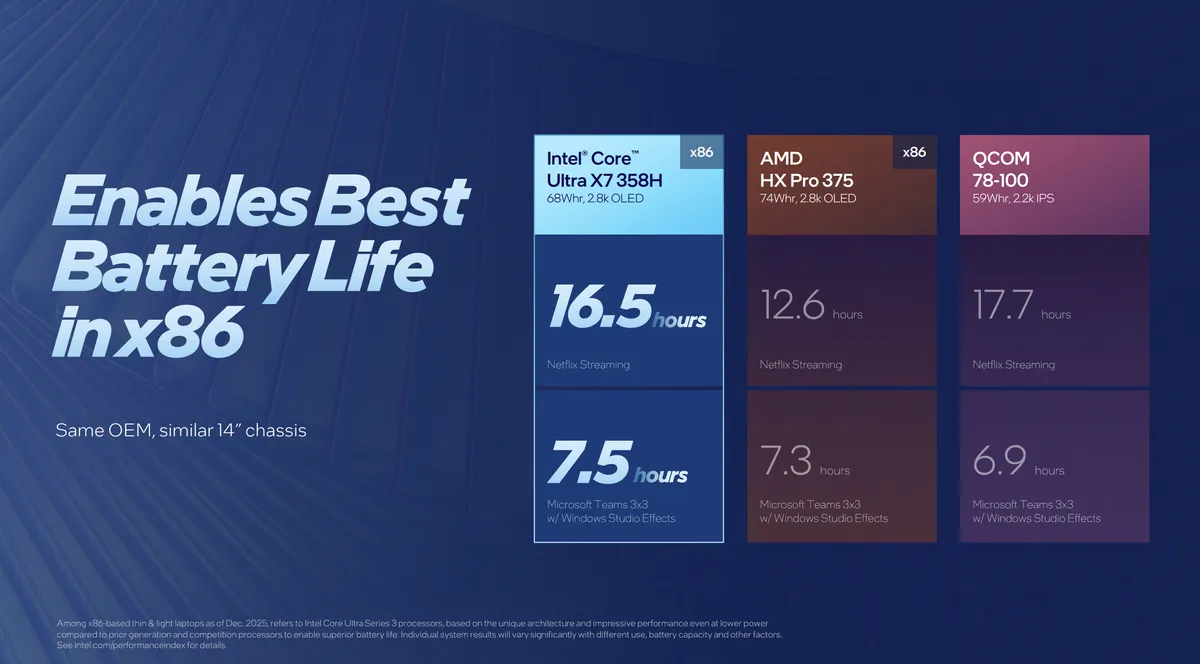


Intel’s goal with Panther Lake was to provide the performance of Arrow Lake-H and the efficiency of Lunar Lake in a single package. We’ll have to wait until the processors are here to see if that’s the case, but the specs certainly look like Intel splitting the difference between the two series.The chips sport the same 25W base TDP as Arrow Lake-H, but they top out much lower; Arrow Lake-H boosted to 115W, while Arrow Lake-HX climbed as high as 160W. If Intel is able to stick the landing with its performance claims, it could be a watershed moment for its mobile lineup, which has struggled to nail a balance between peak performance and multi-day efficiency in the past few generations.
For the Core Ultra 9 and 7 lineups, as well as two of the Core Ultra 5s, Intel has a configurable power design. The range has a base power of 25W and a maximum turbo power of 65W. However, OEMs can instead opt for a base power of 45W and a maximum turbo power of 80W.
| Row 0 - Cell 0 | Core Ultra 5 338H | Core Ultra 5 336H | Core Ultra 5 335 | Core Ultra 5 325 | Core Ultra 5 332 | Core Ultra 5 322 |
Core Count (P + E + LP-E) | 12 (4 + 4 + 4) | 12 (4 + 4 + 4) | 8 ( 4 + 0 + 4) | 8 ( 4 + 0 + 4) | 8 ( 4 + 0 + 4) | 8 ( 4 + 0 + 4) |
Max P-Core Frequency | 4.7 GHz | 4.6 GHz | 4.6 GHz | 4.5 GHz | 4.4 GHz | 4.4 GHz |
Intel Smart Cache (L3 Cache) | 18MB | 18MB | 12MB | 12MB | 12MB | 12MB |
NPU TOPS | 47 | 47 | 47 | 47 | 46 | 46 |
Graphics Brand | Arc B370 | Intel Graphics | Intel Graphics | Intel Graphics | Intel Graphics | Intel Graphics |
Xe Cores | 10 | 4 | 4 | 4 | 2 | 2 |
Platform PCIe Lanes (Gen 5 / Gen 4) | 12 (4 / 8) | 20 (12 / 8) | 12 (4 / 8) | 12 (4 / 8) | 12 (4 / 8) | 12 (4 / 8) |
Thunderbolt | Four Thunderbolt 4 ports, Thunderbolt 5 support | Four Thunderbolt 4 ports, Thunderbolt 5 support | Four Thunderbolt 4 ports | Four Thunderbolt 4 ports | Four Thunderbolt 4 ports | Four Thunderbolt 4 ports |
Wireless Connectivity | Wi-Fi 7 R2, Bluetooth Core 6 | Wi-Fi 7 R2, Bluetooth Core 6 | Wi-Fi 7 R2, Bluetooth Core 6 | Wi-Fi 7 R2, Bluetooth Core 6 | Wi-Fi 7 R2, Bluetooth Core 6 | Wi-Fi 7 R2, Bluetooth Core 6 |
Max Memory Speed and Capacity | 96GB LPDDR5x-8533 | 96GB LPDDR5x-8533 / 128GB DDR5-7200 | 96GB LPDDR5x-7467 / 128GB DDR5-6400 | 96GB LPDDR5x-7467 / 128GB DDR5-6400 | 96GB LPDDR5x-7467 / 128GB DDR5-6400 | 96GB LPDDR5x-7467 / 128GB DDR5-6400 |
Base / Turbo Power | 25W / 65W, 80W | 25W / 65W, 80W | 25W / 55W | 25W / 55W | 25W / 55W | 25W / 55W |
Most of the Core Ultra 5 lineup ditches the H suffix, opting for lower power draw and a drop down to eight cores. The most interesting chip here is the Core Ultra 5 338H. It doesn’t carry the X-series branding, but it comes with a branded iGPU (the Arc B370), along with 10 Xe3 cores. We don’t have any Core Ultra 3 SKUs yet, but those usually arrive six months to a year after the initial product stack.
There are some features that reach across the entire stack. Wi-Fi 7 R2 and Bluetooth Core 6.0 are standard, as is XeSS, including multi-frame generation and Intel’s Endurance Gaming Mode for maximizing battery life. All of the chips also use Intel’s NPU 5 for up to 50 TOPS on the NPU, along with IPU 7.5, enabling higher resolutions on internal webcams.

Follow Tom's Hardware on Google News, or add us as a preferred source, to get our latest news, analysis, & reviews in your feeds.