Back in 2023. a few months after the RTX 40 series had launched, speculation over an RTX Titan coming out in that generation was sky-high. Ultimately, it was never released, which only built up the myths of this GPU that has since slowly become less and less mysterious through prototype leaks. One of those prototypes is in the hands of community legend Roman 'der8auer' Hartung, who's benchmarked it previously, but he's now finally taken it apart to show us what's inside.
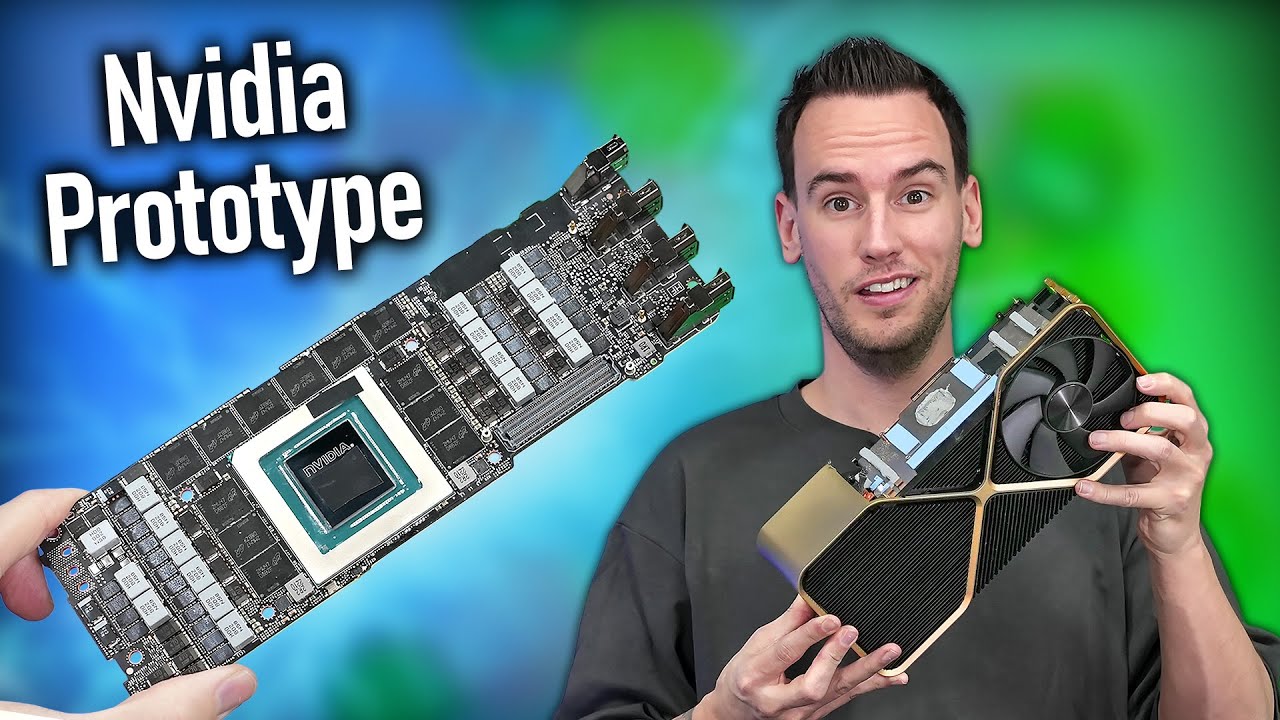

Der8auer remarks how unique this design is, and would've been for its time had it actually launched before the RTX 5090, like it was clearly planned to at one point. The card is gigantic, feeling almost comically large in our host's hands, since it's a monstrous quad-slot design.
Article continues belowThis can be confirmed by just looking toward the back, which houses the vertically stacked I/O in the form of 3x Display Port 1.4a and 1x HDMI 2.1 — these are actually soldered onto the mainboard as you'll see later, unlike how the RTX 5090 FE handles them via a daughterboard. Anyhow, unscrewing the I/O shield here is the first step of getting inside the card.

Image credit: der8auer on YouTube

Image credit: der8auer on YouTube
Once removed, you can see a parting line where der8auer wedges a screwdriver that separates the side plate previously held by the I/O shield. The side plate eventually comes off, and it has heatpipes running through the back with thermal pads placed to make contact with components on the PCB like the memory and VRM controller.

Image credit: der8auer on YouTube

Image credit: der8auer on YouTube

Image credit: der8auer on YouTube
That brings us to the main attraction, the actual PCB, which is mounted on the side of the card, similar to the RTX 4090 Ti prototype we looked at a while ago. The PCB has 12x 2GB GDDR7 memory modules on the top side that's visible right now, with 12x more on the back, for a combined total of 48GB VRAM.

Now, to get the PCB out, the center frame of the GPU needs to be removed, so the card is flipped over and the large silver "X" plastered across the chassis is carefully taken apart. Underneath this are channels hiding the fan ribbon cables that also need to be plugged out from both ends: one in the center of the top frame, and the other connected to the side of the main PCB.


Lastly, there are some more screws on the mainboard, eventually leading to the spring mechanism in the center, which was taken apart off-camera to conceal part numbers to protect the source. The PCB is finally separated from the rest of the chassis, and it's a dense piece of engineering marvel that will impress even Apple engineers, with the AD102 GPU gloriously sitting in the middle.

Unlike a traditional GPU that has the PCIe x16 connector as part of the mainboard, we can see ribbon cables emanating from one side holding a daughterboard for the PCIe, sort of like how a riser cable looks in a vertical GPU mount. Toward the right of the board are the aforementioned display ports, but toward the left are three contact points for the power supply and these are really cool.


There are contact points built into the cooler of this Titan Ada prototype that touch these contact points and provide power. Der8auer says one of the points is likely for ground while the other two are for each of the 12VHPWR connections. Above those dangle the sense pins that were disconnected from the PCB as well.
The final step remaining is to separate the heatsink from the aluminum frame since everything has been removed, which slides off nicely because it's essentially friction-fit at this point. Now that we get a clear look at all the innards, der8auer shows us all the cables running around the perimeter of this chassis, hidden by endless, segregated panels and side pieces that were taken apart till now.

Image credit: der8auer on YouTube

Image credit: der8auer on YouTube

Image credit: der8auer on YouTube
With the entire graphics card disassembled, der8auer said it took him one and a half hours to put it back together, and he had to scrub through footage just to make sure he didn't miss a screw here or there. He once again commends Nvidia's engineering efforts, saying the RTX 5090 and this RTX Titan Ada prototype are the most impressive GPUs he's ever seen.

Follow Tom's Hardware on Google News, or add us as a preferred source, to get our latest news, analysis, & reviews in your feeds.