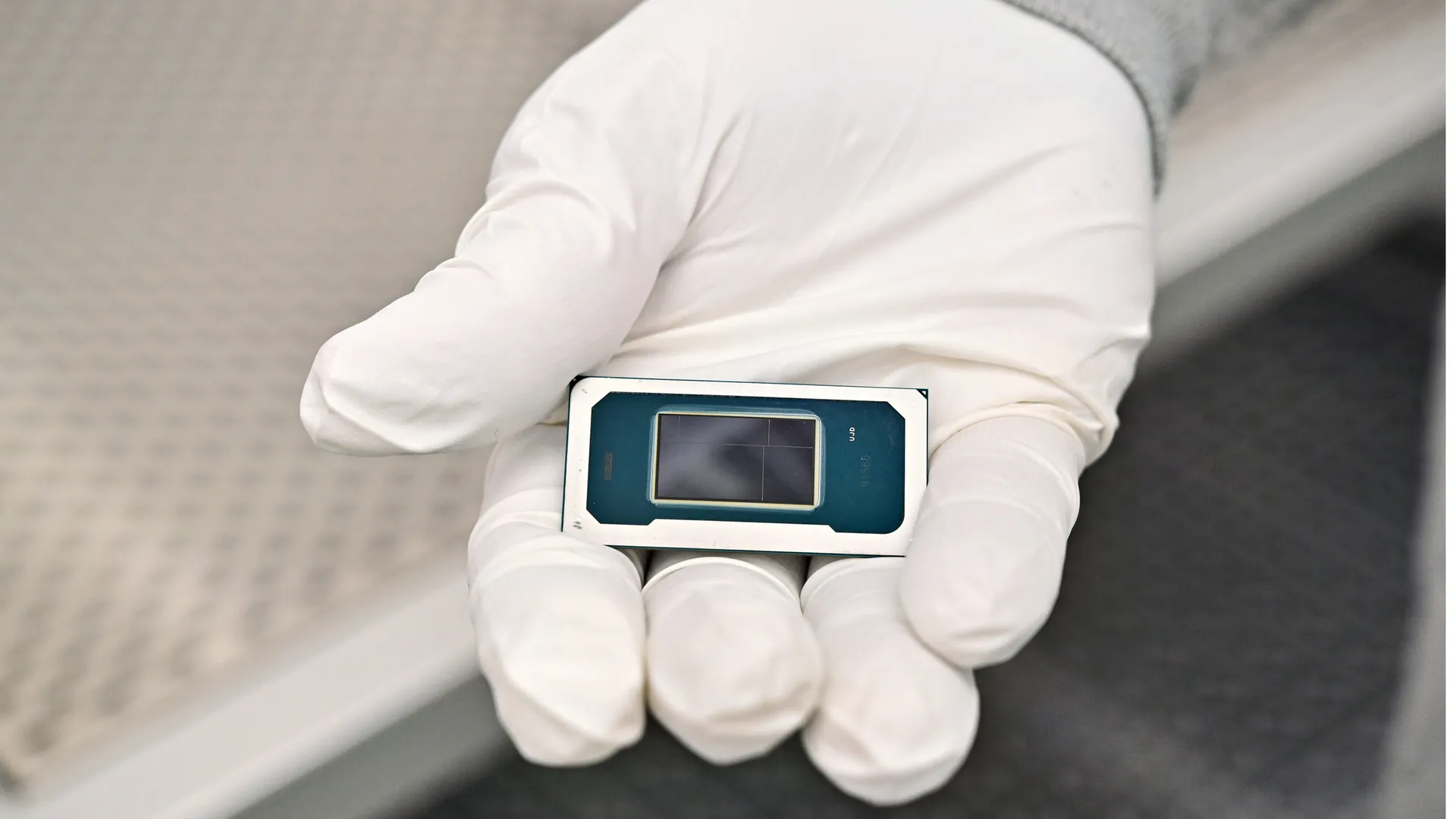
Intel's upcoming Core Ultra X9 388H is up to 8.7% faster for 1T perf than Ryzen AI Max+ 395 — Panther Lake gains significant ground on Strix Halo in early Geekbench leak

Intel
(Image credit: Intel)

Intel didn't talk about Panther Lake performance in detail when it took the wraps off its first 18A processors a bit ago, but a possible flagship SKU from the lineup — the Core Ultra X9 388H — has just appeared on Geekbench, and the scores are quite impressive. They not only one-up Intel's outgoing chips, but match AMD's top-end Strix Halo offerings as well.

Intel Core Ultra X9 388H Geekbench listing

(Image credit: Future)

That all is impressive enough, but compared to Ryzen AI Max+ 395, AMD's best mobile chip right now, the X9 388H's multi-core score is within the margin of error, but the single-core numbers are 8.7% ahead. The Geekbench listing also shows the CPU boosting to 5.1 GHz. Check out the table at the end of the article for a detailed breakdown.

These are exceptional values for a CPU that fits into an even tighter thermal envelope than Strix Halo. The X9 388H has a 45W default TDP versus the Ryzen AI Max+ 395's 55W default.

For some more context, the X9 388H is the highest-spec'd model from Panther Lake we've seen so far, featuring 16 cores in a 4P + 8E + 4 LP-E config, with no Hyper-Threading. The SKU also has the "X" designation because it features 12 Xe3 iGPU cores, but that's beyond the scope of this leak, though we've covered Panther Lake graphics before.

Panther Lake isn't supposed to come out until early next year, but excitement for the release is already dimmed. As it stands right now, surging memory prices may result in insane markups on laptops and other mobile devices featuring Panther Lake parts, no matter how impressive the SoC itself may or may not be.

Also, keep in mind that each Geekbench listing is different, so we have to wait for more benchmarks to come out before an average can be formed, but the first impressions with this leak sure do look great.

Swipe to scroll horizontally
AMD & Intel Geekbench Scores

SKU

Single-Core ↑

Multi-Core

Core Count

Compared to X9 388H

Intel Core Ultra X9 388H

3,057

17,687

16 Cores (4P+8E+4LP-E)

Intel Core Ultra 9 275HX

2,848

17,922

24 Cores (8P+16E)

SC: -6.8% | MC: +1.3%

AMD Ryzen AI Max+ 395

2,792

17,669

16 Cores

SC: -8.7% | MC: -0.1%

AMD Ryzen 9 7945HX

2,765

16,092

16 Cores

SC: -9.6% | MC: -9.0%

AMD Ryzen AI Max 390

2,740

16,850

12 Cores

SC: -10.4% | MC: -4.7%

Intel Core Ultra 9 285H *

2,604

14,796

16 Cores (6P+8E+2LP-E)

SC: -14.8% | MC: -16.4%

Intel Core Ultra 7 255H

2,535

13,519

16 Cores (6P+8E+2LP-E)

SC: -17.1% | MC: -23.6%

Google Preferred Source

Follow Tom's Hardware on Google News, or add us as a preferred source, to get our latest news, analysis, & reviews in your feeds.

Hassam Nasir
Contributing Writer

Hassam Nasir is a die-hard hardware enthusiast with years of experience as a tech editor and writer, focusing on detailed CPU comparisons and general hardware news. When he’s not working, you’ll find him bending tubes for his ever-evolving custom water-loop gaming rig or benchmarking the latest CPUs and GPUs just for fun.

  • User of Computers
    wait for reviews. Geekbench isn't everything for performance.
    Reply
  • George³
    Much less memory bandwidth but more bandwidth per performance core, because its are only 4 in this Intel, hmm, APU.
    Reply
  • bit_user
    The article fails to compare it to Fire Range, which is the actual top-line AMD laptop processor. Ryzen AI Max gets lots of attention, due to its wide memory bus and updated & enlarged IO Die, but it's actually slower than laptop CPUs like the Ryzen 9 9955HX and 9955HX3D.
    Reply
  • Gururu
    bit_user said:
    The article fails to compare it to Fire Range, which is the actual top-line AMD laptop processor. Ryzen AI Max gets lots of attention, due to its wide memory bus and updated & enlarged IO Die, but it's actually slower than laptop CPUs like the Ryzen 9 9955HX and 9955HX3D.
    I know it was an early score as this is, but the 9955HX3D scored 3165/19858 in Mar 2025.
    Reply
  • usertests
    bit_user said:
    The article fails to compare it to Fire Range, which is the actual top-line AMD laptop processor. Ryzen AI Max gets lots of attention, due to its wide memory bus and updated & enlarged IO Die, but it's actually slower than laptop CPUs like the Ryzen 9 9955HX and 9955HX3D.
    Seems Intel will get an efficiency win with Panther Lake, no matter what. They'll also win in integrated graphics with 10-12 Xe3 core models. All AMD can do is throw Zen 5 refreshes at it. They could also sell them cheaper, if possible.

    9955HX = 5.4 GHz turbo. Ryzen AI Max 395+ = 5.1 GHz turbo.

    Maybe Zen 6 will be the generation of 6 GHz mobile parts.
    Reply
  • bit_user
    usertests said:
    Seems Intel will get an efficiency win with Panther Lake, no matter what.
    Quite likely, outside of things where AVX-512 can give Zen 5 an advantage. Zen 5 can't overcome that node disadvantage, but I am eager to see a comparison on some truly MT workload, like rendering. In something like that, even without AVX-512, Ryzen AI Max will still likely beat Panther Lake.

    While the GeekBench 6 MT composite score is basically useless, the sub scores are more interesting. There, the Panther Lake listing shows a Ray tracing score of 29748. In contrast, if I find a Ryzen AI Max 395+ entry with roughly the same ST & MT scores as cited in the article, it gets 31878.

    BTW, I wonder what's their methodology for choosing scores from the comparison systems, because there are definitely higher-scoring Ryzen AI Max 395+ entries. Does Geek Bench's site have some histogram feature for letting you pick a characteristic value, or is it just whatever the author happens to choose?
    Reply
  • timsSOFTWARE
    Local AI will be the next big thing, but it will require the right hardware. The Ryzen AI Max chips are a step in the right direction , but a true "AI PC" is going to have 256+GB of high bandwidth RAM, along with a shared compute type architecture. Along the lines of the Mac Studio, the DGX Station, etc. Obviously it will be a few years before such PCs are affordable for the average person - the DGX Station Blackwell is powerful enough, but too expensive - but the direction seems pretty clear.
    Reply
  • bit_user
    timsSOFTWARE said:
    a true "AI PC" is going to have 256+GB of high bandwidth RAM, along with a shared compute type architecture.
    LPDDR-class memory is the only practical way to do this, right now. 256 GB is probably the realistic upper limit.

    timsSOFTWARE said:
    Obviously it will be a few years before such PCs are affordable for the average person
    Maybe we need 3D DRAM, to make it truly affordable. At the very least, we need to see DDR5 pricing return to its long-term trend.
    Reply
  • ezst036
    It would be nice to see a revitalized Intel.
    Reply
  • thestryker
    bit_user said:
    LPDDR-class memory is the only practical way to do this, right now. 256 GB is probably the realistic upper limit.
    While I certainly agree that's the only practical way high speed LPDDR5X is still only shipping in 16GB packages so 256GB would mean a 512-bit bus which just isn't happening at a mass market price ever. I'm really curious if the memory manufacturers are going to come up with a way to improve the density before the AI collapse happens as I'm sure that market wants it.
    usertests said:
    Maybe Zen 6 will be the generation of 6 GHz mobile parts.
    I doubt it unless the efficiency curves massively improve. Even the 14900HX didn't have a 6GHz peak boost clock and if anything was going to get there that would be it.
    Reply
