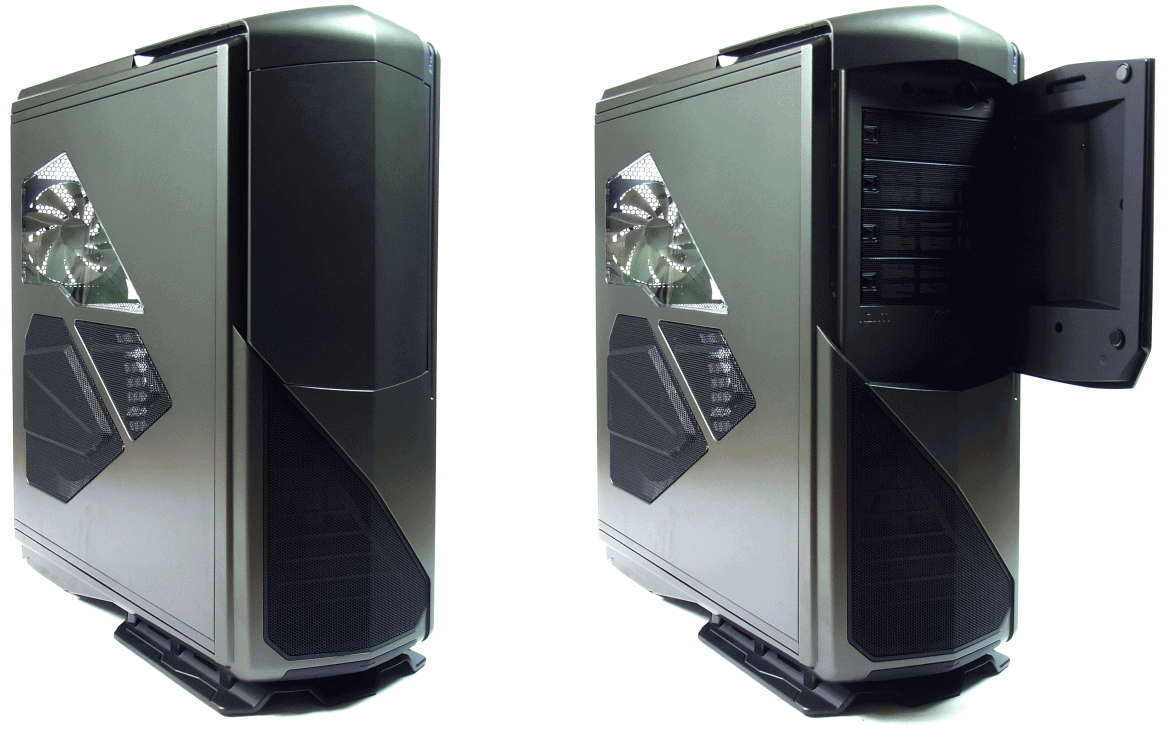
NZXT is extending its portfolio of high-end PC cases with a full-size tower called the Phantom 820. After an extended evaluation, it's clear to us that power users played a big part in defining this enclosure's specs. But the story isn't quite so simple.
Surely you've run across this conundrum before: you know how much you're willing to spend on a new case, you have some idea of what you want it to look like, and you have a rough idea of the hardware you'll be putting inside. And yet, you still don't know which chassis to choose.

This is partly because there are so many PC cases for sale. It doesn't help that many of them are very similar, too. Oftentimes, all that distinguishes one from the next are a few small details and slightly modified aesthetics. That's why we like to approach chassis coverage in a round-up format, allowing us to to compare competing models side by side, making the differences as apparent as possible.
Overall, there aren't many actual case manufacturers, and most of them use the same factories in Asia for production. As a result, any time we see the announcement of a brand new, revolutionary enclosure, we're apprehensive, to say the least. Through no fault of its own, then, NZXT's Phantom 820 was received with a bit of skepticism. Nevertheless, we dusted off a pile of high-end hardware that'd make the chassis sweat and put it through its paces.

The Phantom 820 looks a lot like some of NZXT's other PC cases, leaving us to wonder whether the company extended a mid-tower design or re-worked the insides from the ground up. Whatever it did, for $250, we're expecting it to impress us.
We want to point out that this review went live on Tom's Hardware DE in time for NZXT's launch back in October. Because we received our sample in advance of that introduction, we were fairly sure it was a pre-production unit. Although we were unable to get confirmation in time for the German review, we did confirm with NZXT that, indeed, the Phantom 820 we originally reviewed was just slightly different from the shipping version.
As you read through this story, there are certain aspects of the case we mention because they're truly representative of the review sample we have in the lab. However, we're also updating with feedback from NZXT regarding the parts that were purportedly improved before the Phantom 820 became publicly available.
- Meet NZXT's Phantom 820 Case
- Technical Specifications And Inside The Box
- Exterior Finish And Materials
- Under The Plastic
- Cooling Design And Fans
- Dust Filters And Prevention
- Power Supply Installation
- Storage Installation
- Motherboard Installation
- Factory-Installed Lighting
- Temperature And Noise
- NZXT Phantom 820: A Good Case With Some Small Problems
The intro (and some other content) of my German orginal is different and refers to the Switch 810 (and Phantom). This was my fault as I proofread the translation. Sorry.
Nice, thorough review, though I was interested in how you guys do your 100Kg tests! I would've also liked to see you (who I assume was referred to as the author) standing or whatever on the case as was mentioned.
BTW, I'm not much of a chassis buff, but when I saw the Corsair Obsidian 850D I was amazed at its features. It's been my dream case, but I feel a bit half-hearted about that since I am aware that there are as you said, so many cases out there. I'm not sure if you've ever had your hands on it, but if you have, mind sharing your insights and observations of it, and maybe personally compare it to this or other notable cases. Thanks!
I'm waiting for the corsair Obsidian 900D. My own case is an Obsidian 800D and I've modified this case with USB 3.0 and a new SATA3 PCB. It will be interesting, what the new case can better (or not).
About the test:
Simply sit down (without the plastic crap on top) and try to sit on it one minute. After this I've used my water venture... I'm a typical 100 kg heavy-weight reviewer and this is really enough to destroy something (some cases were mess after this).
I'm waiting for the corsair Obsidian 900D. My own case is an Obsidian 800D and I've modified this case with USB 3.0 and a new SATA3 PCB. It will be interesting, what the new case can better (or not).
About the test:
Simply sit down (without the plastic crap on top) and try to sit on it one minute. After this I've used my water venture... I'm a typical 100 kg heavy-weight reviewer and this is really enough to destroy something (some cases were mess after this).
Oh, so the two tests are one and the same. Hehe... I see... I hope you haven't gotten into any accidents by doing that with any cases. Ripped up pieces of metal can be nasty...
In your opinion, are Corsair Obsidians (or at least the one you have) the best you've seen? (I value your opinion because I bet you've gone through a lot of cases, or at least reviews of them.)
The answer is very difficult. If you look at a case in correlation with the price you get better offers. If you only see on quality or good ideas you get better offers. But if you are searching for a simple, stable and timeless case, the 800D is a very good one.
CPU : Core i7-3930K (oc 4.7Ghz 24/7 but comfortably goes to 4.9Ghz for benching, etc)
Motherboard : Asus Rampage IV Extreme
RAM : 4 x GSkill Ripjaw 1833Mhz 4Gb DDR3
Graphics : 2 x Nvidia GTX670 SLI
Cooling : Custom water cooled loop, 360mm radiator in the top, 240mm radiator in the bottom. XSPC CPU block and dual XSPC Razer blocks for GTX670. Koolance dual bay, dual pump reservoir.
SSD : Kingston Hyper 240Gb SSD
HDD : WD 1Tb Black
PSU : Antec Quattro 1000w
Since this is a heavily watercooled setup I don't experience ANY of the issues of fan noise. The top fans are gone in favour of 3x Scythe Gentle Typhoons pulling air through the top rad and 2x in the bottom. The standard rear fan is in place and doesn't represent a significant noise problem for me but I may change it for something more asthetically pleasing in due course. The standard 200m fan in the front remains in place and I run with the side cover off since I put a lot of effort into the presentation of my build.
Don't know if I missed it but the article doesn't seem to make much ANY mention of the integrated 5 channel digital fan controller - kinda surprised they replaced the rear fan and then put it onto the onboard fan headers .... wtf? It's kind of a major feature. There is sufficient current on each channel to power more than one fan and on some channels they are split two or three ways. There is a tonne of fan controlling capacity. If you were to go out and buy a seperate and comparible fan controller it would cost you 1/4 of the cost of the entire case, but they don't even mention this anywhere.
I've gone for the white version which is a glossy finish and much more durable than the matt black - it doesn't scratch at all. My colour theme is white chassis with black and red components with a combination of red and white LED lighting - all red LED lighting can be too much. I use clear tubing on my loop and a Mayham red dye in the water - I also use Mayhems Red Tharsis when we really want to pose as it does look awesome but not really suitable for a 24/7 rig. The white interior really does show off the internals nicely.
I haven't experienced the issue of the 3.5" drive pins touching the case on my retail purchased case, although the screws for the 2.5" mounts are too short and a complete joke that they didn't even get something so simple right - not a major issue finding the right size screws elsewhere but to be honest it is an irritation that you spend so much money on this thing and they're not the right length. But I don't experience ANY vibration from the HDD and it fits my WD 1TB 'black' perfectly. Taking into account the reviewers comments on HDD/SSD fitment, vibration, etc the ONLY niggle I've experienced is the screw lengths for 2.5" drives and that is all.
I've had no issues with installing my PSU, it fits perfectly and no problems with any part of the chassis interfering with the PSU at all.
I'm pretty sure my board only has the two USB 2.0 headers and also two USB 3.0 headers and so I'll follow the reviewers advise and get an adapter.
So to conclude - I don't experience any of the issues of case finish, drive fitment and the fan noise is a moot point if you are water cooling. So really the only niggle I've had is the SSD drive screws, which means I'm utterly delighted with my Phantom 820.
https://fbcdn-sphotos-h-a.akamaihd.net/hphotos-ak-snc7/393658_479318858769450_566415740_n.jpg
I'm deviating from the topic here, but hey if it means possibly still getting more chassis reviews from you way into the far, far future, I think it's relevant enough. Hehe...
Back to topic:
It is difficult to translate all my reviews everytime to English, I'm writing mostly for our German site (in German) and we have approx. 15-20 longer case reviews every year. If you know my style, the text is not the shortest and the content hard to translate 1:1. I hope, we get a good solution for the future
Translation programs aren't perfected yet (even by big companies like Microsoft I believe), so too bad. Using Google Translate or something does allow us English-speakers to at least make out some of the stuff in foreign language sites.
Igor, whatever chassis articles you guys do translate, I hope one of them would be about the Obsidian 900D. (That's one petition signature from me.)
1. Too Pricey
2. Fans from other companies don't fit
3. For $250, it had better be perfect and it isn't.
You mentioned that the front of the case is held on by magnets, I am going to assume they are fairly strong magnets, to hold it on securely. Where exactly are the magnets? And how close are they to the 3.5" drive bays? It would be a bad day indeed if I boot up, only to find my HDD's been corrupted.