




Enthusiast recreates 43-year-old Apple Lisa with FPGA board — first commercial computer with a GUI faithfully cloned with modernized machine

LisaFPGA project
(Image credit: Alex Anderson-McLeod)

Many think that Apple's history creating computers with graphical interfaces starts with the venerable Macintosh, but the company's first foray into designing GUIs actually started with 1983's Lisa. The machine was the first to bring a popular window application system and mouse control to general availability at an edible (if bitter) price of $9,995 dollars of 1983 vintage, equivalent to nearly $34,000 today.

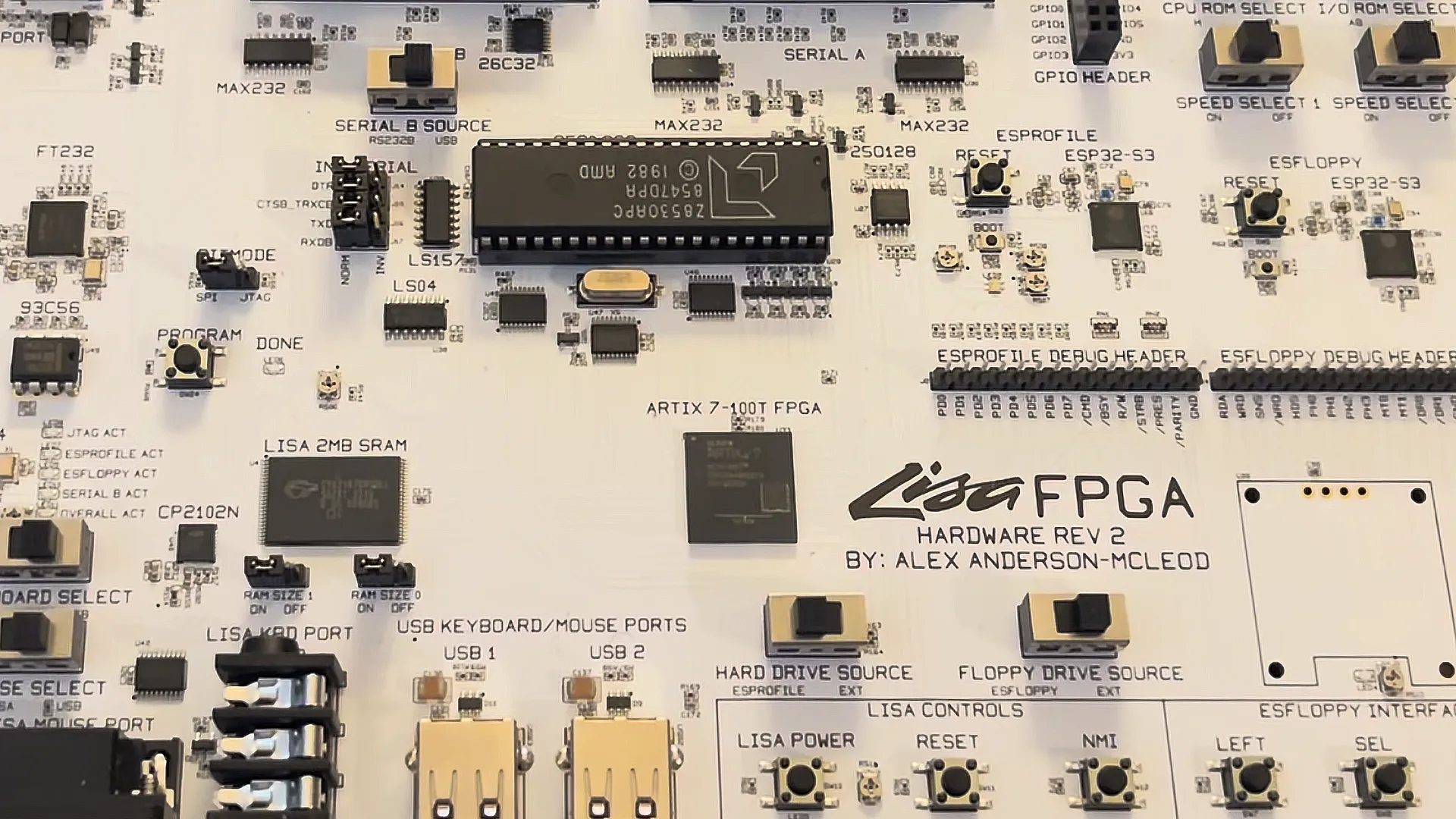
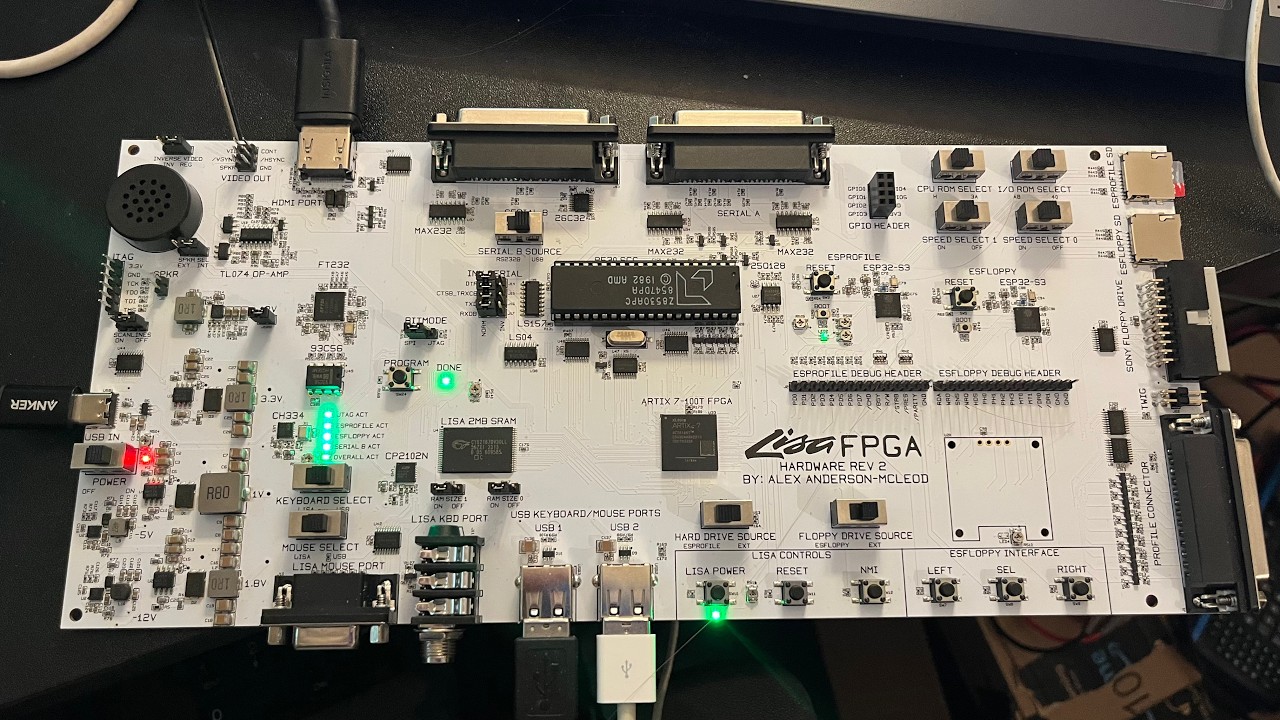
Thanks to enthusiast and Youtuber Alex Anderson-McLeod, you'll soon be able to roll your own much-improved LisaFPGA clone. Alex designed a roomy one-board system centered around an Artix 7-100T FPGA as the Lisa's brains, coupled to 2MB of SRAM and emulated hard drive, floppy, serial, and naturally, keyboard and mouse connectors.
I recreated the Apple Lisa computer inside an FPGA! - The LisaFPGA Project - YouTube I recreated the Apple Lisa computer inside an FPGA! - The LisaFPGA Project - YouTube
Watch On

The clone is far superior to the original, thanks to its reliance on modern hardware and Alex's design smarts. For starters, you don't need a video converter, as the board natively outputs video HDMI with a scanline option; both its main video modes are switchable on-the-fly. Although the board includes original-spec connectors for input devices, it also helpfully has USB ports for keyboard and mouse so you don't have to procure original versions.

Latest Videos From

In a similar fashion, the serial ports can be redirected to the main USB-C connector thanks to the inclusion of a USB hub, saving you having to find USB-to-serial adapters and chunky DB25 connectors. Floppy images can be loaded from an SD card, direct connection to PC, or an original floppy drive connected to the the corresponding port.

Even for its time, the Lisa was pretty slow, thanks to its software design choices and and use of the 5 MHz variant of the Motorola 68000 CPU. As a nod to these limitations, Alex included two overclocking multipliers that can take the machine to the equivalent of 75 MHz, likewise selectable on the fly with physical switches.

The revision of the LisaFPGA featured in the video is version 2, but Alex says that version 3 is coming soon with a handful of fixes. He says the project will be fully open-sourced on Github as soon as he gets his proverbial ducks in a row. He's also considering selling the clones, and will be speaking about them at Vintage Computer Festival Southwest later in the month.

Although it was generally considered a failure due to its price and software availability, the Lisa paved the way for 1984's Macintosh, the $2,459 machine that popularized graphical interfaces and the Apple brand worldwide. The Lisa computer had an undignified ending, too, with 2,700 of them dumped in Logan, Utah, as part of a tax write-off on unsold inventory. Still, similar to how the first iPhone had major issues in hindsight, the Lisa broke ground for much greater things.

Although Apple popularized graphical home computers for the masses, Apple did not invent the GUI, nor the mouse. The GUI was Xerox's doing at its PARC laboratories, that Steve Jobs visited and, cough, cribbed notes from. The Xerox Star 8010 workstation was the first computer with both technologies, but it was sold as part of a larger package and commanded the steep price of $16,595 in 1981, or around $60,000 today. As for the mouse, it was designed at the Stanford Research institute much earlier in 1963.

TOPICS
Bruno Ferreira
Contributor

Bruno Ferreira is a contributing writer for Tom's Hardware. He has decades of experience with PC hardware and assorted sundries, alongside a career as a developer. He's obsessed with detail and has a tendency to ramble on the topics he loves. When not doing that, he's usually playing games, or at live music shows and festivals.

  • hwertz
    Don't know where you got the idea this was the first commercial computer with aa GUI. Part of the whole lawsuit when Apple was trying to sue everyone over GUI related stufff hinged on the fact Jobs had visited Xerox and saw what they had there. Xerox Star 8010 was first on the market with a GUI by several years. (Xerox Alto was done up by 1972 but only sent to universities and treated like a prototype with several hundred sent out rather than a product.)

    Edit: OK I see this is in the article, just some saying it didn't count (because it included a server and laser printer. Xerox did basically view this as a way to sell laser printers, which back then were like $50K.)
    Reply
  • American2021
    hwertz said:
    Xerox Star 8010 was first on the market with a GUI by several years.
    You are correct!

    0_bgAryP380:506
    Reply
  • hwertz
    American2021 said:
    You are correct!

    0_bgAryP380:506
    I must say, it's too bad Xerox did all this work on GUIs, ethernet with file sharing and e-mail, and so on, but really only marketed and sold them as a document editing system (and research models for universities). Although unless they could get the price down I suppose it would have faced the same fate as the Lisa as a standalone system.

    The bit I've read about Mesa is fascinating, and so are LISP and Smalltalk (which were widely used by Xerox PARC and whatever universities received Xerox systems through the 1970s and 1980s.)
    Reply
  • vossile
    I applaud people re-creating the tech that started it all.

    It's just gotten so "normal" to slap FPGAs or a Picos in every project, that it feels a little like AI-slop nowadays.

    Why not collect the originals, repair and restore them while they are still around? You can pick up a Lisa II for what 2K?
    Reply
  • hwertz
    vossile said:


    Why not collect the originals, repair and restore them while they are still around? You can pick up a Lisa II for what 2K?
    I see some hopeful EBayer has one listed for like $6300.

    But, you know, I can see going for a reproduction -- that $2K is a lot of cash. And with the repro you have HDMI, USB-C (for serial ports) and SD Card (for floppy and hard drive)... which is not authentic, but I think it'd be tricky to even get software on or off a machine this vintage otherwise. I'd have real concerns primariy over just how long that CRT will last, and the 5MB HDD.

    Since the Mac used non-standard format I assume the Lisa did too (so you'd need a catweasel or something to even read and write the floppies to supply it with software), and it supports serial (if there's a comms program on the Lisa?) and (when running certain software only) LocalTalk (... which I'm not sure how you'd interface to with modern hardware. Linux *used* to actually have in-kernel AppleTalk networking but I think it was removed a while ago (and I'm not sure it would use LocalTalk as opposed to AppleTalk over ethernet... since the PC serial ports are RS232 rather than the multi-drop-supporting RS422 LocalTalk uses, and a USB to serial adapter would be right out for something like this.) You can bridge LocalTalk to Ethernet with a bridge but these are probably rather rare these days.

    It's like that with collector cars too -- there's a real market for collector cars. But there's also a market for reproductions... which can be a fraction the cost, and even when it's not will still have fuel injection, anti-lock brakes, etc. that the collector car generally wouldn't. If someone wants the authentic experience of tuning up their car (jets, idle mixture, checking out or replacing the plugs and wires, adjusting the timing with the distributor) or souping it up (that stuff, and possibly putting a bigger 4-barrel on there, air intake, and so on) maybe the repro isn't what they want. But if they want to hop in and drive it, perhaps it is.
    Reply
  • American2021
    hwertz said:
    I see some hopeful EBayer has one listed for like $6300.
    Elon should buy it and donate it to the Smithsonian. Give them something to work on besides DEI.
    Reply
  • vossile
    Just to get the tone right: I do think this is awesome and I love that people are tackling projects like these!

    hwertz said:
    I see some hopeful EBayer has one listed for like $6300.

    But, you know, I can see going for a reproduction -- that $2K is a lot of cash. And with the repro you have HDMI, USB-C (for serial ports) and SD Card (for floppy and hard drive)... which is not authentic, but I think it'd be tricky to even get software on or off a machine this vintage otherwise. I'd have real concerns primariy over just how long that CRT will last, and the 5MB HDD.
    Yes, all of us collectors know of these problems and are constantly coming up with new devices to keep the old machines "alive". And then we do slap in modern technology to keep the old robot going - a little like implants.


    hwertz said:
    Since the Mac used non-standard format I assume the Lisa did too (so you'd need a catweasel or something to even read and write the floppies to supply it with software), and it supports serial (if there's a comms program on the Lisa?) and (when running certain software only) LocalTalk (... which I'm not sure how you'd interface to with modern hardware. Linux *used* to actually have in-kernel AppleTalk networking but I think it was removed a while ago (and I'm not sure it would use LocalTalk as opposed to AppleTalk over ethernet... since the PC serial ports are RS232 rather than the multi-drop-supporting RS422 LocalTalk uses, and a USB to serial adapter would be right out for something like this.) You can bridge LocalTalk to Ethernet with a bridge but these are probably rather rare these days.
    As I'm sure you know, we all have those bridges machines that will bring us from one era to the next and it's true that the Lisa is a bit of an island there. Still there are tools available to get around that.

    hwertz said:

    It's like that with collector cars too -- there's a real market for collector cars. But there's also a market for reproductions... which can be a fraction the cost, and even when it's not will still have fuel injection, anti-lock brakes, etc. that the collector car generally wouldn't. If someone wants the authentic experience of tuning up their car (jets, idle mixture, checking out or replacing the plugs and wires, adjusting the timing with the distributor) or souping it up (that stuff, and possibly putting a bigger 4-barrel on there, air intake, and so on) maybe the repro isn't what they want. But if they want to hop in and drive it, perhaps it is.
    Yes, it's a nice idea and I'm sure great hardware design and all (and it looks nice too). Still it blurs the line between experiencing what it felt like to drive "that old car" and using the body to put in an electric drive, bluetooth entertainment center with a 10" screen etc.
    If I do that, why don't I just emulate the thing by software? Gives me the same interfaces too. If I don't hear the whirring, the clacking, the crackling of the crt - where is the real experience?

    Still loving the project and am enjoying the conversation. Thank you for your input.
    Reply