Join Tom’s Hardware today









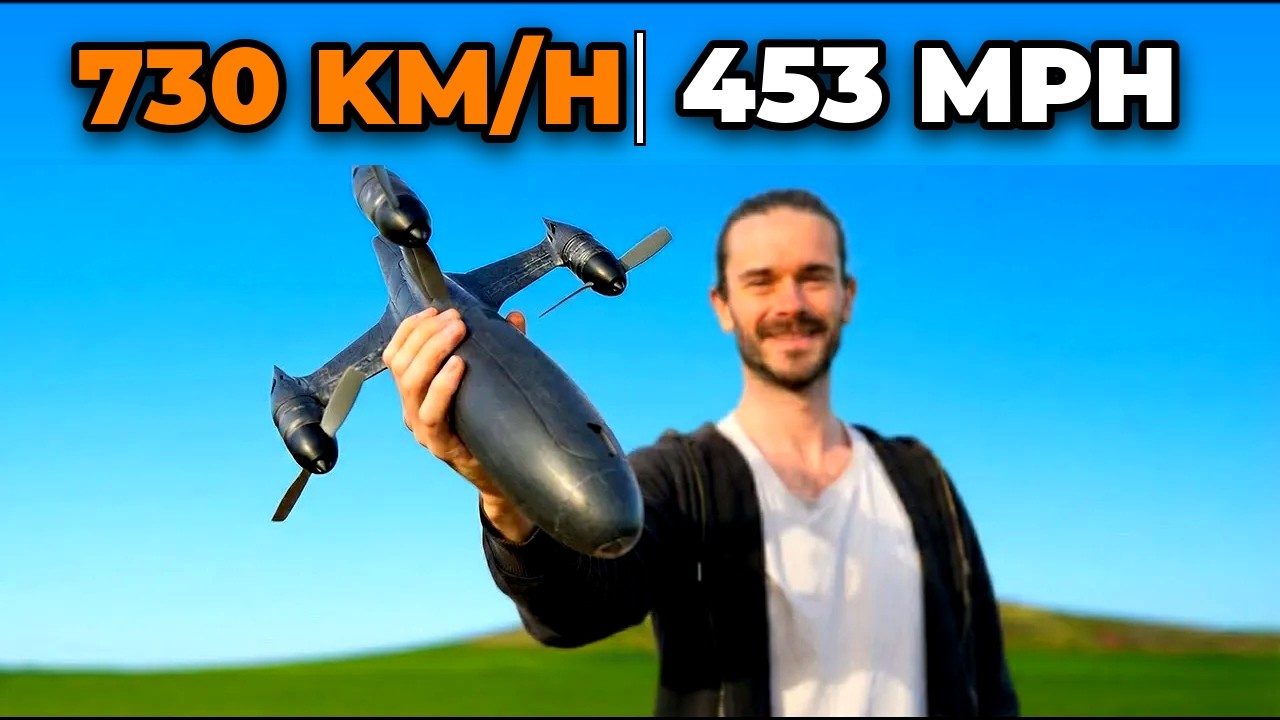
A drone-loving duo just unofficially broke the drone speed world record when they achieved a maximum speed of 453 mph (730 kph or 394 kts) in a single run — for context, most jetliners cruise at around 550 mph (885 kph or 478 kts). The two drone builders, Aidan and Ben, had previously set a record of 388 mph (626 kph or 338 kts) in December 2025, but were soon defeated by the Bell father-and-son team with the 408 mph Peregreen V4. So, to reclaim their crown, they ordered new propellers for the 'Blackbird' and shared their test run on the Drone Pro Hub YouTube channel.
The team’s secret sauce is their custom carbon fiber propeller blades that were specially handmade for this purpose. These featured high-pitch blades (whose pitch angle is a secret for now) that are angled more towards the direction of flight compared to the blades used in previous attempts. This made them more efficient at high speeds as the props are more parallel to the airflow compared to other propellers with a lower pitch angle. One downside to this, though, is that it delivers less power at low speeds — like when taking off or hovering — so the motors must use more battery power during this (rather short) stage of flight.
Another finesse of the design is evident in the sawtooth leading edges found on the custom blades. These generate vortices on the surface of the blade, helping prevent the air from sliding sideways along the blade instead of flowing straight back off its trailing edge to push the drone forward. They also stabilize the boundary layer, or the thin layer of air that acts like a “lubricant” and reduces drag on the propeller itself. This is crucial as it allows the propellers to have a steeper angle without stalling (if the angle is too steep it acts more like a blender than a propeller).

These changes seemed to have pushed the team’s drone further, as it achieved 393 mph (633 kph or 341 kts) in its first test run. Unfortunately, physics got the better of them, as antenna geometry, the Doppler effect, and signal overload caused the drone to lose connection from the controller at such a high speed. The two did not bother attempting to recover it, as they knew that it was lost for good at these speeds. Furthermore, even if the drone lost connection right in front of the controller, it would have traveled miles at its current speed before it would have crashed.
Thankfully, they still had another drone available for testing and another set of their updated propellers. So, they set out again the following day and continued their tests. It seemed that they only had enough batteries for two test runs, and adverse weather was quickly approaching, so they had to set up quickly and get to flying. It was also a windy day, so they made one downwind flight and one upwind flight, and they just averaged the speeds between the two to get a rather fair result.
It was on the downwind test flight that they achieved their record 453 mph, which is above the 441-mph record that they initially hoped for. However, when they accounted for the 34-mph tailwind, this meant that the drone only had an actual airspeed of 419 mph (674 kph or 364 kts). For their final test run, the duo achieved 397 mph (640 kph or 345 kts) against the wind. They averaged the two runs, getting a figure of 425 mph (685 kph or 369 kts) — this might be a bit short of the more than 434 mph (700 kph or 377 kts) they hoped to achieve, but it still beats the current world record.
Official record next?
Their final drone was damaged a bit when it landed hard after the last test run, as the batteries ran completely flat just a few feet off the ground. Nevertheless, this is still repairable, and the two should hopefully be able to get their drone running again for an official record attempt this time. As for the first drone that crashed, the owner of the land where they were conducting the testing found it completely mangled, but that’s already expected.
If you want to make your own attempt at achieving the drone world speed record, you can actually get guidance through their Drone Pro Hub website. And while they use custom propeller blades made by a professional, you can actually 3D print the body and other components at home with one of the best 3D printers you can buy.

Follow Tom's Hardware on Google News, or add us as a preferred source, to get our latest news, analysis, & reviews in your feeds.