Black And White To Color
A color CRT works in almost exactly the same way as a black and white CRT, except that instead of a single electron gun there are three, and instead of single-color phosphor dots there are triads of three different-colored phosphors (red, green, and blue) that make up each pixel. Each gun strikes a colored phosphor, and by adjusting the intensity of these three different-colored dots, it's possible to create almost any color. (Actually, our brains do the color mixing.)
Adding color triads to a picture tube while maintaining high resolutions means crowding the phosphors closer and closer together. This requires even greater precision on the part of the electronics controlling the guns and the magnets. If the beams aren't aimed precisely enough, they might strike adjacent phosphors (causing the picture to smear), produce incorrect colors, or create slight ghosting (causing the image to appear slightly out of focus).
To get around this problem, engineers use a couple of tricks. One solution is to use a mask (called a "shadow mask") placed inside the tube, just in front of the phosphor-coated surface. The mask is simply a sheet of metal (usually made of a material called "invar"), with holes drilled in it. Only beams that are correctly aimed will pass through the holes that correspond to the particular phosphor dots. The mask blocks any stray beams from striking the wrong phosphors. This is the shadow mask approach.

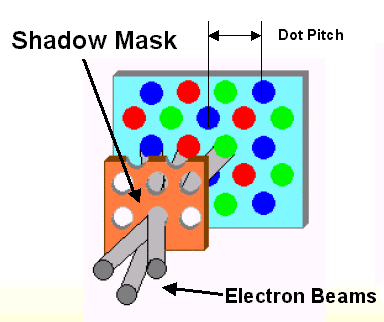
Painting phosphor dots on the inside of a tube can be a tricky business, so another manufacturing trick was used. Instead of dots, the phosphors are painted in vertical lines and very thin wires are run in front, rather than a mask. The thin wires serve to block stray electron beams in the same way as a shadow mask. This is the "aperture grille" approach.
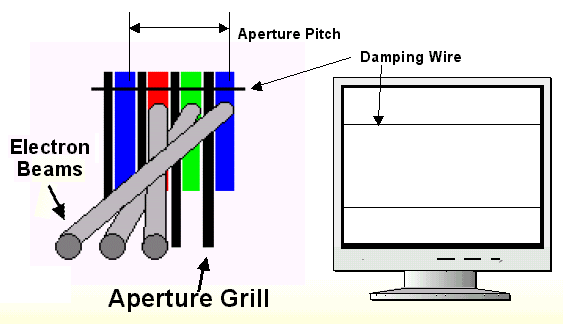
Both of these techniques have their trade-offs. In general, shadow mask CRTs produce a sharper image, while aperture grille CRTs produce better color. Shadow mask CRTs tend to be a little dimmer, while aperture grille CRTs have two horizontal damping wire shadows (to reduce grille vibrations) at 1/3 and 2/3 across the screen. If you want bright, accurate colors (and don't mind the two very faint damping wire shadows), go for an aperture grille CRT. If you do a lot of text work or find the shadows annoying, then go with a shadow mask CRT. If desk space or absolutely perfect geometric reproduction is required, then you might want to consider an LCD instead.