



Intel Xeon 6+ Computex roundtable interview transcript — Kira Boyko and Tim Wilson on 18A wafer allocation, Clearwater Forest, and dropping hyper-threading
Intel's E-core Xeon and silicon-engineering leads took press questions at Computex.
Intel launched its Xeon 6+ "Clearwater Forest" processors at Computex 2026 in Taipei, and on Monday, two of the individuals responsible for the product sat down with the press to answer questions. Kira Boyko, Product Line Director for E-Core Xeon Products in Intel's Data Center Group, led the session, which was joined partway through by Tim Wilson, Vice President and General Manager of Intel's Data Center Silicon Engineering group.
Across roughly half an hour, the two addressed why Intel stripped hyper-threading out of its E-core server parts and the technical case for bringing it back, the agentic AI demand surge that has left expensive GPU fleets idling while they wait on CPUs, the deliberate decision to ship Clearwater Forest with only AVX2, and 18A supply so tight that allocating chips between customers is "daily, in some cases."
Diamond Rapids, Intel's next P-core Xeon, drew repeated questions, but Intel deferred any detail, with Evangelista pointing reporters to fuller commentary roughly two months out. That timing lines up with Hot Chips, where Intel is expected to share more on Diamond Rapids.
Clearwater Forest spec changes
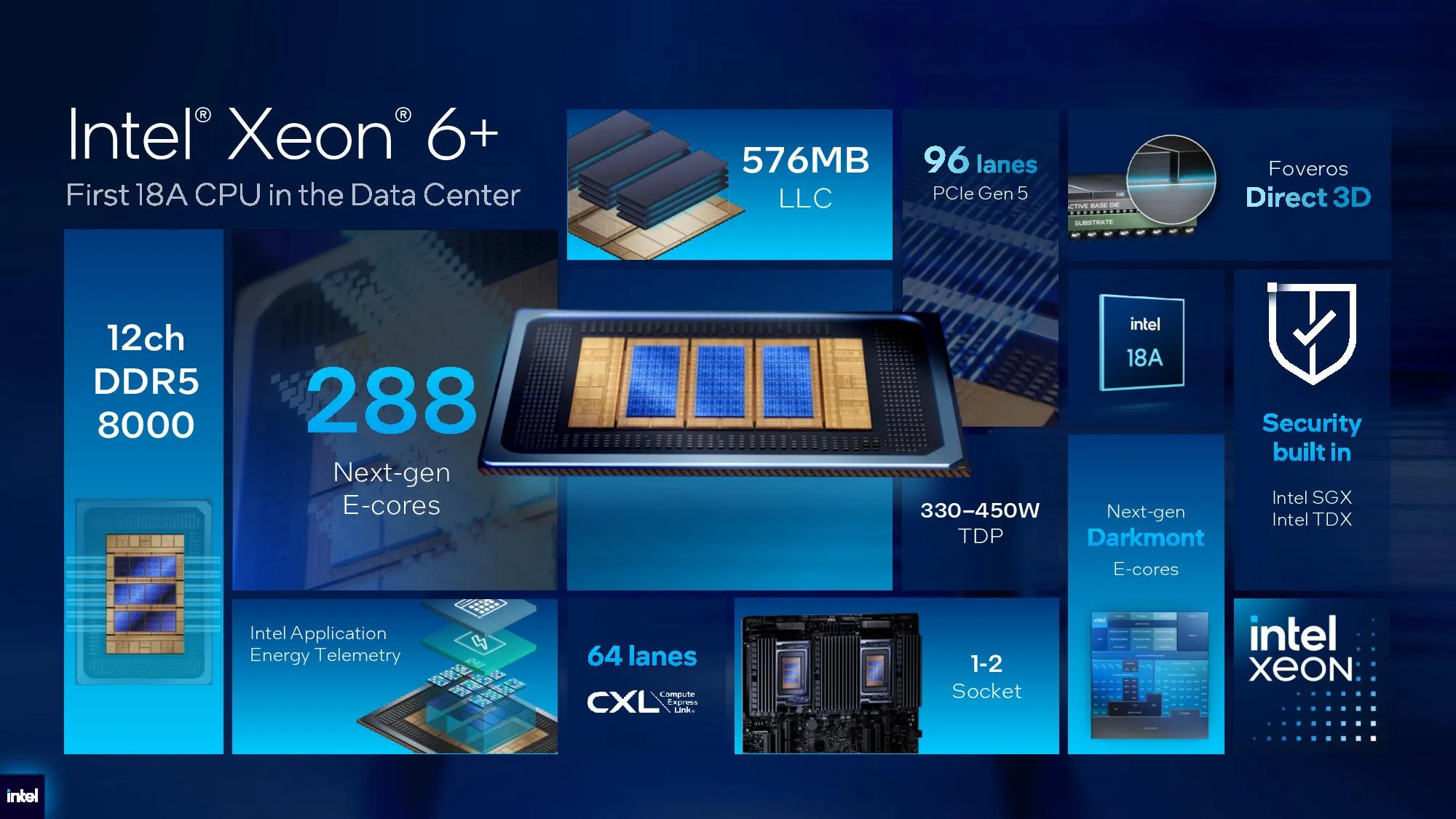
Clearwater Forest tops out at 288 Darkmont E-cores per socket and 576MB of L3 cache, and is Intel's first data center CPU built on its 18A process.
Kira Boyko: It's our most performant Xeon on the market today, specifically for scale-out workloads, so it's not just a per-watt angle of fossil performance.
Jake Roach, Tom's Hardware: Was that the driving force behind the big spec changes compared to Sierra Forest? Obviously, it's double the core count, but I think there's over five times the amount of L3, and a huge increase in TDP.
Kira Boyko: The TDP is mostly that it is socket-compatible with the version of platform design that we had for Granite [Rapids]-AP before, and that is a higher-TDP product. Our initial E-core part was lower TDP, and this one has roughly the same range as the Granite version, so that's part of the platform-design alignment. But in general, we found that our customers were mostly targeting higher-TDP spaces anyway for the core density they were after, so it ended up working quite well. We already had a design that served those spaces.
Jake Roach: And the L3, was that another workload type?
Kira Boyko: You're right, a little over 5x increase, from the hundreds up to 576-ish [MB].
Jake Roach: If you have the flagship, that's quite a lot of L3.
Diamond Rapids and hyper-threading
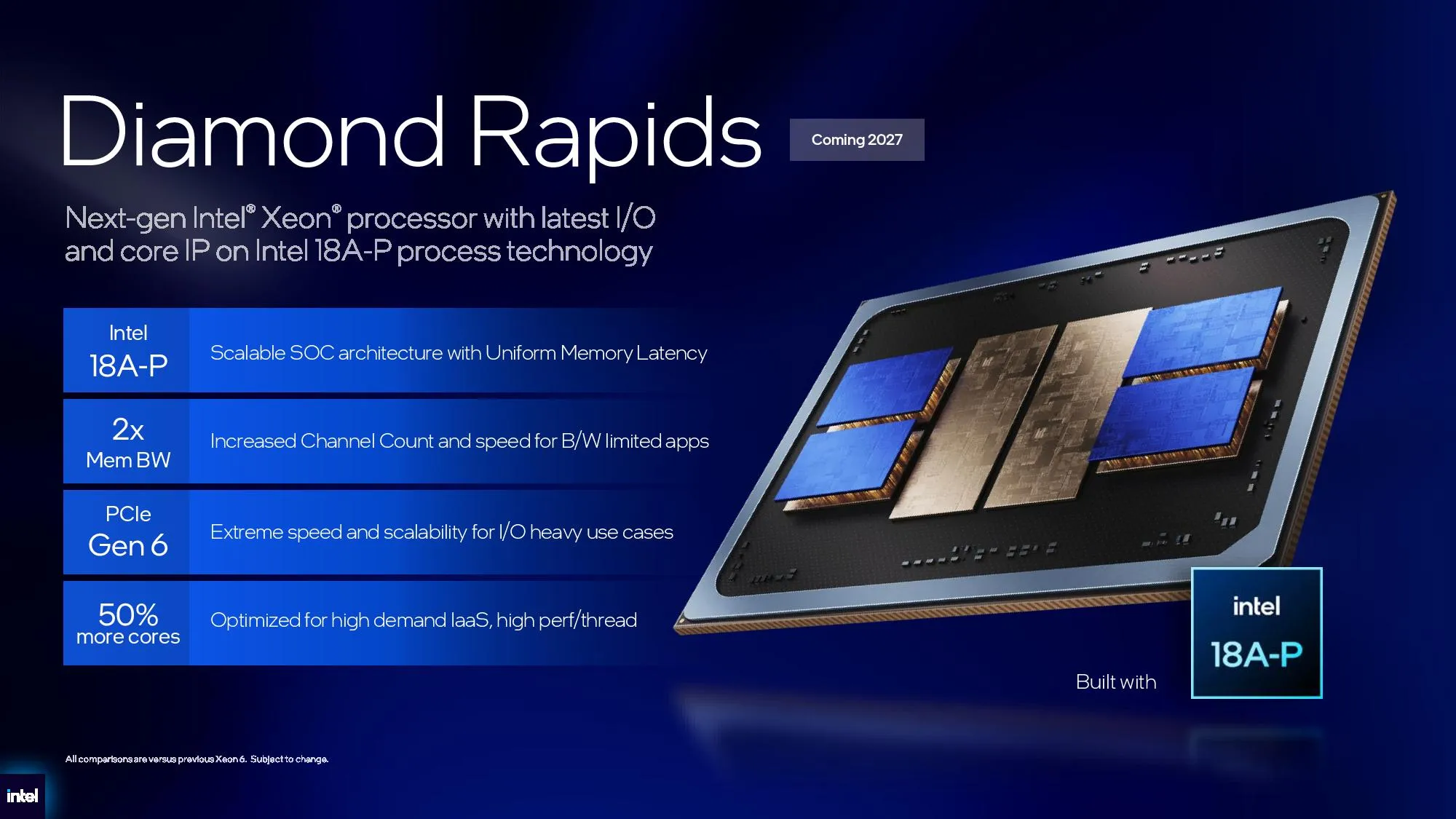
On its recent earnings calls, Intel CEO Lip-Bu Tan has said that moving away from simultaneous multi-threading (SMT) "put us at a competitive disadvantage" and that the company will reintroduce it with the Coral Rapids generation, the P-core Xeon that follows Diamond Rapids. Intel's current shipping E-core Xeons, Sierra Forest and Clearwater Forest, run a single thread per core.
Jake Roach: I appreciate that we can't comment on future products, but there was a tease in the press deck for Diamond Rapids. It's a very anticipated product. I want to ask about hyper-threading. During the last two earnings calls, Lip-Bu Tan has referenced that hyper-threading will return with Coral Rapids. We don't currently have a Xeon P-core product without hyper-threading shipping. Does that mean Diamond Rapids does not have hyper-threading?
Andrew Evangelista: We'll comment more on Diamond Rapids [later].
Kira Boyko: I will say that E-core is single-threaded. It has the core density for the workloads it's servicing, and we are not expecting it to be replaced by Diamond Rapids. We're expecting the workloads that need more of the high-performance aspect of a P-core to go from Granite to Diamond, whereas the more scalar workloads for E-core will stick on Clearwater Forest, continue to be serviced through this next generation, and then pick up with the generation after that.
Andrew Evangelista: I think it was your question that prompted us to talk about Diamond Rapids in general. More to come.
Kira Boyko: The only thing I can really say from a Diamond perspective is AET, the new feature we're introducing on Clearwater Forest. That is expected to roll out across all of our Xeons going forward, so you can expect to see it on Diamond and future ones as well. What the roadmap looks like from a feature perspective gen to gen, I don't have any level of detail for today. But it is definitely being introduced in Clearwater. We have a number of customers deploying it on Clearwater, and others who are more classic P-core customers, with different workloads, running proof-of-concepts on Clearwater so they can hit the ground running with Diamond.
Jake Roach: I had to ask.
Kira Boyko: You're like, "That's not what I wanted, I wanted way more detail."
Jake Roach: There are a lot of articles that have been written saying it's confirmed Diamond does not have hyper-threading, and I haven't been able to find that confirmation anywhere.
Kira Boyko: There's a lot out there on Diamond that is all over the place. There are statements about [unclear] variants, and just a lot of rumors.
Andrew Evangelista: We'll have more official commentary to come, and that's what folks are anticipating. We understand there's excitement, and we'll share more [in two months].
Agentic AI and CPU demand
Journalist 2: What are customers telling you about this agentic AI wave, how they're dealing with it, and how Intel plays into that going forward?
Kira Boyko: Customers are just starting to understand their own AI deployment models, and a lot of them still aren't quite there yet. Many started by investing in GPUs and are now realizing they don't have the CPU counterparts to actually keep those GPUs going. So they made this huge investment, and they're running at something like 20% to 30%, something quite low. They're understanding that there's this space where certain workloads can be offloaded to more efficient CPUs, and that's exciting from a Xeon 6+ standpoint. Others are still going to be partnering with their providers, looking at industry white papers to understand how to best use their AI strategy.
Journalist 2: Just as an outside observer, it seemed like CPU demand was going, and then November and December happened, and everything got sold out instantly. What percent of current demand is agentic-AI-driven versus prior? I'm trying to get a sense of what it is now, and what it's going to be like six to nine months from now. It seems like a paradigm shift happened, and we're going to be riding this trend for several quarters at least.
Kira Boyko: I think we are. I think we're also going to see quite a bit of data center modernization and consolidation, looking at what workloads are already out there that can be consolidated onto CPUs. Some maybe are designed for agentic, maybe aren't, but are more storage-oriented, or workloads that can be serviced just fine on something that isn't super intense. So you can get a little more performance and energy back, and then use that to service some of their AI workloads as well.
Application Energy Telemetry
AET, or Application Energy Telemetry, is a Clearwater Forest feature that gives operators application-level visibility into energy use, which Intel says can be used both to tune workloads and to bill customers on measured rather than estimated consumption.
Jake Roach: You mentioned AET, and I know that's a really big thing with this launch. Is there any connective tissue with what we saw with Arrow Lake Refresh on the consumer front? AET is taking information from actual registers in the silicon. There's hardware on the chips doing it. Similarly, with iBot on Arrow Lake Refresh, it was hardware-enabled, where you could get these readouts running workloads and see where they could optimize. Is there any connective tissue there, or are these completely separate?
Kira Boyko: We can get back to you on whether there's some collaboration. Usually our teams are very separate, but it's very possible there is some, so we'll find out. My understanding is that this is highly customer-driven. Sometimes we leverage existing technologies.
Jake Roach: This is more to satiate my own curiosity.
Andrew Evangelista: Let me grab Tim for a second to answer that, because that's a silicon-engineering-level question. He's worked on both client and enterprise.
Jake Roach: Yeah, just because you're using Darkmont, there's at least a capability there.
Kira Boyko: Touché. Moving on to the next generation, which is not an E-core, it'll still be there as well. So even if there was some synergy, it would be moving forward to a different core base.
Andrew Evangelista: Circling back on two questions. One was similarities related to Arrow Lake.
Jake Roach: Basically, the hooks in Arrow Lake Refresh for iBot to optimize that translation. Are those hardware hooks something you're looking at? Is there any connective tissue there today?
Tim Wilson: I haven't looked at Arrow Lake in quite a while. To first order, I'd say fundamentally no, they're different use cases. Are we leveraging some of the same telemetry capability built into the hardware? It wouldn't surprise me.
SMT removal and its return
Intel split its Xeon 6 line into P-core parts with hyper-threading, such as Granite Rapids, and E-core parts without it, beginning with Sierra Forest.
Andrew Evangelista: The question on the decision for SMT and hyper-threading.
Journalist 2: Just why it was taken out, what the thinking behind that was. Was it a security thing?
Tim Wilson: I have a lot of my own personal thoughts. If you step back to the data center a couple of years ago, the thesis was that what matters is maximum core performance and then core density in the socket. So if I can deliver maximum core performance and increase the number of cores in the socket, do I really need [SMT]? One or two physical cores are always better than two virtual cores built on one physical core. I fully expect we will see use cases and workloads where that decision is incredibly useful and valuable and gives real-world value, and we've heard from some customers that, for what they're doing, single-threaded is the right answer. Having said that, there's a big portion of work that is still very much multi-threaded, especially in the virtualized space, so completely eliminating it is a problem, because we cut off some not-insignificant portion of workloads, especially when you're in a virtualized, licensed environment where licensing is based on cores and threads. So there was a technical reason for why you'd want [SMT], and that technical reason probably still holds. [...]
Journalist 2: Like a VMware thing, with a big price on cores. How are you going to market versus your main rivals, like AMD, and now Nvidia? What's the messaging going forward? From 18A to what's next, you'll be much better on the node side.
Tim Wilson: Our intention is to have leadership products with every generation, and we fully intend to do that going forward. Our go-to-market strategy is to sit down with customers and ask what they value, then go build leadership that meets those needs. With all our data center customers, we have deep discussions around the personality of the platform they want to build, beyond just cores and feeds and speeds. What is the system balance, the memory-to-compute ratio? How are they viewing multi-socket versus single-socket? What's the right number of cores for their workloads, for both private and public workloads, enterprise versus cloud? It's really sitting down in each of those and asking what the markets and customers buying our parts value, and how we optimize our products to meet their needs.
Journalist 2: Is that changing now with this agentic AI demand explosion? Are we going to see CPU racks with agentic AI as the primary use?
Tim Wilson: I'm sure you will, just like we've always built CPU racks. There are principles around CPU design that have always been true and will continue to be true. You want the highest-performance core you can build. Power efficiency is always going to matter as long as we're constrained by the amount of power you can bring inside a building's walls and the heat you can extract from them. Your memory-to-CPU harmonics, how much memory each workload takes, how much you allocate to each core, those are key. We've always designed for those parameters, and the end markets evolve over time.
Agentic AI is now exploding, but what's driving that explosion is not a new type of CPU. It's that the new AI workloads are not one call, one inference, one response. They're complex, execution-driven, multi-task queries that involve tens or hundreds of agents, and suddenly you need a control plane and an orchestrator, tasks the CPU is historically good at. How do I take a complex task and decompose it into subcomponents, figure out which can be parallelized and which depend on each other and need to be serialized, and pass those off to the GPU? I have to map memory to each of those subcomponents, and not all of them want the same memory, and I have to make calls to I/O, and in some cases to the OS or APIs.
Those are all things the control plane and orchestrator, the CPU, does really well. As you move away from a chatbot answer to "go do this analysis and give me a report on the actions I should take," that's a much different query, and the CPU plays a much bigger role. Data centers that have built on GPUs for the last three years are suddenly finding they're bottlenecked by the CPU. They have a massive GPU fleet that costs billions of dollars sitting idle, waiting for the CPU to respond. So do I see a future with agentic AI and CPU racks? Yes, but with characteristics very similar to the sorts of things we've always built into CPU racks. It's exploding because the things the CPU has always done well are the things in demand now.
Journalist 2: It seems like the whole storage infrastructure has to change, too.
Tim Wilson: That comes along with it. There's demand for storage, which drives I/O advancements and connectivity.
18A yield and wafer allocation
Clearwater Forest is a multi-process design: the compute tiles are built on Intel's 18A node, with base tiles on Intel 3 and I/O tiles on Intel 7.
Journalist 2: Questions you probably want to ask but won't answer. 18A yield volume for Xeon 6+, progressing?
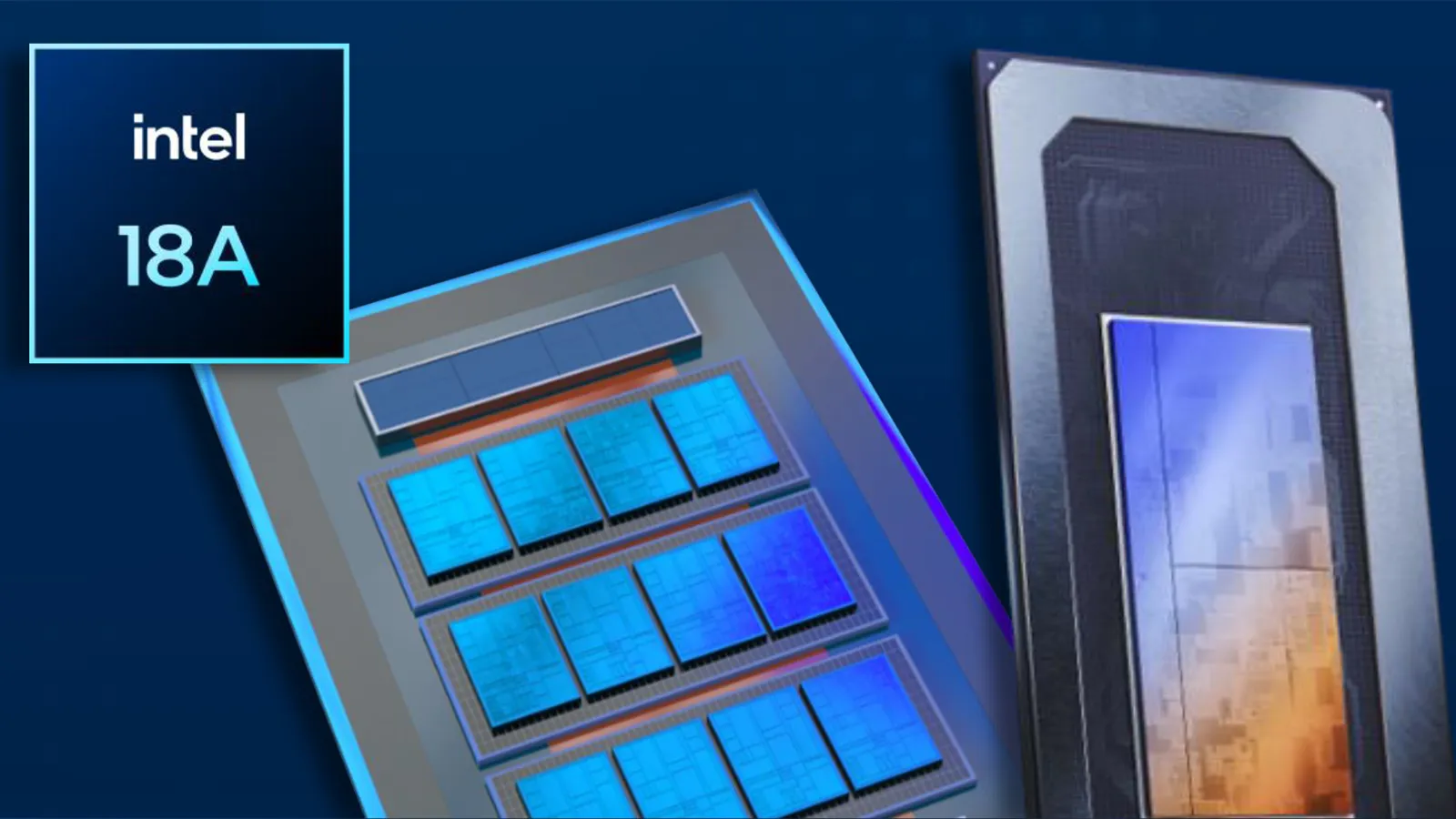
Kira Boyko: We're ramping well. We have strong demand throughout the lifetime of the product, and we're working from a capacity standpoint across all of our products to hit customers at the point in time they need most. Compute is 18A, but we also have base on Intel 3 and I/O on Intel 7, so it's a multi-process product. We're mapping demand against all of our other products to figure out where we need to build.
Journalist 2: How do you choose who gets the product in this compute-supply-constrained world? Is it whoever orders first? You're sold out right now.
Tim Wilson: We give as many CPUs to as many people as we can. It tends to be more business decisions than engineering decisions, so it's a combination of long-term deals and customer relationships. The biggest problem is not demand in any way, shape, or form. The biggest problem is how we satisfy demand across every single product. If I have people demanding Xeon 6 and Xeon 6+, and still Xeon 5, how do I balance all of those and match where the supply constraints are in the industry? In some cases, customers are struggling with mismatches. They can get the GPU but not the memory to pair with it, or the memory but not the CPU. There's a lot of matching going on in the industry.
Journalist 2: On the client side, people are demanding even older products because they've already verified them.
Kira Boyko: I've seen that on the data center side, too. They've verified and tested a product, so they want that product. In such a supply-constrained environment, people will buy whatever’s on the table. And 6+ has the benefit of some backward-compatibility elements, the socket compatibility, and again, using processes that are hardened on previous products, so we can mix and match in some cases. We have customers looking for multiple products on multiple processes, and it's working with them to understand exactly what they critically need, when, and how we best service that across all their orders.
Jake Roach: If I'm remembering correctly, it was the earnings call before the most recent one, where we talked about wafer allocation split between client and data center, with a greater emphasis on wafers going toward the data center. Is that still the plan?
Tim Wilson: That's definitely the plan, and we're always having those conversations. That's more of a foundry conversation than a product conversation. [...] The whole ecosystem is sucking up all the wafers and memory, whether it's client, automotive, or any of the other industries. AI data center tends to take the supply because they're willing to pay the most, and the rest of the industries can't pay the price until supply balances out. We saw a similar effect during COVID, though that was supply-chain-driven rather than demand-driven. Those trade-offs, Gen 5 versus Gen 6 versus Gen 7, are a weekly conversation.
Kira Boyko: Daily, in some cases, on CPU allocations. [...] Given the dynamic space, our customers are modifying on a regular basis. Can we shift? What do they really need, and when? If you're asking long-term whether we'll stay in these constraints, we do see a space where things will lighten up. It's not in the immediate timeframe.
Journalist 2: Dave talked about multi-year hyperscaler contracts. What's the latest on that? Are deals getting signed, and are you getting more requests for those kinds of contracts?
Tim Wilson: I doubt either of us is the right person, by the way. They don't trust us with a lot of that information.
Journalist 2: You're not talking with data center customers on the purchase side?
Kira Boyko: We're not in the contract negotiation.
Tim Wilson: There's a principle here. If you mix commercial negotiations in with the technical discussions, it doesn't work out well, so you generally try to separate them. You let the finance people argue over pricing and contracts, and let the engineers figure out the best products to build together. When you're talking with product-side engineers, we don't have a lot of that information, and even if we did, we probably couldn't tell you.
Journalist 2: What percentage of Intel's data center revenue is hyperscaler?
Tim Wilson: You can go look at our earnings.
[Session ends]

Jake Roach is the Senior CPU Analyst at Tom’s Hardware, writing reviews, news, and features about the latest consumer and workstation processors.
- Luke James Contributor