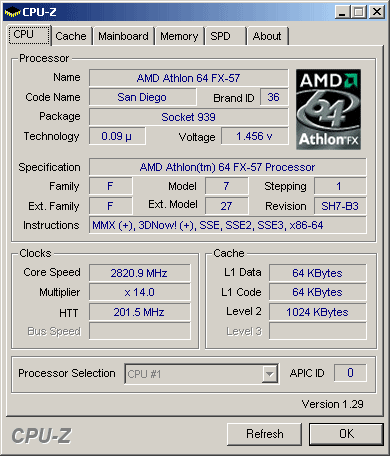
San Diego Core Goes FX

The most sophisticated 90 nm core is the San Diego, featuring AMD's latest E4 stepping with SSE3 support and 1 MB L2 cache. Both the San Diego and Venice cores come with a slightly improved memory controller. This not only has a positive influence on overall performance, but also finally allows the deployment of four double-sided DDR400 DIMMs, something that used to cause problems .
Unchanged is Socket 939, the 1 GHz full duplex HyperTransport interface that interfaces with the chipset, support for 3DNow! Professional, MMX, SSE and SSE3, support for the virus-protecting non-execute bit (NX) and the Cool & Quiet feature. Cool & Quiet has the operating system monitor the CPU load by using a special CPU driver, and then modifies the CPU core clock on the fly. Athlon 64 CPUs have two, three or four performance states (P-states) for doing the clock switching. The minimum clock speed is either 800 or 1,000 MHz, depending on the processor model. At the lowest P-state, the maximum thermal power is almost cut in half, lowering heat dissipation, and thus the need for extensive cooling and energy consumption.
From an architecture point of view, there is no real news here; please refer to our initial Athlon 64 and Athlon 64 FX review for all the details.