Third Step: Is 500 MHz FSB Possible?
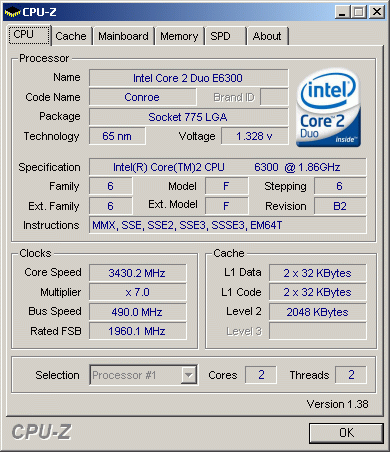
490 MHz FSB speed! However, the system didn't run reliably at this speed anymore, and we decided to run our benchmarks at 485 MHz.
The declared goal was to reach 500 MHz FSB speed (FSB2000), but our test motherboard wasn't capable of running that fast. We believe the chipset is the limit, since 470 to 480 MHz is what users have published in forums across the Internet, using various motherboards. Also, even extreme overvoltage and aggressive cooling didn't help.
We reached 490 MHz, but applications started to fail at this speed, so we had to step back to 485 MHz for benchmarking. Nevertheless, 485 MHz multiplied by the standard multiplier of 7 results in a 3,395 MHz clock speed (3.4 GHz). This is far beyond the clock speed of the $999 Core 2 Extreme X6800 - at this speed, even though the E6300 comes with less L2 cache memory, it outperforms the extreme top model.
Here are the voltage settings we used:
DDR2 Voltage +0.6 V
MCH +0.55 V
FSB +0.3 V
CPU 1.4 V
What About SpeedStep?
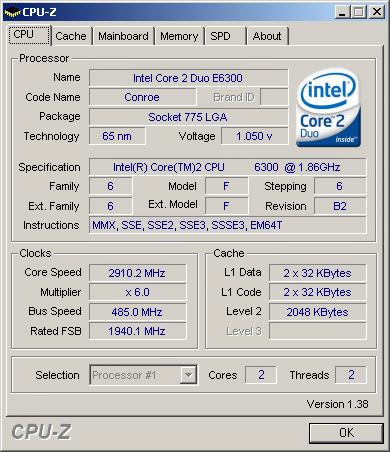
Most people going for such extreme overclocks probably don't care much about power consumption, but we still decided to include some information for the sake of completeness.
Core 2 Duo processors in the desktop space can switch down to a lower performance state (P-state), which results in reduced clock speed and reduced voltage. The lowest performance state will reduce the multiplier to x6. Coming from the E6300's default multiplier of x7, this doesn't seem to make much of a difference, as the standard clock speed of 1,866 MHz would decrease to only 1,600 MHz. It is still worth it, however, as the core voltage is reduced to 1.115 V. At higher clock speeds, the voltage reduction is disabled by the motherboard, as CPU stability has priority over energy savings.
