Introduction
The first half of this year felt like Nvidia was taking a time-out or a nap, leaving both its third-party board vendors and customers impatient (BFG, of course, paid the ultimate price). It seemed the company was content to keep creatively renaming its desktop graphics chips, and thus sticking with its then-current portfolio.
Meanwhile, AMD launched its entire line of DirectX 11-compatible Radeon HD 5000-series cards, literally from top to bottom.
Finally, after several delays, Nvidia brought its own DirectX 11 GPU to market, officially called GF100 and based on the Fermi architecture.


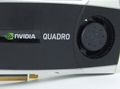
The first cards to employ the new design were called the GeForce GTX 480, GeForce GTX 470, and GeForce GTX 465, and all of them were aimed at the gaming enthusiast. Now, Nvidia is introducing a workstation-class card belonging to the Quadro line. Again, AMD enjoys a bit of a lead here as well, having already updated its FirePro line of professional graphics cards in late spring.
That sets the stage for today’s comparison in which we will pit Nvidia’s new Quadro 5000 against AMD's flagship ATI FirePro V8800, comparing both cards to previous-generation parts as well. Since some of our readers may not be familiar with workstation graphics, allow us to provide a frame of reference by comparing them to their mainstream gaming brethren.
The Quadro 5000 is based on Nvidias GF100 GPU and contains 352 shader cores, making it more or less a twin of the GeForce GTX 465. The main differences between the two relate to the memory subsystem and the clock frequencies. AMD's FirePro V8800 is built around the company's Cypress XT (RV870), the same GPU powering its Radeon HD 5870.
So, going into this comparison, what should our expectations be? Comparisons between the gaming versions of these cards show them going head-to-head in many cases, with AMD taking the lead in some cases and Nvidia in others, depending on the game, benchmark, and settings. In the past, this sort of pattern has translated quite well into the workstation world. Will this hold true here as well, or will we see a clear winner emerge?
When it unveiled its Fermi architecture, Nvidia repeatedly stressed that this design was not developed expressly for the gaming market. Instead, the company strove to create a design that could also target the workstation segment, as well as HPC markets. Today‘s test will also show whether Nvidia achieves this goal.
Before we dive into the benchmarks, we’ll take a closer look at the contenders, sizing up Nvidia’s Quadro 5000 and the ATI FirePro V8800. We’ll also consider their respective fields.
