Loud Or Quiet, Hot Or Cold: A Direct Comparison Of 29 Aluminum-copper Coolers
What properties does the user expect from a good cooler? The ideal cooler should be as quiet as possible and still do a very good job of cooling. However, the physics, or more precisely the material properties - e.g. the conductivity of the material - place certain restrictions on cooler developers.
Let's assume a manufacturer would like to design a very quiet cooler. He will have to assume that his product has a relatively low cooling capacity (=high thermal resistance Rtherm). After all, the material of the heat sink only has a certain heat conductivity and a specific heating capacity. If a cooler made of the same material still offers the highest possible cooling capacity (=low thermal resistance Rtherm), it will be at the cost of the noise level.
The manufacturers of cooling solutions are therefore forced to optimize their products with regard to the two criteria of "cooling capacity" and "noise level", or to find a good compromise between good cooling capacity and a tolerable noise level.

The following figure shows to what extent the manufacturers achieved this balancing act.
It visualizes the test results of the four coolers tested (black dots) in comparison to all Al-Cu coolers tested to date (yellow dots).
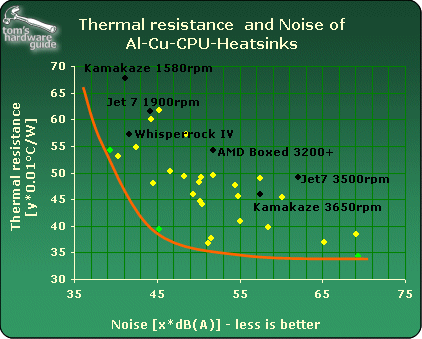
The green dot in the upper left marks the result of the quietest cooler, the Coolermaster CP5-7JD1B-0L. Outside on the right, at the bottom of the figure (green dot) is the cooler with the best cooling capacity (Swiftech MCX462-U+ Vantec TD8038A). The breaking point in the red curve marks a product with very well balanced properties: It has very good cooling capacity, but is acoustically quite inconspicuous (Vantec VA4-C7040).
The red line marks the limits placed by physics on developers. Products with performance statistics - pair of values for thermal resistance and noise level - that are below this curve are obviously impracticable because of their material properties and physical principles.
Please note that the noise level measurements were taken with the side panels removed, at a distance of approximately 35 cm from the fan wheel and with an ambient noise level of 34 dB(A). However, levels may be considerably below our results with the side panels, in practice.