Overclocked Core Temperatures
Because of increased clock rates, it's certainly no secret that core temperatures must increase, along with power consumption levels. For a stock AMD Athlon 64 FX-62, power consumption measures 125 W (TDP), while a stock Intel Core 2 registers 75 W. Our tuned-up Athlon consumed about 140 W at 3.05 GHz under heavy load, and we measured core temperatures of 149° F (65° C) at the same time. The fan on a stock cooler has its work cut out at these temperatures, and operated at a rotational speed of 3300 RPM. This still leaves room for more speed, at least where temperatures are concerned. AMD indicates that the Windsor core temperature boundary is at 203° F (95° C).
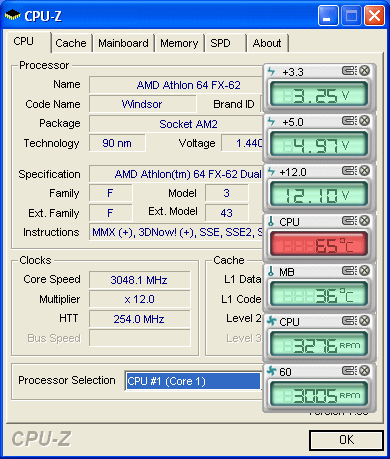
When the tuned up FX-62 is heavily loaded, core temperatures read 149° F (65° C) when using the stock CPU cooler. Cool & Quiet wasn't operating.
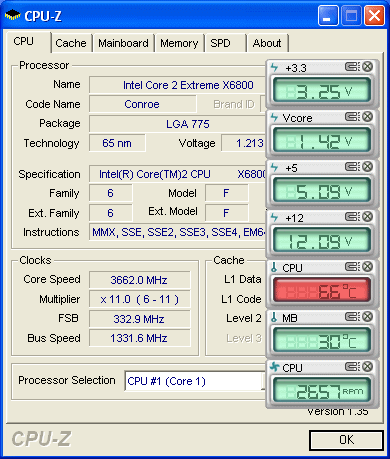
At a clock speed of 3.66 GHz, the Intel Core 2 Extreme registers 151° F (66° C).

Under heavy loads, the overclocked Core 2 Extreme reads 151° F (66° C), and power consumption registers 95 watts. Don't forget that these readings occur because the clock rate was boosted from its stock value of 2.93 GHz to an impressive 3.66 GHz. In this situation, the stock cooler fan ran at a rotational speed of 2700 RPM, easy to notice at higher clock rates. By comparison, however, the older Pentium D 840 running at its standard clock rate of 3.2 GHz requires fan speeds of 4000 RPM to keep its cool.

The stock cooler included in the Core 2 Extreme retail package.
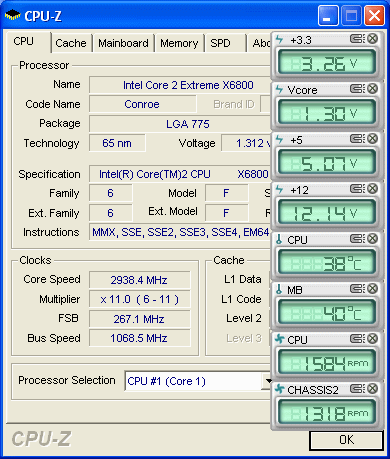
Despite overclocking, automatic speed throttles still worked as we used this processor. Intel calls this function C1E.
The C1E function enables the Core 2 Extreme to throttle back to its standard clock rate of 2.93 GHz under light load. But the Speedstep function, which turns things down further to 1.6 GHz, doesn't work on an overclocked system. Nevertheless, it was delightful to observe that cutting back on input voltage lowered core temperatures to a relatively comfortable 101° F (38° C), and the fan spun down to 1500 RPM at the same time.

Because the BIOS version on this motherboard is relatively early in its life cycle, the maximum multiplier available is 11x.

Comparing tuning efficiencies: the Core 2's input voltage levels are about 29 W lower than the Athlon 64 FX under heavy load. But the tables turn around completely in idle mode: in that case, the AMD processor uses exactly 29 watts less than its Intel counterpart.