




First Intel Wildcat Lake laptop spotted in the wild, geared to compete with MacBook Neo — features an aluminum chassis with 11W fanless mode
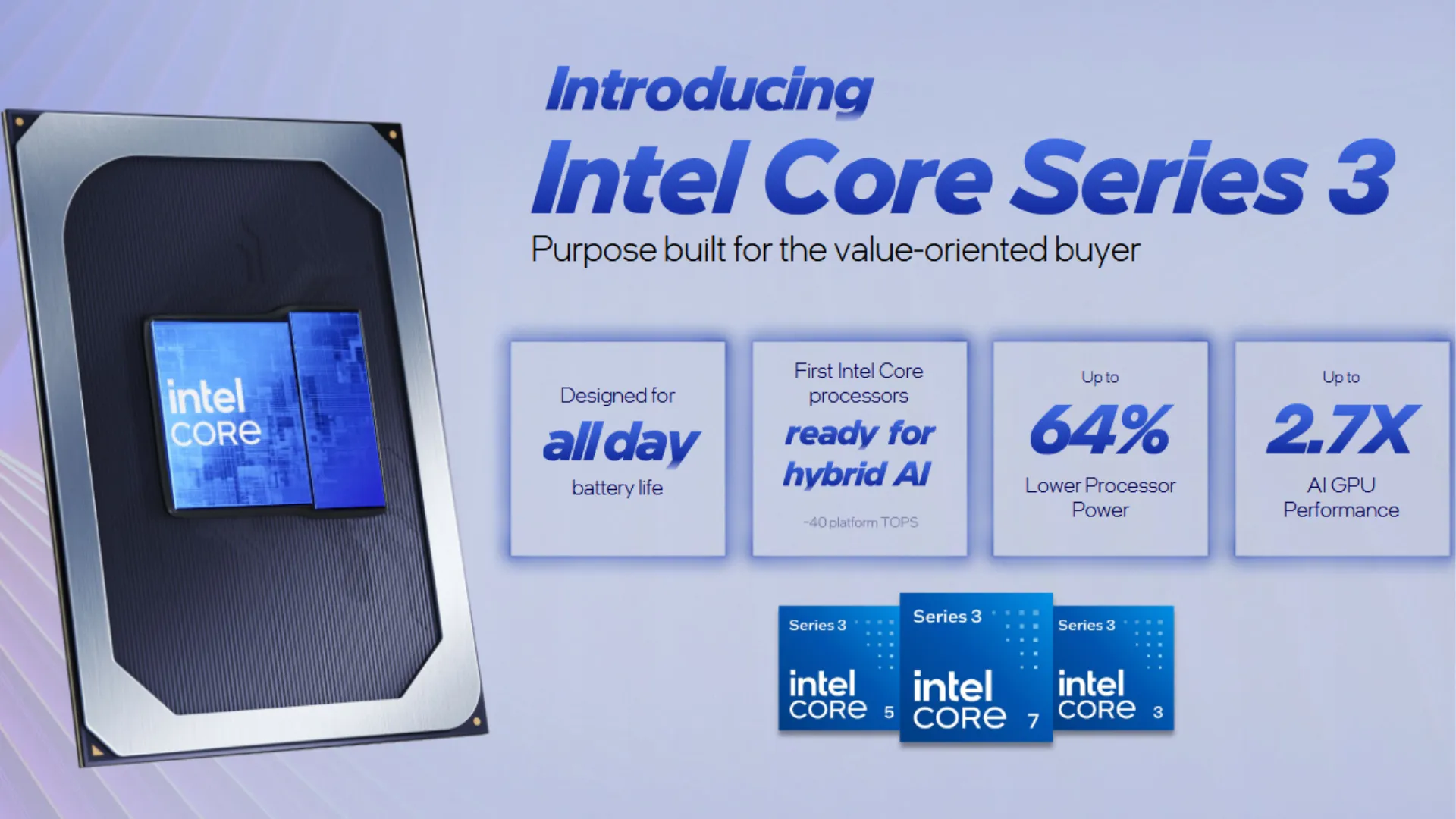
Wildcat Lake is Intel's new budget lineup intended for entry-level and edge.
Intel launched its Wildcat Lake series of CPUs last week, called "Core Series 3," with but we haven't seen any laptop with these chips.. That is, until today. NotebookCheck's Vaidyanathan Subramaniam just took to X to show off the first machine equipped with Wildcat Lake silicon. It's a reference design, as denoted by the Intel branding on the laptop, but it's still our best look at a potential MacBook Neo competitor on the Windows side.
First look at an Intel Wild Cat Lake laptop in the wild. 2 Cougar Cove P + 4 Darkmont E cores 17 W PL1 and 35 W PL2 / 22 W PL1 Max / 11 W fanless17 TOPS NPU2 Xe coresThin and light designLooks like a perfect laptop for the beach, innit 🌊🏖️ pic.twitter.com/MCsCVbpM4AApril 23, 2026
As a reminder, Wildcat Lake is the successor to Twin Lake and the Blue Team's lowest-end offering this generation. It features up to two 'Cougar Cove' P-cores and four 'Darkmont' low-power E-cores, alongside up to 2 Xe3 cores for integrated graphics. There are seven SKUs in total, one intended only for the edge market, and all of them feature a basic NPU for AI tasks, topping out at 17 TOPS.
The laptop in question has four power modes: 17W PL1, 22W PL1 Max, 35W PL2, and an 11W 'fanless' mode. That's a decent bit of grunt for entry-level silicon, and the device also features an aluminum chassis, according to a reply on the original X post. That positions it as a clear MacBook Neo rival, but one with a much higher power envelope. The Neo rarely ever touches 10W and usually operates between 3-5W with normal workloads.

The cooling system just isn't sufficient to tame the A18 Pro inside, but you can add something as simple as a thermal pad to reduce thermal throttling and improve performance. Since this Intel reference laptop has a comparatively-ludicrous 35W PL2, it seems like some Wildcat Lake devices can benefit from fans and perhaps even vapor chambers to extract more juice out of that silicon.
We can see that this laptop has 16 GB of RAM, as reported in Task Manager, with 8.9 GB shared with the GPU. That's already more than the 8 GB the Neo offers, which is a real bottleneck as soon as you start to go beyond web browsing or media consumption. Of course, we're in a RAM shortage right now so this machine seems like an even more solid package overall, but keep in mind that it's not a real laptop with a price tag.
Subramaniam said he wasn't allowed to run tests on the machine, but was told that PL1 Max (22W) can be sustained for up to 2 minutes versus PL2 (33W) which will only be hit for about 56 ms before throttling. We're most likely looking at the "Core 7 360/350" here, which are two of the highest-end SKUs in the Wildcat Lake lineup. That's about all the info we have — at least, the teal gradient design looks really cool.

Follow Tom's Hardware on Google News, or add us as a preferred source, to get our latest news, analysis, & reviews in your feeds.

Get Tom's Hardware's best news and in-depth reviews, straight to your inbox.

Hassam Nasir is a die-hard hardware enthusiast with years of experience as a tech editor and writer, focusing on detailed CPU comparisons and general hardware news. When he’s not working, you’ll find him bending tubes for his ever-evolving custom water-loop gaming rig or benchmarking the latest CPUs and GPUs just for fun.
-
salgado18 Intell will keep sinking if they don't address the massive power consumption of their power cores. AMD, Qualcomm and Apple have efficient cores, but Intel keeps on relying on a hybrid setup only.Reply -
thestryker ReplyAs a reminder, Wildcat Lake is the successor to Twin Lake and the Blue Team's lowest-end offering this generation.
It's not its a replacement for ADL-U/RPL-U the power floor on these is 10W. The corner cutting on IO and memory channels is likely all about keeping the costs to a minimum on a leading edge process node. There hasn't been, and likely won't be for a while, a successor to ADL-N announced. I don't think we'll see it until Intel decides to update the Atom offerings with one of the new core designs. This would also point at using an internal process node of which they very much do not have capacity to spare. -
usertests Reply
I think it's already being treated as a replacement for ADL-N in the embedded world, especially as they can tout the NPU and its "edge AI inference" capability during this bubble. Going down to a 10W TDP can be good enough for tiny, fanless systems:thestryker said:It's not its a replacement for ADL-U/RPL-U the power floor on these is 10W. The corner cutting on IO and memory channels is likely all about keeping the costs to a minimum on a leading edge process node. There hasn't been, and likely won't be for a while, a successor to ADL-N announced. I don't think we'll see it until Intel decides to update the Atom offerings with one of the new core designs. This would also point at using an internal process node of which they very much do not have capacity to spare.
https://www.advantech.com/en-us/resources/news/advantech-delivers-lightweight-edge-ai-inference-with-intel-core-series-3-processorsThe addition of a dedicated NPU in a mainstream Intel Core Series 3 provides power-efficient AI inference optimized for always-on edge workloads. Combined with CPU and GPU compute capabilities, the solution is well suited for lightweight edge AI inference applications such as smart retail kiosks, self-checkout systems, healthcare assistance devices, and industrial robotics—where responsiveness, efficiency, and reliability are essential.
In addition to AI performance, the architecture is designed for long-term industrial use, offering up to 10 years of product availability. It also supports real-time computing capabilities through Intel Time Coordinated Computing (TCC) and Time-Sensitive Networking (TSN), enabling deterministic performance for automation and control applications.
Advantech plans to introduce multiple Intel Core Series 3-based systems starting April 2026, including the MIO-5356 embedded single-board computer, the ARK-1252 DIN-rail edge computer, and the ARK-2233 fanless edge computer. These systems are designed to deliver efficient and balanced computing for lightweight edge AI inference across diverse industrial applications.
This is an older roadmap putting Twin Lake and Wildcat Lake on the same footing. I think 2.5" could be referring to a class of boards smaller than Pico-ITX, but I'm not sure:
https://wccftech.com/industrial-motherboard-roadmap-reveals-intel-nova-lake-u-h-cpu-planned-bartlett-lake-s-panther-lake-h-wildcat-lake-u-in-2026/https://cdn.wccftech.com/wp-content/uploads/2025/08/DFI-roadmap-1.jpg -
thestryker Reply
It's really just not though. It can exist in the same market segment without being a replacement. Technically the 850x series is cheaper than the N3xx, they can run in a lot of the same power envelopes and are used in a lot of the same devices. None of this means they're interchangeable however and the same is true here. ADL-N is not heterogeneous and can operate in a lower power envelope and the same will be true with whatever it's actual replacement is.usertests said:I think it's already being treated as a replacement for ADL-N in the embedded world, especially as they can tout the NPU and its "edge AI inference" capability during this bubble. Going down to a 10W TDP can be good enough for tiny, fanless systems:
https://www.advantech.com/en-us/resources/news/advantech-delivers-lightweight-edge-ai-inference-with-intel-core-series-3-processors
This is an older roadmap putting Twin Lake and Wildcat Lake on the same footing. I think 2.5" could be referring to a class of boards smaller than Pico-ITX, but I'm not sure:
https://wccftech.com/industrial-motherboard-roadmap-reveals-intel-nova-lake-u-h-cpu-planned-bartlett-lake-s-panther-lake-h-wildcat-lake-u-in-2026/https://cdn.wccftech.com/wp-content/uploads/2025/08/DFI-roadmap-1.jpg -
Notton "Geared to compete with Macbook Neo"Reply
MBN is $599 for an all aluminum chassis and 13" 2408x1506/60Hz 500nits IPS screen.
$499 with student pricing.
Which means the expectation is to have the same $599 price with a 2560x1600p 500nits IPS screen, on top of similar build quality, sound quality, weight, battery life, performance, etc. -
usertests Reply
I've seen good ADL-U (RPL-U is identical) laptops in the $200-300 range, and I bought at around $200 (1080p plastic). If Wildcat Lake is a sidegrade or slightly better, that's where I would want it to end up, even if it starts at $400-500.Notton said:"Geared to compete with Macbook Neo"
MBN is $599 for an all aluminum chassis and 13" 2408x1506/60Hz 500nits IPS screen.
$499 with student pricing.
Which means the expectation is to have the same $599 price with a 2560x1600p 500nits IPS screen, on top of similar build quality, sound quality, weight, battery life, performance, etc.
Copying the build quality is the easy part. Matching the Neo's performance and battery life could be impossible, I don't know. Wildcat Lake should perform well, but it definitely shouldn't be priced at $600 given the various chips it's competing with.
I would rather see Ryzen AI 7 350/450 at the $500-600 price points with a premium feel. -
JamesJones44 Reply
AMD is one of the few mainstream chip designers that doesn't use a hybrid setup primarily. Apple, Intel and Qualcomm all use the big.little design primarily.salgado18 said:Intel keeps on relying on a hybrid setup only. -
Notton AMD does offer hybrid CPUs on mobile with compact cores.Reply
Though I can understand not noticing their existence. -
thestryker Reply
All Zen 5 mobile other than HX/Strix Halo is.Notton said:AMD does offer hybrid CPUs on mobile with compact cores.
Though I can understand not noticing their existence.