









Intel launches Wildcat Lake as Core Series 3 for value laptops and edge systems — six consumer SKUs built on 18A promise 'all-day' battery life
Six consumer SKUs ship today on Intel 18A.
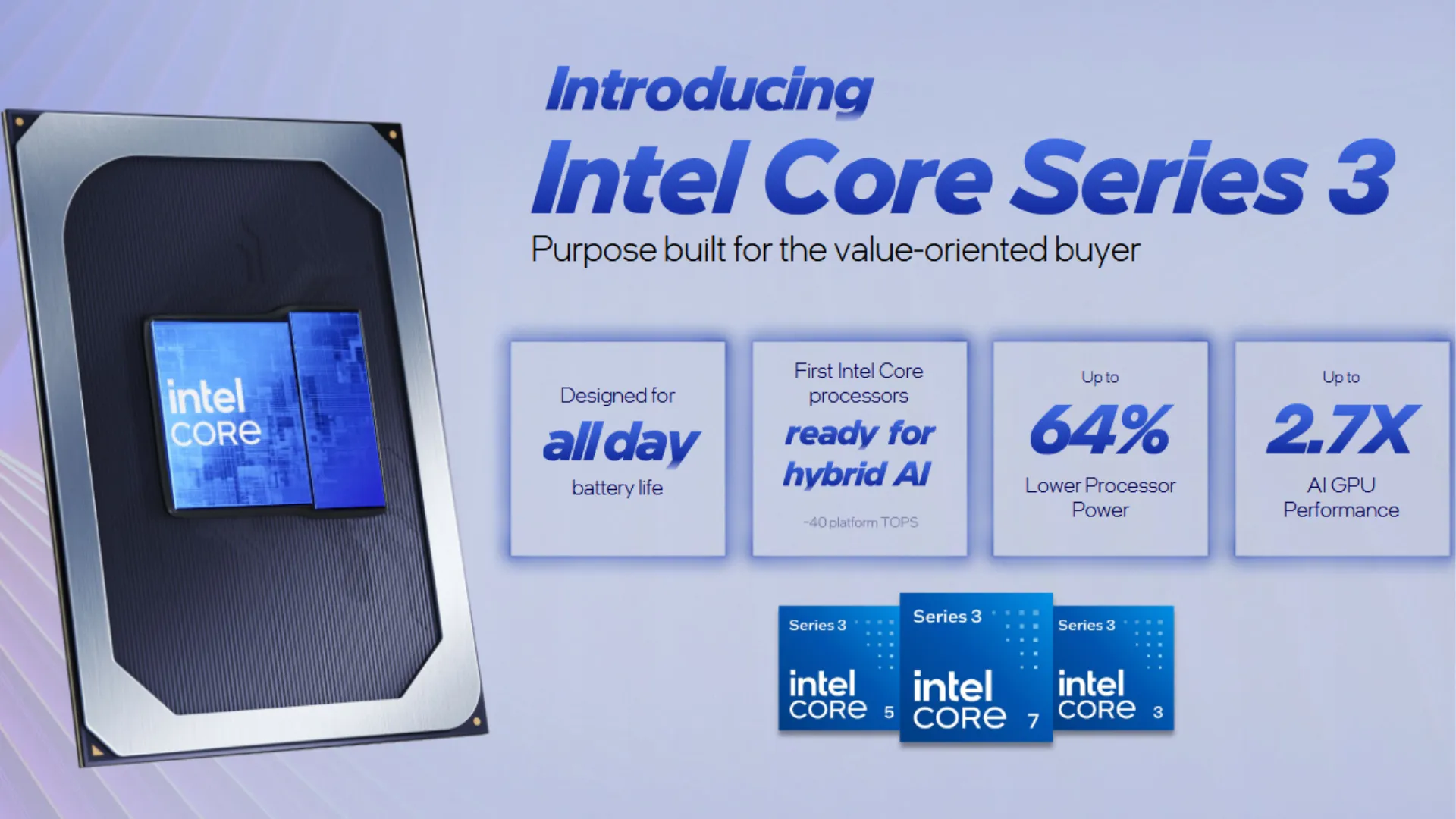
Intel has today launched its Core Series 3 mobile processors, confirming the official branding for the silicon tracked under the Wildcat Lake codename since late 2024.
The lineup covers six consumer SKUs plus an edge-only variant, all fabbed on Intel 18A, with more than 70 laptop designs scheduled from Acer, Asus, Dell, HP, Lenovo, MSI, Samsung, and others through the rest of 2026. Intel is positioning this family as the value-segment counterpart to Panther Lake, which shipped as Core Ultra Series 3 following its debut at CES in January.
Processor |
Cores/Threads |
P-core Turbo |
NPU TOPS |
GPU (Xe-cores / freq / TOPS) |
Core 7 360 |
6 |
4.8 GHz |
17 |
2 / 2.6 GHz / 21 |
Core 7 350 |
6 |
4.8 GHz |
17 |
2 / 2.6 GHz / 21 |
Core 5 330 |
6 |
4.6 GHz |
16 |
2 / 2.5 GHz / 20 |
Core 5 320 |
6 |
4.6 GHz |
16 |
2 / 2.5 GHz / 20 |
Core 5 315 |
6 |
4.4 GHz |
15 |
2 / 2.3 GHz / 18 |
Core 5 305 (edge only) |
6 |
4.3 GHz |
N/A |
1 / 2.3 GHz / 9 |
Core 3 304 |
5 |
4.3 GHz |
15 |
1 / 2.3 GHz / 9 |
The silicon uses a two-tile package with a compute die and an external platform controller tile. The compute die carries up to two Cougar Cove P-cores, four Darkmont low-power E-cores, an NPU 5 block, and an Xe3 integrated GPU with up to two Xe-cores, while the platform controller tile delivers six PCIe 4.0 lanes, up to two Thunderbolt 4 ports, Intel Wi-Fi 7 (R2), and Bluetooth Core 6.0.
Memory tops out at LPDDR5x-7467 or DDR5-6400 in a single-channel configuration, with a 4MB memory-side cache. That sits well short of Panther Lake's 4P+8E+4LPE top configuration with 12 Xe3 cores and dual-channel memory.
Intel describes the family as "hybrid AI-ready" with up to 40 platform TOPS. The NPU alone hits 17 TOPS on the Core 7 360 and 350, below the 40 TOPS Microsoft requires on the NPU for Copilot+ PC certification. Intel's performance figures compare the Core 7 360 to its previous-generation Core 7 150U on Raptor Lake Refresh, claiming up to 64% lower processor power during 4K YouTube streaming, up to 2.1 times faster productivity, and up to 2.7 times GPU AI performance.


For battery life, Intel claims the Core 7 350 inside a reference platform can achieve up to 9.6 hours of battery life in a Zoom call with AI effects, up to 12.5 hours in office apps as measured by Procyon, and up to 18.5 hours of video playback via Netflix streaming.

All seven parts share a 6MB L3 cache, single-channel memory support, and 15W/35W base/turbo power envelopes. The Core 3 304 ships with one P-core fused off, matching the pre-release sample that appeared last month. The Edge-only Core 5 305 eliminates the NPU entirely and reduces the GPU to a single Xe3 core.
Get Tom's Hardware's best news and in-depth reviews, straight to your inbox.
Among the first shipping designs are the Ace Aspire Go 14/15/16, HP Omnibook 5 14-inch, and the MSI Modern 14S/16S. Asus Vivobook 14/15/17 systems are expected to follow at some point this quarter, with ExpertBook B3/B5/P3 models in the second half of the year. Lenovo (ThinkBook, ThinkPad E, IdeaPad Slim 3i/5i, IdeaCentre AIO 3i), Dell, Samsung's Galaxy Book 6, and Positivo are “coming soon,” per Intel.
Josh Newman, general manager and vice president of Consumer PC at Intel's Client Computing Group, said the family targets students, small businesses, and edge deployments on a typical five-year upgrade cycle, with Intel citing up to 47% higher single-thread performance versus a 2020-era Core i7-1185G7.

Follow Tom's Hardware on Google News, or add us as a preferred source, to get our latest news, analysis, & reviews in your feeds.

Luke James is a freelance writer and journalist. Although his background is in legal, he has a personal interest in all things tech, especially hardware and microelectronics, and anything regulatory.
-
usertests There's not much we didn't learn from the last few weeks of leaks. Except the 4 MiB memory side cache, which could be important to keeping LPEs from being dog slow, but I'm not that familiar with it and I recall previous implementations of this cache were underwhelming.Reply
Goofy benchmarks with too much AI focus and no comparisons to Alder Lake-N. Intel Core 7 150U is Alder Lake-U Refresh Refresh with 2+8 cores. Wildcat Lake should do pretty well in most ways against the cheapest ADL-U 2+4 chips. But it may end up as a better laptop choice than full ADL-U 2+8 from the single-thread and efficiency improvements.
I hope the market largely ignores the Core 3 304 with its single graphics core. Instead of pushing that one as the new N100.
No info about a configurable TDP in the articles I looked at. But it could be 10 Watts. -
IntelUser2000 Reply
Lunarlake's memory side cache was dog slow. It was only faster than system memory.usertests said:There's not much we didn't learn from the last few weeks of leaks. Except the 4 MiB memory side cache, which could be important to keeping LPEs from being dog slow, but I'm not that familiar with it and I recall previous implementations of this cache were underwhelming.
Pantherlake's LPEs are much better. I'm not sure if that's due to the memory side cache improving or other things. It was less than 5% difference from regular E cores on the ring bus, whereas Lunarlake LPE was 15-20%. Combined with the small improvements in Darkmont, LPEs are 20% faster per clock in Pantherlake generation.
Pantherlake has an improved memory controller with lower latency plus a memory compression capability. Pretty sure all of them helps the LPE immensely.
They are much more granular than they say in the sheets. Pantherlake's 12 Xe models didn't show SO-DIMM support, yet it does.usertests said:No info about a configurable TDP in the articles I looked at. But it could be 10 Watts.
For example we users can download throttlestop and adjust power settings in fine granularity. Manufacturers can do that in firmware(UEFI).
It's a two-chip device that doesn't use Foveros, instead uses traditional organic interposers with UCI as a connection, so it should be cheap to make. The presentation says it allows cheaper 6-layer motherboard as well. -
User of Computers Reply
N100 was half the core count of the rest of ADL-N, whereas this entire lineup (except the aforementioned core 3) has the same number of cores. Thus, no reason not to have options up to the core 7 imo.usertests said:I hope the market largely ignores the Core 3 304 with its single graphics core. Instead of pushing that one as the new N100. -
User of Computers Reply
WCL is actually a really neat tech demo for this reason entirely: it's the first commercial, widely shipped part from any manufacturer to use UCIe (I believe Ian quoted around 40 million units by the end of this year).IntelUser2000 said:It's a two-chip device that doesn't use Foveros, instead uses traditional organic interposers with UCI as a connection, so it should be cheap to make. The presentation says it allows cheaper 6-layer motherboard as well. -
usertests Reply
If the Intel Core 3 304 is as rare as the dual-core Intel Processor N50, and virtually all WCL laptops, mini PCs, and SBCs are using the Core 5 315 at a minimum, I'll be happy. Losing a P-core would be bad, but the 1 Xe core graphics could be the bigger loss.User of Computers said:N100 was half the core count of the rest of ADL-N, whereas this entire lineup (except the aforementioned core 3) has the same number of cores. Thus, no reason not to have options up to the core 7 imo.
A CrossMark result for a "Core 3 310" was spotted, but it didn't make it into this announcement. -
usertests Reply
Frankly, that's a good thing. What appeared to be the majority of all of Alder Lake-N was sold as gimped quad-cores, but here there is only a narrow path for the consumer to getting less CPU/GPU. 304/305 may be focused on embedded and extremely low-end stuff like touch panels.bit_user said:So many SKUs, yet so few apparent differences!
I think they've learned lessons from Lunar Lake, where every SKU had all 8 CPU cores enabled. Some had only 7/8 Xe2 cores and less L3 cache. -
bit_user Reply
I disagree. It bugs me to see such seemingly minor differences between them. I think it argues for fewer SKUs.usertests said:Frankly, that's a good thing.
That's a somewhat different issue, IMO. Intel didn't have to make so many of its SKUs and such a large amount of its product volume be quad-core or charge such a premium for the 8-core models.usertests said:What appeared to be the majority of all of Alder Lake-N was sold as gimped quad-cores,
I think the main reason the quad-cores dominated their product lineup is that 4 cores are enough for most of that market. That meant they could pitch the 8-core models as high-end, and charge a price to match. -
IntelUser2000 Reply
Since physically they are basically using the same method as Raptorlake having PCH and using DMI to assemble the whole thing, UCIe is a minor change in that case.User of Computers said:WCL is actually a really neat tech demo for this reason entirely: it's the first commercial, widely shipped part from any manufacturer to use UCIe (I believe Ian quoted around 40 million units by the end of this year). -
bit_user Reply
I'm not totally clear on what you mean by that statement. Are you referring to Raptor Lake laptop CPUs with the PCH die as a separate chip on the package? How did Raptor Lake differ, in that regard, from what prior Intel laptop CPUs did?IntelUser2000 said:Since physically they are basically using the same method as Raptorlake having PCH and using DMI to assemble the whole thing,