



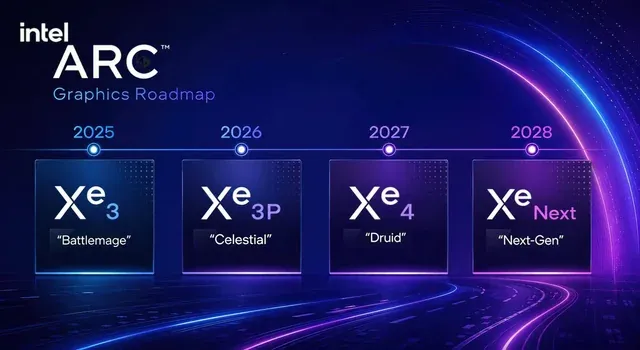
Panther Lake debuted Intel's latest Xe3 graphics architecture, but the IP isn't said to expand beyond iGPUs. For a while, we've known that "Xe3P" (codenamed Celestial) will serve as the refined follow-up, with many awaiting a proper successor to the existing Arc B-series dedicated GPUs. Unfortunately, a massive new leak dump from reliable tipster Jaykihn claims Intel canceled discrete gaming GPUs for Celestial a long time ago, and their fate hangs in the balance for even the next-gen Xe4 "Druid" architecture.
Celestial was canned long ago.Druid is up in the air.April 24, 2026
Originally, Xe3 was supposed to be Celestial with a planned 2025 launch, but Intel changed it to Battlemage, pushing Xe3P to be Celestial instead. That's why the iGPUs inside Panther Lake chips are classified as Battlemage parts. Last year, Intel announced the Crescent Island data center GPU as the first Xe3P/Celestial product, featuring an unprecedented 160 GB of LPDDR5X VRAM, slated for a 2026 release (that Jaykihn confirms for late 2026).
Xe3P is also reportedly used across Nova Lake for the display and media engine block, while a special NVL-S desktop CPU featuring 12 Xe3P cores (iGPU) is also in the works; NVL-S otherwise features only 2 Xe cores. Nova Lake-H (mobile) is rumored to use Xe3P throughout the entire lineup. So that, mixed with Cresent Island, perhaps Arc Pro-series workstation GPUs, and the rumored "Razor Lake-AX" (Strix Halo competitor after Nova Lake-AX was canned), constitutes the entirety of Xe3P.

There is no discrete gaming-focused graphics card planned. That means Battlemage will remain Intel's latest gaming dGPU at least until the next-gen Xe4/Druid architecture comes along. Jaykihn's leak points to a late-2027 release for Druid, but the possibility of a discrete gaming GPU remains "up in the air." Intel is planning to focus on the AI sector once again, with "Jaguar Shores" marking the debut of Xe4.
Snapshot, subject to change.Clearwater Forest 1H 2026.Diamond Rapids mid 2027, 16CH.Coral Rapids mid 2028, starting with 8CH.As mentioned in Q1 call, may be accelerated.Crescent Island and Crescent Island Workstation late 2026, Xe3p.Jaguar Shores late 2027, Xe4.April 24, 2026
Around the same time, the "Titan Lake" mainstream consumer CPUs might also feature Xe4 IP for integrated graphics and/or other display blocks. A supposed "Arc D-series" for gamers yearning for a next-gen dedicated GPU from Intel remains unconfirmed. The successor to Xe4 is rumored to be planned for mid-to-late 2028, according to the leak, and is likely to debut on whatever comes after Jaguar Shores in the rack-scale segment.
Xe3P = Celestial.Followed by Xe4 down the line.Xe4 successor may or may not be Xe5.Intel’s graphical architecture naming is not as straightforward as integer iterations; Xe4 itself has had multiple names, and multiple architectures have been referred to as Xe4, over time.April 24, 2026
All of this information is, of course, subject to change and of a speculative nature. Intel's roadmaps haven't been the most consistent, so take these leaks with a grain of salt. The main takeaway is how Intel has almost given up on the discrete gaming GPU market after a turbulent launch for Alchemist and Battlemage. Given the AI boom we're in, it's easy to understand how Celestial production could've been entirely reallocated to serve the datacenter and workstation markets. Let's hope that Druid marks the revival of dedicated gaming GPUs from the Blue Team.

Follow Tom's Hardware on Google News, or add us as a preferred source, to get our latest news, analysis, & reviews in your feeds.