









PCIe 4.0 SSD Exclusive: Testing Phison's PS5016-E16 NVMe Controller
Breaking The PCIe Speed Barrier
The debut of AMD's Ryzen 3000 series processors brings the industry's first PCIe 4.0 platform to market, promising more available bandwidth for all PCIe devices, like GPUs and storage. But do we really need a new faster interface and up to 5GB/s of blistering throughput from the latest SSDs, especially given the premiums associated with stepping up to PCIe 4.0-equipped X570 platforms? We've got Phison's new PCIe 4.0 reference SSD, which is the same design as the leading wave of new SSDs to hit the market, in our labs to find out.

Storage is an obvious use-case that can benefit from the doubled throughput of the faster interface. Flash has redefined storage, but the once-revolutionary technology easily outstripped the bandwidth limitations of the 6Gb/s SATA interface long ago. That led to the migration to the PCIe interface and the speedy NVMe protocol, but now the latest flash devices saturate the PCIe 3.0 x4 interface, too, and a flash glut has led to rock-bottom pricing, meaning you can score stupid-fast SSDs on the cheap.
But what if you want more? AMD has its PCIe 4.0 Navi graphics cards coming to market in tandem with the X570 chipset, but we don't expect the wider PCIe 4.0 pipe to impact GPU gaming performance much. The trick is to feed that pipe with faster data transfers, and that's where the new line of PCIe 4.0 SSDs will step in.
From entry-level SATA controllers to high-end NVMe controllers, Phison has made big strides in SSD controllers over the past four years, and now we have third-party SSDs that can compete with the likes of Samsung, WD, and Intel, but are less hurtful to our wallets.
We've been tracking progress on Phison's latest NVMe controller, the first PCIe 4.0 model on the market, for the last few months. Phison designed the PS5016-E16, better known as the E16, to power some of the fastest SSDs on the market. A few companies, such as Corsair, Gigabyte, Patriot, and a few others have announced Phison E16-powered SSDs and will have products out once available later this year, and we expect the second wave of products to come in the future.
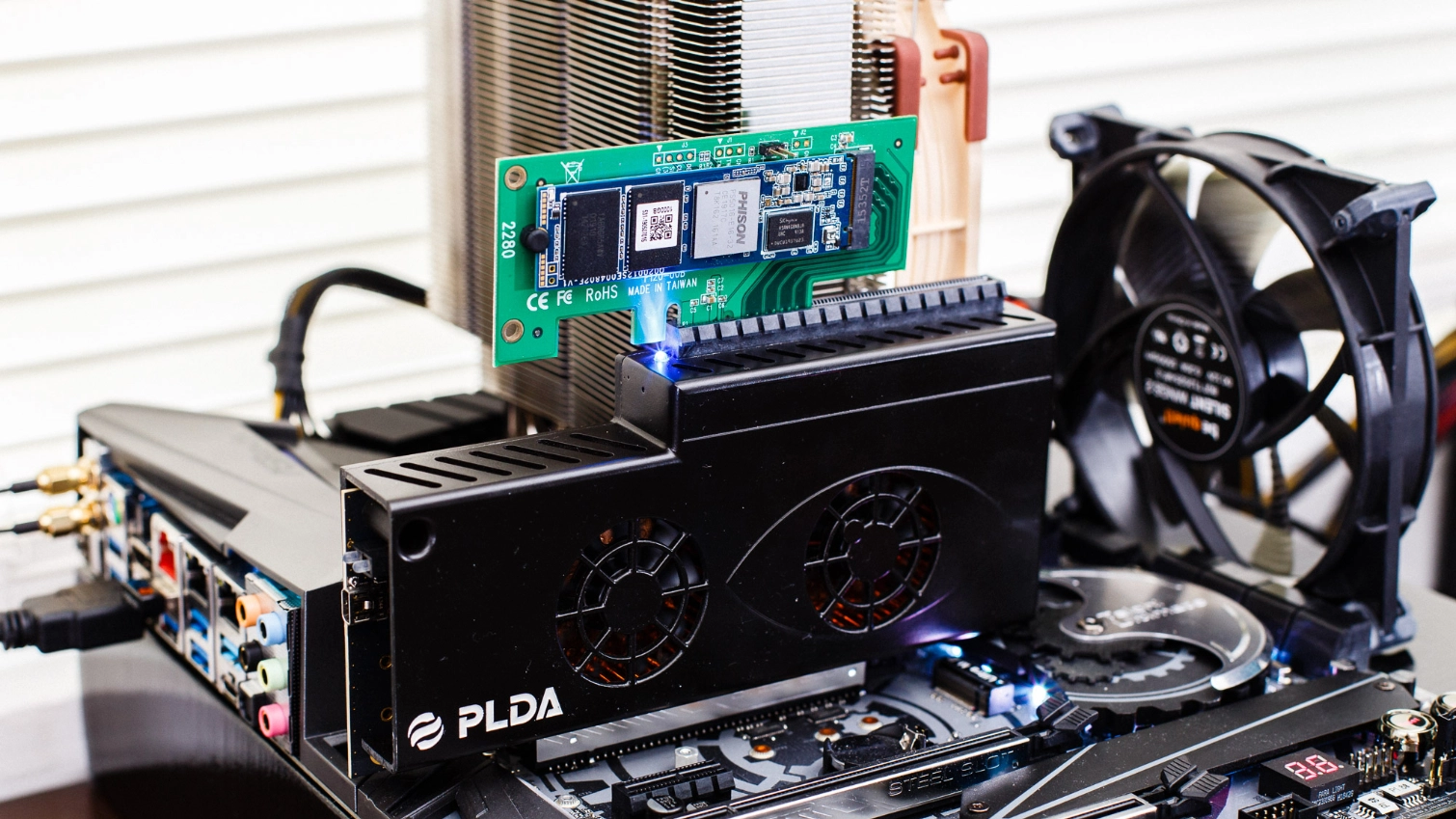
That means our sample, which is a reference Phison PCIe 4.0 SSD design, is nearly exactly the same as the first PCIe 4.0 SSDs that will come to market soon. We had the rare opportunity to test this SSD with a special $20,000 PCIe adapter to see how the increased performance impacts real-world workloads.
The Beginning of a New Era
PCIe is the fastest widely-used storage interconnect on modern motherboards. By slapping in a new NVMe SSD, you can hit speeds of upwards of 3.5GB/s over the PCIe 3.0 x4 interface. However, AMD’s new X570 chipset paired with Ryzen 3000 CPUs will open up the PCIe 4.0 interface, starting a new race to the top when it comes to enthusiast-class storage performance.
Get Tom's Hardware's best news and in-depth reviews, straight to your inbox.
The new interface enables more flexible lane width configurations and speed selection and doubles the potential bandwidth, which is huge. This means that we will see up to ~2GB/s per PCIe lane as opposed to the ~1 GB/s we see with the PCIe 3.0 interface. PCIe 4.0 carries over the same 128b/130b encoding as PCIe 3.0, so we won't lose most of the bandwidth to protocol overhead. Once NAND and controller designs improve, we may see SSDs hit upwards of ~8 GB/s (each direction) of throughput, or more.
Phison has always been rather fast to market with its controllers, and this time around is no exception. At CES 2019, Phison showed off early PCIe 4.0 SSD engineering samples running at ~4GB/s speeds when paired with Toshiba BiCS3 64-Layer TLC flash, but the flash actually slowed the controller down: At the time, Phison said it could hit ~4.8 GB/s with faster flash.
Phison developed the E16 with newer 3D TLC and QLC flash in mind. The chip supports eight NAND channels with 32 chip enables (CE) at up to 800 MT/s speeds, enabling up to 2TB of total capacity. The E12 can theoretically support up to 8TB of flash, but without enough demand for such hefty SSDs, Phison optimized its latest controller with support for mainstream capacities.
Specifications
| Model | Phison PS5016-E16 |
| Interface | PCIe 4.0 x4 |
| Protocol | NVMe 1.3 |
| NAND Channels | 8 |
| NAND Chip Enables | 32 |
| NAND Flash Support | 3D TLC & QLC |
| Supported Capacities | 512GB - 2TB |
| Form Factor | M.2 |
| DRAM | DDR4 |
| Manufacturing Process | 28nm |
| Sequential Read | 5,000 MB/s |
| Sequential Write | 4,400 MB/s |
| Random Read | 750,000 IOPS |
| Random Write | 700,000 IOPS |
| Error Correction | Phison's 4th Gen LDPC & RAID ECC |
| Encryption | AES-256 / TCG OPAL 2.0 & Pyrite |
| Endurance | Up to 3,600 TBW |
The sample we have in our lab today features firmware revision EGFM10E3 and Toshiba’s BiCS4 96-Layer TLC flash that has unlocked even more performance than Phison initially hoped for. With the new memory and a few more firmware optimizations in place, the E16 can now reach speeds of 5 GB/s read and 4.4GB/s write. That's record-breaking for a tiny M.2 device.
The E16 is built on a 28nm process node, just like the E12 before it. Actually, the E12 and E16 are very similar. Phison built the E16 on the E12’s design, so features like end-to-end data protection and thermal monitoring are included. The E16 controller supports AES-256, TCG OPAL 2.0 and Pyrite encryption features as well as S.M.A.R.T. data reporting, Trim, and the Format NVMe command to securely wipe data. In essence, the controller uses the E12's back end paired with a faster PCIe 4.0 PHY, Phison’s 4th Gen LDPC ECC engine, and some improved NAND IP. So, while the PHY is new, there aren't a lot of changes to compute capabilities: Most of the innovation is in the code.
A Closer Look
Because Phison built the E16 on the E12 foundation, the PCB design is basically the same, too. Our double-sided 1TB M.2 2280 form factor sample looks the same as current SSDs in the market, except for one thing: just like Silicon Motion, we see that Phison now places a nickel finish on the controller to help with heat dissipation. This is a great addition to see, but, hopefully, vendors will do away with the engineering sample’s blue PCB.


View Original

View Original

View Original

View Original

View Original

As mentioned earlier, our sample came with Toshiba’s 96-Layer BiCS4 TLC flash. Products 1TB and under will feature 256Gbit die, while 2TB products will feature 512Gbit die. BiCS4 enables a boost in performance over BiCS3, and, based on Gigabyte's marketed 3,600 TBW endurance for their 2TB Aorus NVMe, endurance figures have slightly improved over the E12’s max support for up to 3,120 TBW of endurance. That could also be partially due to the fourth-Gen LDPC engine, too.
SSD Test System


View Original

View Original

View Original

View Original

View Original

| CPU | Intel Core I7 9700K @5GHz |
| RAM | 2x8GB Kingston HyperX Predator RGB @4GHz |
| Motherboard | ASRock Z390 Taichi Ultimate |
| CPU Cooler | Noctua NH-U14S |
| PSU | EVGA 500W |
Wait…PCIe 4.0 isn’t out, how did we test it?
Considering there aren’t any consumer PCIe 4.0 systems on the market at the time of writing, testing one of these bad boys seemed rather impossible. That is until we pulled some strings and happened to come across a $20,000 Gen4HOST add-in card from PLDA. What does this AiC do? Basically, it converts our PCIe 3.0 x16 slot on the host system to a PCIe 4.0 x8 connection that communicates with PCIe 4.0 endpoints. This type of board is used for development and validation, just as we are going to validate performance here today.
MORE: Best SSDs
MORE: How We Test HDDs And SSDs
MORE: All SSD Content

Sean is a Contributing Editor at Tom’s Hardware US, covering storage hardware.
-
AlistairAB Those results were not very good, not enough to justify PCIe 4.0. I'm very happy with my SX8200 Pro SSDs as you can see barely any real OR synthetic differences. Looking forward to the E19 SSD next year then :)Reply -
djayjp I don't understand the purpose of this test. Seems there are two variables (the new interface and the drive itself)?Reply -
seanwebster Reply
The purpose? We got an early sample of an upcoming SSD controller that is going to be at the heart of SSDs that are coming out later this year. It's a preview on the upcoming tech. The purpose is to show how future SSDs will compare to current gen as it stands in development. It just happens that even with the faster interface low queue depth random performance is still about the same, so we don't see much improvement in applications that rely on that metric. High QD random and all sequential applications will see decent gains more than anything thanks to the new interface. For more gains, the underlying media needs to be changed for faster, as we see with Intel's Optane, or applications need to be coded to better take advantage of all of NVMe's goodness.djayjp said:I don't understand the purpose of this test. Seems there are two variables (the new interface and the drive itself)? -
srbabs On the 4th and 5th slides of power consumption, the units are labeled as watts, my guess it is supposed to be miliwatt. Could some one check it out?Reply -
USAFRet Reply
Is it worth "upgrading" from what you have now?AlistairAB said:Those results were not very good, not enough to justify PCIe 4.0. I'm very happy with my SX8200 Pro SSDs as you can see barely any real OR synthetic differences. Looking forward to the E19 SSD next year then :)
No.
But it will just be the (slightly faster) protocol for your next system. -
seanwebster Replysrbabs said:On the 4th and 5th slides of power consumption, the units are labeled as watts, my guess it is supposed to be miliwatt. Could some one check it out?
Yeah, those are supposed to read milliwatts. I recently changed it from Watts to Milliwatts for better visual comprehension. I thought I had fixed that testual label tho...looking back I did, just in a different file! I'll get that fixed. Thanks for noticing! -
daglesj Will still grind to a halt when copying system folders full of thousands of micro files. This is where we need to improve performance not just raw bandwidth.Reply -
BulkZerker ReplyAlistairAB said:Those results were not very good, not enough to justify PCIe 4.0. I'm very happy with my SX8200 Pro SSDs as you can see barely any real OR synthetic differences. Looking forward to the E19 SSD next year then :)
djayjp said:I don't understand the purpose of this test. Seems there are two variables (the new interface and the drive itself)?
Well I'm beginning to wonder what version of Windows was being used during testing. That information is not disclosed in the review as of me posting. -
seanwebster Reply
The latest: Win 10 Pro 64-bit - RS6BulkZerker said:Well I'm beginning to wonder what version of Windows was being used during testing. That information is not disclosed in the review as of me posting. -
epobirs I couldn't help wondering if the device that created the PCIe 4.0 interface for the test was introducing its own issues. That aside, it looks like there will need to be advances elsewhere in consumer PC design before the performance potential can be realized. Boot time haven't shifted much in quite a while, despite huge gains in SSD capability. It doesn't seem like getting the OS into RAM is the issue at this point but rather how long it takes the OS to sort itself out. Might there be opportunities for improvement in the hardware that stores and loads the firmware, for example?Reply