




Elon Musk's Terafab semiconductor project could cost $5 trillion, Bernstein claims — herculean effort would cost more than 70% of the total yearly US government budget
But for TeraFab, money is not the only limitation.
Although the $20 billion funds injected in Elon Musk's TeraFab project — which is supposed to build logic and memory chips as well as package them under one roof — is barely enough to build a 7nm-class logic fab, Elon Musk's eventual ambitions include producing millions or billions of AI chips that consume 1 terawatt (1 TW) of power per year. This ambition by far exceeds today's industry capacity, and if Musk pursues it, he will need $5 trillion, according to Bernstein, a premier semiconductor analysis firm (via @Jukan05). Interestingly, the order of the sum is similar to what Sam Altman was seeking for his failed fab network a couple of years ago.
To build 1 TW of AI silicon per year, Elon Musk's TeraFab would need to process 22.4 million Rubin Ultra GPU wafers, 2.716 million Vera CPU wafers, and 15.824 million HBM4E wafers annually using from 142 to 358 fabs, according to Bernstein.
The firm gets these figures, which it describes as "a very rough back-of-the-envelope wafer capacity calculation," by using a top-down approach, translating rack-level power demand into required semiconductor manufacturing capacity. Using power consumptions of rack-scale systems (120 kW for Rubin to 600 kW for Rubin Ultra), analysts convert system volumes into chip counts and then into wafer demand using their die sizes, such as ~825 mm² for GPU dies, ~800 mm² for CPU dies, the number of HBM stacks, and yields.

But Bernstein seems to overstate the typical capacity of logic fabs (50,000 wafer starts per month, WSPM, instead of 20,000 WSPM), understates the capacity of DRAM fabs (50,000 WSPM instead of 100,000 – 200,000 WSPM), and assumes prices per fab at $35 million, which likely inflates total estimates even if the multi-trillion-dollar magnitude is generally correct.
Trillions for fabs and packaging facilities
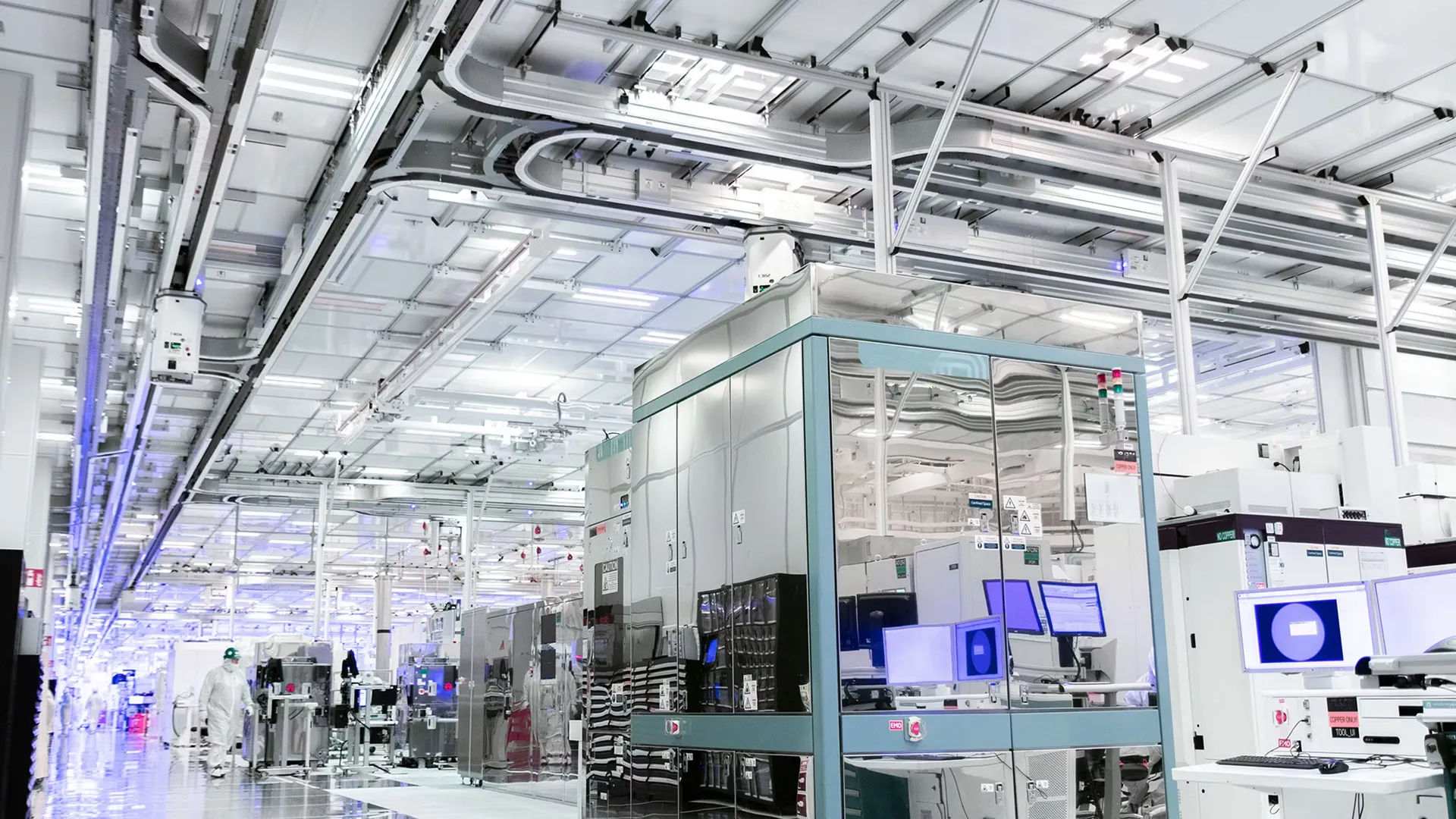
Based on what we know about the modern semiconductor industry, a modern leading-edge logic fab typically delivers around 20,000 WSPM, or roughly 240,000 wafers per year. To produce 25.116 million logic wafers annually, TeraFab would require about 105 fabs at perfect yields, or 126 fabs at 80% yields. A 2nm-class capable fab costs from $25 billion to $35 billion (~$30 billion midpoint), so logic capacity alone would require around $3.15 trillion, assuming a 100% yield and $3.78 billion at 80% yield.
For context, TSMC shipped 15.023 million 300-mm-equivalent wafers in 2025, which includes 200-mm wafers and 300-mm wafers made on outdated process technologies. Also important, TSMC currently operates about 50 300-mm fab modules built over two decades.
Large-scale high-bandwidth memory (HBM) production is also crucially important for achieving Elon Musk's goals for TeraFab. Modern DRAM fabs — run by Micron, Samsung, and SK hynix — typically offer 100,000 to 200,000 WSPM (so, let us take 150,000 WSPM as the midpoint). Producing 15.824 million HBM4E wafers would require about 9 fabs at 100% yield, or ~12 fabs at 70% yield. Each of these fabs costs at least $20 billion, or roughly $240 billion for front-end memory capacity alone. However, HBM output is constrained by stacking and packaging capabilities and yields, not only by the output of DRAM devices. For comparison, the three major DRAM makers currently operate only ~30 fab modules built since the early 2000s.
Get Tom's Hardware's best news and in-depth reviews, straight to your inbox.
Advanced packaging facilities used for 2.5D and 3D integration, as well as HBM assembly, cost around $2 billion to $3.5 billion per phase, and TeraFab would require tens or even hundreds of such facilities to assemble AI processors and HBM stacks, which means hundreds of billions of dollars in additional investment.
Altogether, TeraFab would require well north of $4 trillion, which generally aligns with Bernstein's $5 trillion estimate, excluding land, process R&D, software, and ecosystem development.
Constraints beyond money
Raising $5 trillion would be extraordinarily difficult. For context, companies like Nvidia, Apple, and Alphabet have market capitalizations of $4.34 trillion, $3.71 trillion, and $3.5 trillion, respectively, so Musk would need to mobilize capital exceeding the value of the world's most valuable corporations. It is hard to imagine a private fundraising round, consortium, or even sovereign funding of this magnitude. For example, even if the U.S. would like to fund Musk's semiconductor venture, it could not do this that easily, as its budget for this year is about $7 trillion.
The only conceivable path would involve multi-government backing, sovereign wealth funds, hyperscalers, and capital markets acting in concert. However, we doubt this is possible at all. Furthermore, at a scale of $5 trillion deployed within a foreseeable timeframe, constraints would extend beyond capital and would include limited availability of wafer fabrication equipment, construction materials, and a sufficiently large and skilled workforce to build, operate, and maintain such fabs.
Then again, does Musk really plan to build a foundry that would leave behind TSMC, Samsung, and Intel combined just to make enough chips for Tesla, SpaceX, and xAI? Well, this is an open question.


Anton Shilov is a contributing writer at Tom’s Hardware. Over the past couple of decades, he has covered everything from CPUs and GPUs to supercomputers and from modern process technologies and latest fab tools to high-tech industry trends.
-
usertests If they pull out technology that can substantially beat ASML EUV, maybe there's a chance, and multi-trillion estimates can be revised downward. If they plan to buy ASML machines, forget about it.Reply
There's always the possibility of a technological surprise upending the status quo, but you should assume it won't happen in this field.
Substrate's claims about revolutionary ASML-beating chipmaking technology scrutinized, analyst likens the venture to a fraud — report pokes holes in the startup's technology, messaging, and leaders -
spooh_ Bernstein seems to calculate exactly how TSMC would manufacture nvidia chips.Reply
But Tesla/SpaceX doesn't try to compete with them - they're aiming to manufacture just two highly specialized chips in insane amounts for internal needs. Then without time or cost pressure from external clients they can try things unimaginable for TSMC -
Elrabin Reply
You do realize that Tesla HW3 is 100 watts, HW4 is 160 watts and HW5 is "up to 800 watts when processing complex environments" right?spooh_ said:Bernstein seems to calculate exactly how TSMC would manufacture nvidia chips.
But Tesla/SpaceX doesn't try to compete with them - they're aiming to manufacture just two highly specialized chips in insane amounts for internal needs. Then without time or cost pressure from external clients they can try things unimaginable for TSMC
The Bernstein calculations are based on 1400 watt B300 accelerators.
If we swap that out for HW5 800 watt target TDP, we have to increase the fab numbers by 60% to hit the power target output per year.
So your argument makes Elon's claim even MORE ridiculous. HW5 isn't even out yet. The design might be complete, but it's not shipping yet. -
DougMcC Reply
But the terafab hasn't even broken ground yet. It would surely manufacture HW8 at the earliest.Elrabin said:You do realize that Tesla HW3 is 100 watts, HW4 is 160 watts and HW5 is "up to 800 watts when processing complex environments" right?
The Bernstein calculations are based on 1400 watt B300 accelerators.
If we swap that out for HW5 800 watt target TDP, we have to increase the fab numbers by 60% to hit the power target output per year.
So your argument makes Elon's claim even MORE ridiculous. HW5 isn't even out yet. The design might be complete, but it's not shipping yet.
The general idea holds: if Terafab can't get any price advantage for optimizing for a single target, it would be colossally embarrassing. The only real question is how much cost savings you get out of the optimization, and this price estimate doesn't seem to factor this in at all. -
Stomx "Elon Musk's eventual ambitions include producing millions or billions chips that consume 1 terawatt (1 TW) of power per year. "Reply
The introduced unit "terawatt per year" is really something new the technical world never heard of so far 😀 -
DS426 There we go, now we're looking at more realistic figures given the specs that Musk laid out for this project. $20b just gets the project underway.Reply -
Elrabin Reply
It is exceptionally unlikely that they're going to get a price advantage in excess of the $20-25bn to break ground let alone the hundreds of billions or even trillions needed to hit these types of production targets.DougMcC said:But the terafab hasn't even broken ground yet. It would surely manufacture HW8 at the earliest.
The general idea holds: if Terafab can't get any price advantage for optimizing for a single target, it would be colossally embarrassing. The only real question is how much cost savings you get out of the optimization, and this price estimate doesn't seem to factor this in at all.
Simple math.
Even if they reduced price per chip by 50%, which is unlikely, are they buying billions of dollars of chips per year to make this make sense?
2025 Tesla sold a grand total of 1.65 million vehicles globally. The company's GAAP Operating Income was $4.4 billion.
Please explain how spending hundreds of billions to make net income of $3.8 billion makes sense? The actual chip costs here are a fraction of the income.
In Jan 2026, average Tesla price was $52,628.
The math doesn't math man -
SkyBill40 Typical Musk boast, complete with unrealistic and laughably unattainable end results. Are we to the point yet of just sidestepping anything he says given so much of it is bordering on ridiculous?Reply -
truerock If Musk said, “The Terafab is expected to produce one terawatt of computing power in chips each year."Reply
First, there is no time-frame of when the goal would be reached.
Second "one terawatt of computing power each year" is an not a clear and meaningful phrase. -
alan.campbell99 Reply
I really do think this is how he should be treated. Does he ever say this stuff in a venue or situation where he can immediately be pressed with critical questions in response rather than into his managed echo chamber?SkyBill40 said:Typical Musk boast, complete with unrealistic and laughably unattainable end results. Are we to the point yet of just sidestepping anything he says given so much of it is bordering on ridiculous?