Shop for Computer Cooling Fans
CNPS7000B-AlCu LED CPU Cooler CNPS7000B-AlCu LED CPU Cooler

Compare the top 5 lowest prices by hovering your mouse over the product names on the left

$29.65
Vanquisher CPU Cooler Vanquisher CPU Cooler $24.99
CL-P0401 V1 CPU Cooler CL-P0401 V1 CPU Cooler $69.99
HDT-S1283 CPU Cooler HDT-S1283 CPU Cooler $34.99
Zalman CNPS9500 AM2 CPU Cooler $55.99

See More Products...

Pentium D 830

The Pentium D 800 series equals two Pentium 4 600 dies on a chip, but with only 1 MB L2 cache per core. All other features of the Pentium 4 600 series were retained. Since two processing cores require more power than a single one and the power envelope of 130 W imposes a restriction, clock speeds had to be reduced a bit. As a consequence, the fastest model was the Pentium D 840 at 3.2 GHz, with the Pentium D 820 at 2.8 GHz being the entry-level dual core. Our Pentium D 800 at 3.0 GHz, which is model 830, provided slightly more performance than the Pentium 4 630, but also required the most power of all processors in our lineup: 215 watt-hours is a lot, especially when compared to the 106 watt-hours of the Core 2 Duo E6850.

Related Articles:

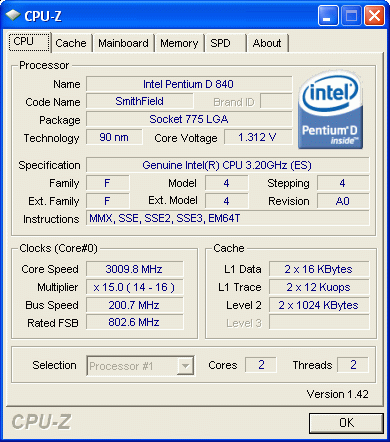
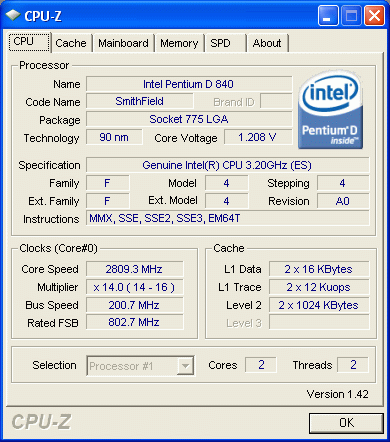
We used a Pentium D840 (3.2 GHz) and set it to 3.0 GHz (Pentium D 830).

With Enhanced SpeedStep enabled, a Pentium class FSB800 processor on Socket 775 will reduce its idle clock speed to 2.8 GHz. In case of the Pentium D 830, this is not much of a difference compared to the default clock speed of 3.0 GHz.

Talkback
hkazemi 05/31/2008 1:52 AM
Hide
-0+
hkazemi
The 'SYSmark Performance per Watt' can be misleading when comparing the dual and quad core processors, particularly when looking at other types of loads that make better use of the additional cores. In particular, look at x264 encoding, where a quad-core processor offers nearly double performance. See the graysky's articles on TechARP for actual charts and tables:
http://www.techarp.com/showarticle.aspx?artno=442
http://www.techarp.com/showarticle.aspx?artno=520

For a load that will use all processors, I believe that testing will show better performance per watt for a quad core compared to a dual (or even single) core because there is little or no additional overhead from the motherboard or powersupply or hard drives when adding an additional core.

It may be easier to understand this by comparing running 2 separate PCs with dual core CPUs in them vs. running a single PC with a quad core CPU. The quad core system won't need another motherboard, power supply, fans, drives, etc. so all those items are areas of power savings.

From the published tests above, the 2 extra cores consume 195-132=63 watts at max load and 94-77=17 watts at idle. That is in contrast to adding a 2nd system identical to the E6850 testbox which used 132 watts at max and 77 at idle.

A simplistic scaling using a spreadsheet, and assuming that performance doubles going from dual to quad cores (reasonable for x264 encodes), shows that:

state cores watts perf/watt perf perf/core perf ratio
Idle 2 77 1.46 112.42 56.21 1
Idle 4 94 2.391914894 224.84 56.21 1.638
Avg 2 90 1.46 131.4 65.7 1
Avg 4 112 2.346428571 262.8 65.7 1.607
Max 2 132 1.46 192.72 96.36 1
Max 4 195 1.976615385 385.44 96.36 1.354

In other words, using the system power numbers given, the quad core can be 35% to 64% more efficient than using a dual core, if given an appropriate load. A look at the Sysmark benchmark scores will show you that it did not scale up very much going from dual to quad.

Note You are going to post a comment as anonymous.