CPU And GPU Performance
CPU Performance

| Hardware Comparison | ||||
|---|---|---|---|---|
| Row 0 - Cell 0 | SoC | CPU | RAM | GPU |
| Kindle Fire (First-Gen) | OMAP 4430 | 1.0 GHz Dual-Core Cortex-A9 | 512 MB | PowerVR SGX540 @ 304 MHz |
| Kindle Fire (Second-Gen) | OMAP 4430 | 1.2 GHz Dual-Core Cortex-A9 | 1 GB | PowerVR SGX540 @ 304 MHz |
| Kindle Fire HD | OMAP 4460 | 1.2 GHz Dual-Core Cortex-A9 | 1 GB | PowerVR SGX540 @ 384 MHz |
| Nexus 7 | Tegra 3 (T30L) | 1.3 GHz Quad-Core Cortex-A9 | 1 GB | ULP GeForce |
The OMAP 44x0's dual-core ARM Cortex-A9 processor now operates at 1.2 GHz, but it still falls between 20 and 30% behind the quad-core Tegra 3 at 1.3 GHz in our integer and floating-point benchmarks. Although its new tablets sport a faster SoC, Amazon continues to trail when it comes to performance. When competing tablets based on Qualcomm's S4 Pro emerge, the Kindle Fire and Kindle Fire HD will fall even further behind.
| GeekBench v2 | Overall | Integer | FPU | Memory |
|---|---|---|---|---|
| A5/A5X (Dual-Core Cortex-A9, 1.0 GHz)(iPad 2/iPad 3) | 764 | 691 | 921 | 830 |
| OMAP 4430 (Dual-Core Cortex-A9, 1.0 GHz)(Kindle Fire, First-Gen) | 827 | 591 | 1139 | 974 |
| OMAP 4430 (Dual-Core Cortex-A9, 1.2 GHz)(Kindle Fire, Second-Gen) | 1085 | 881 | 1571 | 1001 |
| OMAP 4460 (Dual-Core Cortex-A9, 1.2 GHz)(Amazon Kindle Fire HD) | 1113 | 900 | 1540 | 1098 |
| Tegra 3, T30L (Quad-Core Cortex-A9, 1.3 GHz)Google Nexus 7 | 1527 | 1298 | 2288 | 1222 |
| S4 Pro (Quad-Core Krait, 1.5 GHz)Qualcomm Dev Platform | 1960 | 1400 | 3292 | 1276 |
GPU Performance

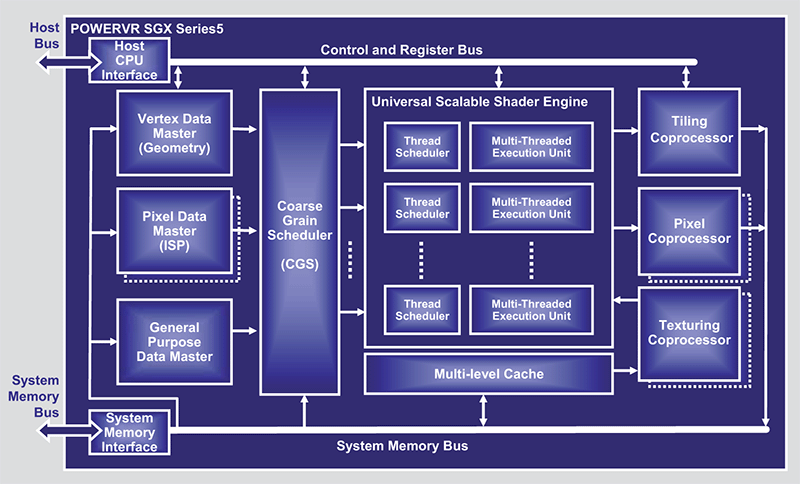
Both the OMAP 4430 and 4460 employ Imagination Technologies' PowerVR SGX 540. If this graphics engine sounds familiar to you, that might be because it's derived from the same architecture as the GPUs in Apple's A4 and A5.
| GPU Subsystem | |||
|---|---|---|---|
| Row 0 - Cell 0 | PowerVR SGX 535 (Apple A4) | PowerVR SGX 540 (OMAP 4430) | PowerVR SGX 543 (Apple A5) |
| SIMD | USSE | USSE | USSE2 |
| Pipelines | 2 | 4 | 4 |
| TMUs | 2 | 2 | 2 |
| Bus Width (in bits) | 64 | 64 | 64 |
| Triangle rate @ 200 MHz | 14 MTriangles/s | 28 MTriangles/s | 35 MTriangles/s |
The SGX 543 used in the Apple A5 includes four USSE2 (Universal Scalable Shader Engine 2.0) pipes. In comparison, the SGX 540 found in Amazon's new tablets features the same number of pipes based on the older USSE design. The SGX 535 used in Apple's A4 hails from the same GPU generation as the SGX 540, but features only two USSE pipes.
| GLBenchmark 2.1.2 | |||||
|---|---|---|---|---|---|
| Row 0 - Cell 0 | Egypt Standard | Pro Standard | Egypt Offscreen (720p) | Pro Offscreen (720p) | Fill Rate |
| PowerVR SGX543MP2 (iPad 2) | 6661 frames(59 FPS) | 2962 frames(59 FPS) | 10 146 frames(90 FPS) | 7352 frames(147 FPS) | 998.24Mtexels/sec |
| PowerVR SGX543MP4 (iPad 3) | 6709 frames(59 FPS) | 2975 frames(60 FPS) | 15 663 frames(139 FPS) | 12 546 frames(251 FPS) | 1964.68Mtexels/sec |
| PowerVR SGX540 (Kindle Fire, First-Gen) | 2966 frames(26 FPS) | 1952 frames(39 FPS) | 2632 frames(23 FPS) | 2079 frames(42 FPS) | 234.3Mtexels/sec |
| PowerVR SGX540 (Kindle Fire, Second-Gen) | 3492 frames(31 FPS | 2399 frames(48 FPS) | 3296 frames(29 FPS) | 2478 frames(50 FPS) | 226.1Mtexels/sec |
| PowerVR SGX540 (Kindle Fire HD) | 2835 frames(25 FPS) | 2073 frames(41 FPS) | 3709 frames(33 FPS) | 2656 frames(53 FPS) | 225.01Mtexels/sec |
| Tegra 3 (Nexus 7) | 5968 frames(53 FPS) | 2830 frames(57 FPS) | 7073 frames(63 FPS) | 4095 frames(82 FPS) | 467.57Mtexels/sec |
| Adreno 320 (S4 Pro MDP) | - | - | 15447(137 FPS) | 9560 frames(191 FPS) | 795.62Mtexels/sec |
If you've already read Snapdragon S4 Pro: Krait And Adreno 320, Benchmarked, then you know Qualcomm's S4 Pro has a performance advantage thanks to its Krait processor cores. It doesn't have the lead in graphics, though. Rather, the S4 Pro normalized to 720p edges-out Nvidia's Tegra 3 and comes up just short of the PowerVR SGX543MP4 in Apple's A5X.
Of course, it's interesting to compare graphics engines rendering at the same resolution for evaluation purposes. But, in the real-world, the devices you find each SoC in employ different resolutions. Amazon's second-gen Kindle Fire outperforms its predecessor, but the Kindle Fire HD is actually the slowest of the three. It does benefit from a slightly faster GPU, but is then hampered by a higher resolution.
The second-generation Kindle Fire outperforms its predecessor, but the Kindle Fire HD is actually the slowest of the three. It benefits from a slightly higher GPU clock speed, but it is hampered by its higher resolution. Compared to the Kindles, Google's Tegra 3-equipped Nexus 7 dominates, even though it uses the same resolution as the Fire HD.
| GLBenchmark 2.5 | ||||
|---|---|---|---|---|
| Row 0 - Cell 0 | Egypt HD | Egypt HD OffscreenFixed Time (1080p) | GLBenchmark Egypt HD Offscreen (1080p) | Fill RateOffscreen |
| PowerVR SGX543MP2 (iPad 2) | 2446 frames(22 FPS) | 102.7 s (11 FPS) | 1507 frames (13 FPS) | 938.6Mtexels/sec |
| PowerVR SGX543MP4 (iPad 3) | 2363 frames(21 FPS) | 57.4 s (20 FPS) | 2731 frames (24 FPS) | 1772.8Mtexels/sec |
| PowerVR SGX540 (Kindle Fire, First-Gen) | 824 frames(7.3 FPS) | 275.4 s (4.1 FPS) | 532 frames (4.7 FPS) | 289.3Mtexels/sec |
| PowerVR SGX540 (Kindle Fire, Second-Gen) | 960 frames(8.5 FPS) | 267.3 s (4.2 FPS) | 566 frames (5.0 FPS) | 297.8Mtexels/sec |
| PowerVR SGX540 (Kindle Fire HD) | 919 frames(8.1 FPS) | 271.3 s (5.2 FPS) | 691 frames (6.1 FPS) | 284.0Mtexel/s |
| Tegra 3 (Nexus 7) | 1464 frames(13 FPS) | 148.2 s (7.6 FPS) | 995 frames (8.8 FPS) | 490.3Mtexels/sec |
| Adreno 320 (S4 Pro MDP) | - | 54.1 s (21 FPS) | 2927 frames (26 FPS) | 530.1Mtexels/sec |
Going back to normalized testing, forcing each solution to run at 1920x1080 changes the story. Now, Qualcomm's Adreno 320 wins by a small margin over the SGX543MP4, even though it can't compete with the PowerVR architecture's fill rate.
GLBenchmark 2.5 improves on the prior version in a number of ways. First, the benchmark focuses exclusively on the Egypt scene. Adding higher-quality textures makes it a more taxing workload, and cranking up the intensity hurts the A5X.