Codenames, Continued
November 2004 saw AMD move into the 90 nm age, nine months after Intel did. AMD unveiled a new and very impressive CPU, codenamed Winchester (D0), which was only available in the low-cost market segment. As such, the core made its way into the Athlon 64 3000+, 3200+ and 3500+ models. The technology it was based on was anything but low-cost, though: we would have loved to see the looks on the faces of Intel's engineers when they measured the power consumption of AMD's 90nm CPUs and realized that even under full load, this unimposing CPU draws a mere 31.4 W. This means AMD was able to reduce the power consumption by about 44% clock for clock. Further measurements taken on a specially-modified motherboard in our Munich lab showed an idle power consumption of only 11.1 W.

Although it looks the same from the outside, the X2 contains two cores.
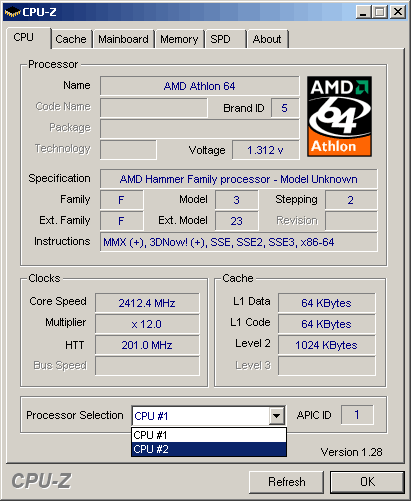
When the CPU arrived at the THG lab, it was so new that CPU-Z could not yet identify the X2.
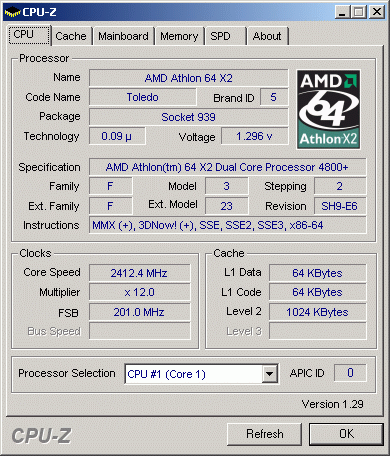
A newer version of CPU-Z displaying the correct information.
Underneath the heat spreader, the two cores run at a maximum clock speed of 2.4 GHz. AMD codenamed its first dual-core die Toledo (E6) and appended the X2 tag to the processor number to denote dual core technology. The first two models were the Athlon 64 X2 4800+ and 4400+, each with 1 MB of L2 cache (per core). As far as performance is concerned, these processors are superior to Intel's offerings. Among other things, this is due to the fact that AMD connects the two cores using its Hyper Transport interface. As a result, the performance penalties in single-threaded environments - compared to a single-core CPU running at the same speed - are lower than on Intel's Pentium D. In our dual-core benchmarks with four applications, the X2 impressed us by offering a 24% performance advantage over its rival from Intel. In games, the AMD chip was even able to outpace the Pentium D 840 by up to 47%.