- 17" LCD: Samsung 171N & NEC LCD1760V vs. Everyone Else
- An LCD Screen to Start the Year: Hitachi CML174SXW
- 17" LCD Part III: It's Christmas Already!
- 15" LCD Comparison Part III: Better and Cheaper
- Comparison: Seven 21" and 22" CRT Monitors
- 17" LCD Part II: The Heavyweights Enter The Ring
- 17" LCD Part I: Six Sexy Panels
- Comparison of 15" LCD Monitors - Part II
- Comparison: Twelve 19" CRT Monitors
- Looks Good for the Money: The Cornerstone p2460 19" Flat Screen CRT...
- THGC Needs You -Team 40051
- Core 2 Duo 4300 vs Brisbane 4800+
- What will it take for safe power supply to run this?
- Limitations/drawbacks of Dual xenon vs Dual Core Quad
- Is vista really that bad performancewise ?
- Phenom 9600 BE & Vista x64 users- STABLE?
- Overclocking general questions
- How do I get my attempted overclocked x1900xt back to stock?
- Ram speed question..
- machine still slow after 1gb mem added
Source: Tom's Hardware US – Keywords: penalty
Topics: CeBIT
Syndication:
QDI, Relisys, Samsung, Solarism, Sony, VideoSeven, ViewSonic
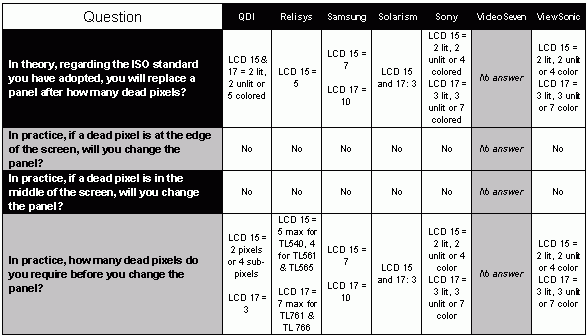
QDI sticks pretty much to the standard. The difference might just be due to a slip in their answer.
After getting an initial rejection from Relisys, we finally met with them at the CeBIT. Since then, Relisys has completely cleaned up its line of products. Gone are the days when 12 pixel errors were required before they took action. Now, all it takes are four or five faulty pixels (depending on the model) with the 15" models and seven pixels with the 17" model. However, this is still above the average and pushes the tolerance level.
Sony is one of the few exceptions: they follow the ISO standard, they understand it and they apply it.

Solarism has a straightforward policy: whether 15 or 17 inches, they change it after three dead pixels.
Samsung could try harder. Six dead pixels allowed on a 15", or nine on a 17", are too many!
ViewSonic assured us they have applied the ISO 13406-2 standard to the letter since it came into force. This is something of an exception.
- Previous page LaCie, Lite On, Mitac,...
- Next page ISO Standard: What It Actually Says