Sign in with
Sign up | Sign in

Firecracker or Power Plant?

Who's Who In Power Supplies, 2014: Brands Vs. Manufacturers
By

How do you identify a bad power supply before buying it?

  • Extremely high wattage claims at comparatively low prices are suspicious. There are simply no decent 750 W power supplies for $50. For every product class based on performance and features, there must be a minimum price. When a product is significantly below that price, be cautious. You can get a "400 W PSU" for $20, and such fire hazards are installed in budget PCs every day by unscrupulous companies that know exactly the risk they're handing off to buyers.
  • Check the specifications. For example, if a PSU claims high performance on the 3.3 and 5 V rails while the 12 V rail numbers are low, then you know something is wrong.
  • The manufacturer does not specify any combined maximum performance, but instead only shows the maximum load for each rail separately. This is done without specifying how much real power would be available if all rails are used at the same time. Avoid PSUs without this information.
  • Be careful with juicy marketing expressions and commercial lingo: Super, Extreme, Gaming, Combat, etc. Using superlatives to describe something quite normal should arouse suspicion and have you double-check specification details.
  • Passive rather than active Power Factor Correction (PFC) leads to lower power efficiency.
  • Very few or short power connectors and cables might be an issue. A 750 W PSU usually has four PCIe connectors for graphics cards (2 x 6-pin and 2 x 6+2-pin), so think twice if a model only offers two (or at least consider your upgrade options).
  • With cheap PSUs, the quality of the cable insulation may be poor, or the cables may not be insulated at all. The power cable grommet may also be insufficiently padded.
  • Be careful if there are few or no indications of protection circuitry. If the PSU specification only says OPP (overload protection) or perhaps SCP (short circuit protection), this points towards a normal fuse. If the specification also says OVP (overvoltage protection), this probably means that it is equipped with a simple metal oxide variable resistor. These security measures by themselves are absolutely insufficient and cannot replace any kind of digital safety chip. 

Unfortunately, you can't always tell at first glance whether you're dealing with a high-quality PSU or whether there's nothing but disappointment waiting behind the pleasant facade. Therefore, we decided to open up two budget PSUs representative of what you can find in many of today’s OEM PCs and illustrate the points and features you should be examining.

A First Look At the Inside: Primary Capacitor and PFC

First, look at the storage capacitors in the primary circuit. These act as buffers and help protect the PSU and computer from voltage fluctuations. The electrolyte used in them is key, because it evaporates or dries out through a combination of heat and time. As a general rule, capacitor lifetime is halved for each 10 degrees Centigrade increase in temperature over the specified normal load. Using higher-quality capacitors that can handle 105 degrees instead of 85 degrees (C) should almost double their lifetime, greatly contributing to the PSU's durability.

A PSU equipped with a big choke like in the photo above is a clear indicator of passive Power Factor Correction (PFC). Only more sophisticated active circuitry allows for factors close to the optimum value of 1, while passive components can reach 0.7 to 0.8 at best. The type of power factor correction indirectly suggests the expected efficiency of the power supply. Although PFC and efficiency are casually unrelated, devices with active PFC are also usually more complex and modern, meaning you're more likely to get better efficiency from them.

Protection Circuits

Even without opening the PSU, a data sheet can reveal some of the safety measures taken (or not) by manufacturers. A decent PSU should contain the following safety measures:

  • OCP (Over Current Protection): protection against power spikes
  • OVP (Over Voltage Protection)
  • OPP (Over Power Protection): overload protection, sometimes called OLP 
  • OTP (Over Temperature Protection): protection from overheating 
  • UVP (Under Voltage Protection) 
  • SCP (Short Circuit Protection) 
  • NLO (No Load Operation): this isn’t exactly protection in the same sense as the other features, but it allows the PSU to power up and function normally, even with no load.

Without this information, you have to look inside the PSU to find out what you need to know.

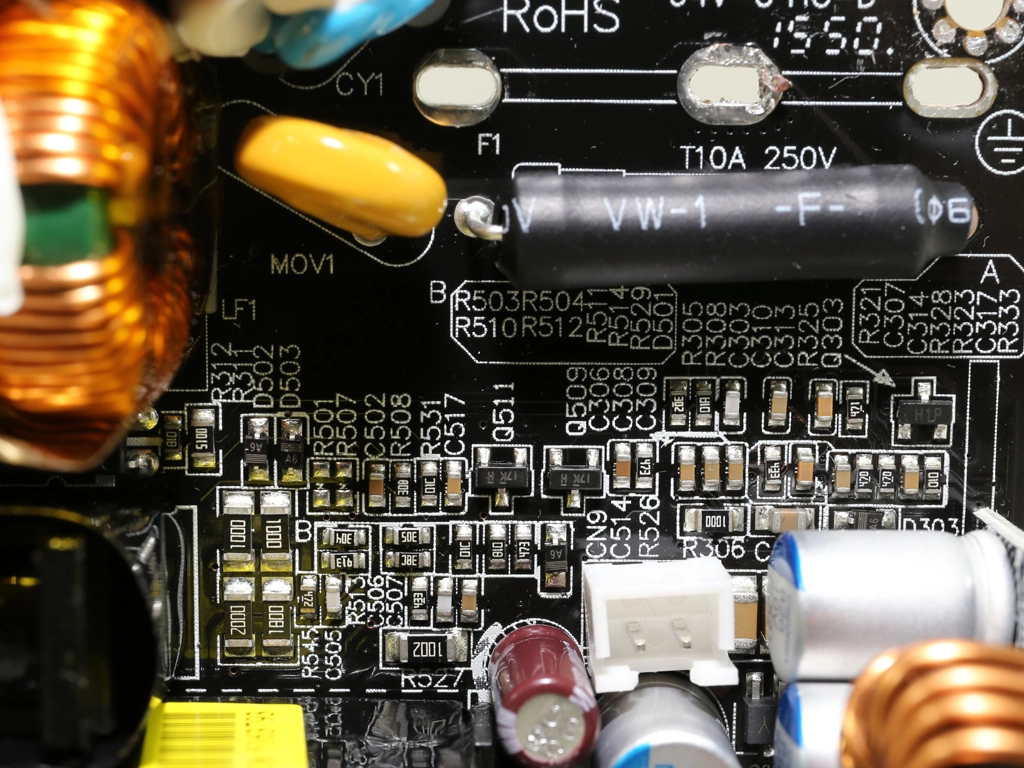
We found no protection at all on this unit, except for a simple fuse. Sadly, this PSU is still available on the market under a couple of different labels.

Passive components do not guarantee sufficient protection. Without a digital security chip, the computer hardware is severely exposed to risks.

The security chip PS223 from Silicon Touch is popular, and you should avoid PSUs not using it or similar products, such as the PS332S.

Cables and Short Circuits

You can tell a lot about your PSU by looking at its internal wiring. A lack of heat shrink tubing, carelessly exposed solder joints, and components fastened with a glue gun are symptomatic of cheap and hazardous manufacturing. If unprotected cables are placed next to hot components, a PSU failure is nearly assured.

Boards

A final quality indicator is the circuit board material. Impregnated laminated paper (like the yellow boards in the pictures) is a sure sign of cost cutting. Fiber materials are much more durable and, perhaps more importantly, non-flammable.

Ask a Category Expert

Create a new thread in the Reviews comments forum about this subject

Example: Notebook, Android, SSD hard drive

Display all 50 comments.
This thread is closed for comments
  • 1 Hide
    iam2thecrowe , July 23, 2014 12:10 AM
    The thing i find most interesting in these who's who articles is Thermaltake. Such a range of manufacturers, that generally corresponds to quality of product in reviews. Shame that such a well known company can have such a varying range of quality. But as always, good article, nice to know who is doing what.
  • 1 Hide
    arunphilip , July 23, 2014 2:02 AM
    Wow, this was very informative and educative - kudos on such a comprehensive article. I'm now itching to go home and check the various PSUs I have in my Dells at home (IIRC, they're Lite-On) and look at the UL data.
  • 1 Hide
    Memnarchon , July 23, 2014 3:42 AM
    Thank you very much. I was waiting for this since a lot new PSU's have been released since the last article.
  • 1 Hide
    ubercake , July 23, 2014 4:23 AM
    A great compilation of info for 2014. It's always good to be an informed shopper.

    Thanks again!
  • 6 Hide
    rustyg43 , July 23, 2014 5:02 AM
    Awesome article as always Tom's. Can you please do one on GPU manufacturers as well?
  • 2 Hide
    avarice , July 23, 2014 5:18 AM
    Good article with an amazing presentation of information in the charts. Well done.

    With the caveots given about brands and quality - would it be unreasonable to suggest staying with a brand that manufactures it's own PSUs? I am refering to the FSPs, SeaSonics and Zippys on the list. I have had FSP and have heard very glowing praise about the other two brands.

    Also does the quality of their products meet or exceed the brands that are subcontracted to them - OR do some of the designs from other brands that use these three companies exceed even those of the three mentioned brands? For example - is there a case where say 'Named Brand Company' design as manufactured by FSP exceeds the quality of any FSP branded PSU?
  • 1 Hide
    randomstar , July 23, 2014 5:20 AM
    I still see incorrect information with respect to logisys- they are sold in the houston area by several vendors, and distributed in cases, and as over the counter parts at a local distro house.. they have in every model I tested proven to be the worst of the worst. when you see a 450 watt for under 20 bucks, and a unit labeled as 600 for under 30, you know something is up.
  • 0 Hide
    avarice , July 23, 2014 5:20 AM
    Good article with an amazing presentation of information in the charts. Well done.

    With the caveots given about brands and quality - would it be unreasonable to suggest staying with a brand that manufactures it's own PSUs? I am refering to the FSPs, SeaSonics and Zippys on the list. I have had FSP and have heard very glowing praise about the other two brands.

    Also does the quality of their products meet or exceed the brands that are subcontracted to them - OR do some of the designs from other brands that use these three companies exceed even those of the three mentioned brands? For example - is there a case where say 'Named Brand Company' design as manufactured by FSP exceeds the quality of any FSP branded PSU?
  • -3 Hide
    Teeroy32 , July 23, 2014 7:02 AM
    I didn't find my psu in that list the brand is a Brianology and the name is a Big Ant ATX-S750, I paid $89 dollars Aus for it, it would be nice too know what the quality is. The home page for it is http://www.brianology.com.au/english/content.asp?ModuleType=3&ChannelID=3&id=400this
  • 0 Hide
    smog0 , July 23, 2014 7:09 AM
    i didn't find the omega brand which make cheap (and normally bad) psus for example a "1200 W" for $50
  • 0 Hide
    dstarr3 , July 23, 2014 8:02 AM
    This is, hands down, the most helpful and informative article on Tom's.
  • 1 Hide
    lp231 , July 23, 2014 9:00 AM
    Informative article, but when it comes to buying a PSU most of us look at the branding first and then find out who makes it. XION is made by Super Flower and Super Flower makes good PSUs, but many of us would probably not pick XION as our very first choice. We usually go with more popular brands like Corsair, Antec, Seasonic, etc.
  • -4 Hide
    canadianvice , July 23, 2014 9:23 AM
    My rules are simple, simply avoid buying Chinese wherever possible.
    I understand almost everything is made there, but Western companies understand Western standards of quality.

    The whole Chinese business model is based on manufacturing crap and making it hard to return.

    I almost put off my younger brother's build because I had to get a ThermalTake PSU, but he didn't have enough money to get a different one, so I figured I'd get the warranty and hope for the best.

    Western is the only thing worth buying because Chinese means Chinese quality, and that's an oxymoron.
  • -1 Hide
    Avus , July 23, 2014 9:37 AM
    I always found using "weight" is ONE of the easy way to find out the quality of a power supply... Try pick up a $30 550W power supply on one hand and a 80+ 550W on the other hand...
  • 2 Hide
    Damn_Rookie , July 23, 2014 11:28 AM
    Quote:
    My rules are simple, simply avoid buying Chinese wherever possible.
    I understand almost everything is made there, but Western companies understand Western standards of quality.

    The whole Chinese business model is based on manufacturing crap and making it hard to return.

    I almost put off my younger brother's build because I had to get a ThermalTake PSU, but he didn't have enough money to get a different one, so I figured I'd get the warranty and hope for the best.

    Western is the only thing worth buying because Chinese means Chinese quality, and that's an oxymoron.

    What about the norm of a Western company selling Chinese made goods though? Surely, if the 'Western companies understand Western standards of quality', as you say, they wouldn't dream of selling something that doesn't live up to their Western standards, right?

    While your rule may sound like a sensible one in theory, you really need to keep in mind that manufacturing in China these days (like most other places) is based around building to a cost. If that cost, specified by the buyer (the company who will sell the product to the consumer), is realistically too low for what they want, they're going to get a low quality product. On the other hand, if the buyer specifies certain quality factors they want, and costs the product realistically, the product manufactured for them can be of very high quality.

    So while it's easy to write off everything manufactured in China as being junk, that's really not fair. Items manufactured there do vary massively in quality, and that quality is signed off on by the company (western or not) that then sells the product, so they're just as culpable for any quality issues as the manufacturer.

    At its simplest, I guess you could say it all comes down to that oft said cliche: you get what you pay for.
  • 0 Hide
    larkspur , July 23, 2014 11:28 AM
    Helpful article thanks for updating! There is also the PSU Review Database at realhardtechx. It also contains links to reviews when available. I usually head there first. http://www.realhardtechx.com/index_archivos/Page673.htm
  • 1 Hide
    damric , July 23, 2014 2:16 PM
    Good info.

    Missing Superflower as the EVGA SUPERNOVA G2 OEM.
  • 2 Hide
    caqde , July 23, 2014 5:57 PM
    PC Power and Cooling is no longer owned by OCZ they are now owned by Firepower Technology as of Feb 2014.
  • -1 Hide
    canadianvice , July 23, 2014 6:53 PM
    Quote:
    Quote:
    My rules are simple, simply avoid buying Chinese wherever possible.
    I understand almost everything is made there, but Western companies understand Western standards of quality.

    The whole Chinese business model is based on manufacturing crap and making it hard to return.

    I almost put off my younger brother's build because I had to get a ThermalTake PSU, but he didn't have enough money to get a different one, so I figured I'd get the warranty and hope for the best.

    Western is the only thing worth buying because Chinese means Chinese quality, and that's an oxymoron.

    What about the norm of a Western company selling Chinese made goods though? Surely, if the 'Western companies understand Western standards of quality', as you say, they wouldn't dream of selling something that doesn't live up to their Western standards, right?

    While your rule may sound like a sensible one in theory, you really need to keep in mind that manufacturing in China these days (like most other places) is based around building to a cost. If that cost, specified by the buyer (the company who will sell the product to the consumer), is realistically too low for what they want, they're going to get a low quality product. On the other hand, if the buyer specifies certain quality factors they want, and costs the product realistically, the product manufactured for them can be of very high quality.

    So while it's easy to write off everything manufactured in China as being junk, that's really not fair. Items manufactured there do vary massively in quality, and that quality is signed off on by the company (western or not) that then sells the product, so they're just as culpable for any quality issues as the manufacturer.

    At its simplest, I guess you could say it all comes down to that oft said cliche: you get what you pay for.


    The difference is that Western companies understand the end goal is something that's in good enough condition to run and not to ship broken crap that is cheap beyond a reasonable standard and make it hard to return. You won't catch them selling crap simply to make a quick buck like the Chinese do.

    Western companies have a sense of honesty and duty to the customer; the Chinese companies not only understand, but they also happily exploit caveat emptor.

    Western companies also have far better R&D and specs, so it makes sense the end product would be better than a Chinese-created and manufactured one. There's a very simple reason that Chinese made items are of such poor quality. It's a business strategy there.

    Do you think a Western company could survive by being cheats?
  • 0 Hide
    junkeymonkey , July 24, 2014 6:52 AM
    this list from a to z that starts on page 4 is it a up dated list or the same one from a few years back just copied in to this article ??
    the one I got saved is from 2010

    http://www.tomshardware.com/reviews/psu-manufacturer-oem,2729-5.html
Display more comments
