CPU Overclocking Results
We had previously been just a little conservative in the voltage levels used for overclocking our old Intel Core 2 Duo E6700 sample, choosing a level of 1.50 volts. Chief among the reasons were that we wanted to preserve the CPU for future testing, and that higher settings caused a runaway heat condition where all the cooling we could find couldn't help it go much faster than 3.46 GHz. But enough of the past: our new E6750 sample was much more voltage-tolerant.
So how did we choose the next level? We still wanted the processor to last a while and found one company that was putting extended warranties on Intel Core 2 processors pushed as high as 1.60 volts! That company is Dell, and this is the voltage it uses in its water-cooler XPS 720 H2C.
Searching the Web, we found some extreme overclockers pushing 1.625 volts, and a few going a bit farther, but testing revealed that settings above 1.625 volts once again let the heat monster out of the box, even with an enormous triple-fan radiator. The high water volume made the processor heat up more slowly, but the same system crash eventually resulted. Dell's overclock voltage settings proved to be spot on for our processor.

Now for the results!
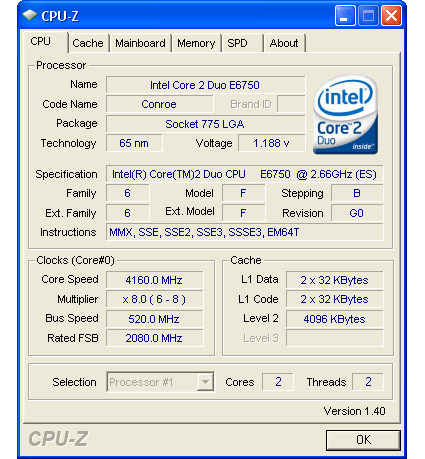
This E7650 sample reached its same 4.16 GHz limit on three of the four motherboards tested. We were hoping to reach at least 4.4 GHz, but even OPPainter thought such goals were a little optimistic using ambient water cooling. Perhaps the next generation of 45 nm processors will take us past 5 GHz, but only if the motherboards can live with the high bus speeds needed to get there.
How far can these boards go?

The Asus Blitz Extreme comes out on top for achievable bus speed, but doesn't even reach 550 MHz FSB clock (FSB 2200). It's further hampered by an inability to keep our CPU stable at anything beyond 4.02 GHz, far short of the 4.16 GHz reached on the other three boards.
