




AMD ‘had to re-engineer’ the Ryzen 7 5800X3D for a re-release — 10th Anniversary Edition chip had ‘a whole body of engineering work’ put into it

5800X3D
(Image credit: Tom's Hardware)

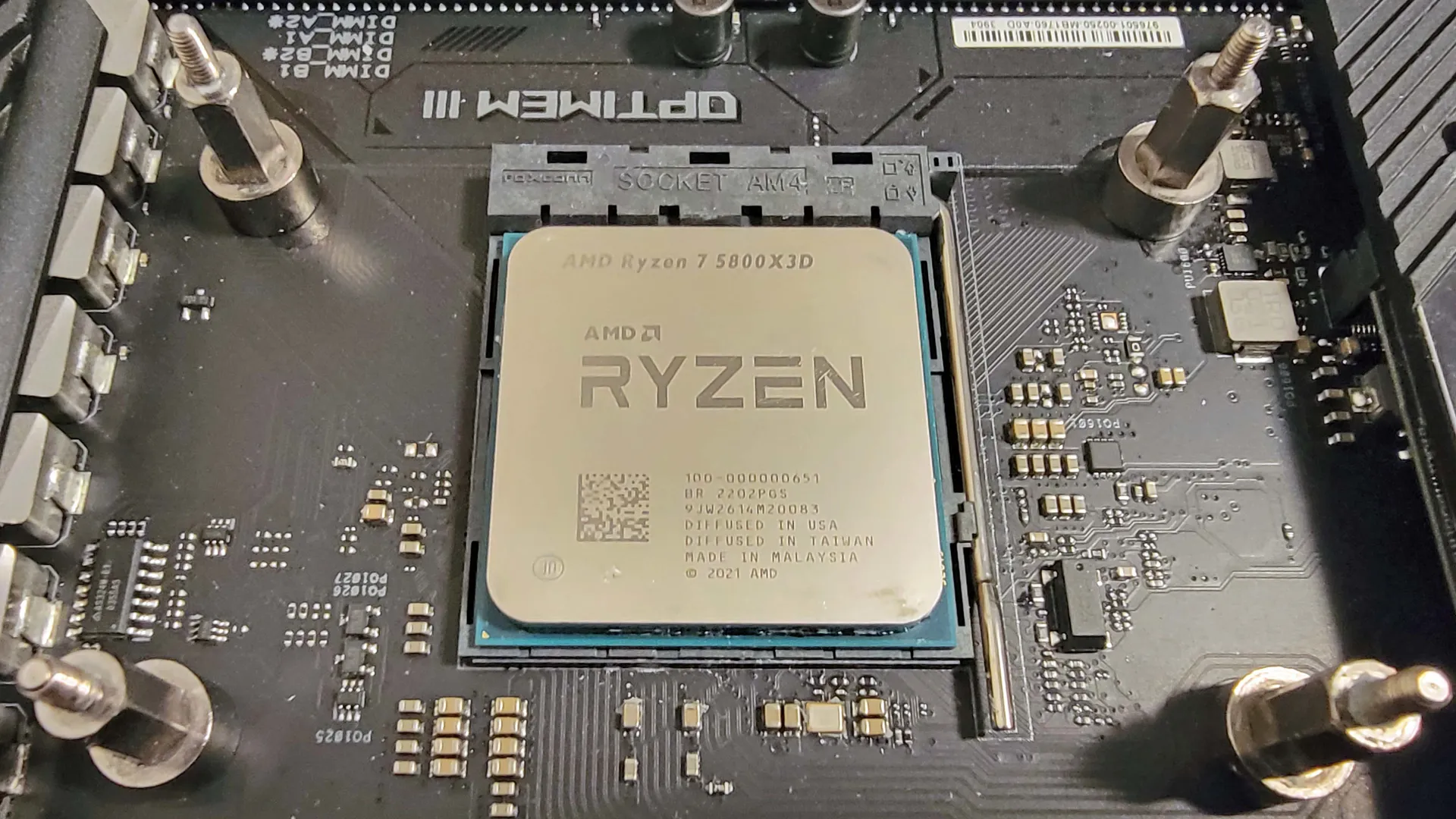
AMD finally reintroduced the Ryzen 7 5800X3D at Computex 2026, more than four years after it originally launched in a bid to combat rising DDR5 prices. Despite the re-release looking like a simple product spin-up, AMD’s David McAfee, VP and general manager of Radeon and Ryzen, says that “a whole body of engineering work” went into the re-release, as the original bonding process TSMC used for the Ryzen 7 5800X3D was no longer available.
“It's not as simple as just bringing back the 5800X3D,” McAfee said. “The original stacking process that was used at TSMC changed when we went from first-gen to second-gen cache, so we had to re-engineer that product, and there actually was a fair amount of development that went into bringing back the 5800X3D.”

The Ryzen 7 5800X3D used TSMC’s SoIC or System-on-Integrated-Chips hybrid bonding technology. It uses a combination of “hot” and “cold” bonding to marry two pieces of silicon together, which then share power with through-silicon vias (TSV). Fundamentally, this connection hasn’t changed over the course of 3D V-Cache’s existence, but it has evolved. With the move to Ryzen 7000, AMD had to make some changes to the 3D V-Cache design, which it then carried forward with Ryzen 9000.

Latest Videos From

To avoid any confusion, when we talk about second-gen 3D V-Cache here, we’re not talking about AMD’s new packaging available on Zen 5 CPUs, where SRAM is placed under the CCD rather than on top, as is the case with Zen 4 and 3 X3D chips. We’re talking about the bonding process that AMD used at TSMC, which changed from first-gen X3D chips to second-gen X3D chips.

“It completely changed the characteristics of how those two pieces of silicon are bonded together and how they were stacked together, and so when that first-gen facility really kind of went offline, then it meant there was a whole, you know, body of engineering work that had to be done to understand if we could even migrate the 5800X3D to the new, second-generation stacking process,” McAfee said.

It’s possible that AMD intended to bring back the Ryzen 7 5800X3D sooner, though McAfee stopped short of saying that outright. The shift in packaging helps explain the Ryzen 7 5800X3D’s (and eventually the 5700X3D’s) absence from the market. The chip has seen spotty availability over the past two years, and it’s been completely sold out over the past year, with resellers demanding as much as $800 on the secondhand market.

“That's been a lot of the work that's kind of been going on in the background to get us to where we are today, is redoing the qualification of that stacking process, building samples, testing to make sure that the reliability is top notch for consumers who might want to buy this product, and then, you know, kind of rolling it out and ramping it into production again in a new process of stacking those dies together,” McAfee told Tom’s Hardware.

You can read more about second-gen SoIC in our SoIC roadmap on Tom’s Hardware Premium, though it has far more implications for the data center (at least currently) than for consumer chips. Regardless, AMD couldn’t simply reintroduce the Ryzen 7 5800X3D; instead reworking the chip to work with TSMC’s second-generation stacking process. McAfee says it ended up being “a labor of love” for the engineers to work on this part again, as the company went through testing and validation for a re-release.

Google Preferred Source

Follow Tom's Hardware on Google News, or add us as a preferred source, to get our latest news, analysis, & reviews in your feeds.

TOPICS
Jake Roach
Senior Analyst, CPUs

Jake Roach is the Senior CPU Analyst at Tom’s Hardware, writing reviews, news, and features about the latest consumer and workstation processors.

  • MG1103
    I'd be interested to see a few benchmarks between the original 5800X3D and the re-engineered one to see if there's any performance differences. (including thermals)
    Reply
  • usertests
    MG1103 said:
    I'd be interested to see a few benchmarks between the original 5800X3D and the re-engineered one to see if there's any performance differences. (including thermals)
    https://www.tomshardware.com/news/amd-shares-new-second-gen-3d-v-cache-chiplet-details-up-to-25-tbs
    AMD has finally answered a few of our follow-up questions and shared important new details, including that the chiplet remains on the 7nm process and now has a peak bandwidth of up to 2.5 TB/s, whereas the first-gen 3D V-Cache peaked at 2 TB/s (among lots of other new info).
    Second-gen 3D V-Cache in 7800X3D and friends has 25% higher peak bandwidth than first-gen. So if that has carried over to the 5800X3D Anniversary Edition, it may improve performance slightly on its own, independently of thermals.
    Reply
  • umeng2002_2
    I think it would only change the thermal or voltage characteristics, which should really only affect the boosting behavior.

    Will be interested in the reviews.
    Reply
  • Pegaroo
    usertests said:
    https://www.tomshardware.com/news/amd-shares-new-second-gen-3d-v-cache-chiplet-details-up-to-25-tbs
    Second-gen 3D V-Cache in 7800X3D and friends has 25% higher peak bandwidth than first-gen. So if that has carried over to the 5800X3D Anniversary Edition, it may improve performance slightly on its own, independently of thermals.
    I think you are getting mixed up between gen 2 3d v cache and TSMCs 2nd gen stacking process.
    I could be wrong but I don't think the 2 are necessarily the same thing
    Reply
  • abufrejoval
    From what I understand, they had to build some new machinery to obtain the same product: they built new facilities to do the V-cache+CCD bonding part of the production process, they didn't change the specification of the product itself, nor the three major components: IOD, CCD and V-cache chiplets.

    With that in mind, the resulting product should be near indistinguishable, in fact that's what their aim would be.

    Now they might be cheaper to produce, they might produce a larger percentage of perfect bins, resulting in a statistical bias towards better chips, but eggregious success beyond that would be failing the mission.

    And from personal and thus only anectdotal experience, bin spread in 5800 CCDs was significant. I counted myself lucky to get an 8-core 5800X on launch night and was quite happy with it most of the time, but I couldn't help noticing that it was running so hot (and maxing out those 110 Watts of energy budget), that I couldn't quite imagine how they'd be able to run the 16-core variant with two such CCDs and only 30 extra Watts of power (140). Especially since I didn't overclock it, just ran PBO and a hefty Noctua air cooler.

    A few years later those 16-core variants became cheap enough and I got both a few 5800X3D chips and a single 5950X. Both of those were very different beasts in terms of power consumption from the first 5800X.

    The 5800X3D were obviously heat and clock constrained, but clock-for-clock they seemed to make do with much less power than the original 5800X: they certainly never felt slower, even if some synthetic load results were a tad lower. Essentially the 5800X3D felt like a true 5800X replacement with V-cache benefits where those applied and generally much lower power consumption.

    Even more extreme was the 5950X, which not only clocked higher, but seemed to use half as much power per CCD than the 5800X did: it's quite a beast yet stays relatively cool with that same cooler. It outperformed the 5800X on any task using 1-8 cores, being able to use higher clocks, and then it still had 1-8 cores to go and power budget to make them useful.

    I guess it had to, so the 2nd CCD had any chance to let its cores run: a dual CCD chip using bins like the original 5800X would have wound up close to 200 Watts, just adding up those HWinfo number, which of course aren't exactly precise.

    My take from that was that dual CCD cpus (like the better EPYCs) got much better quality bins and most likely the 5800X3D did as well, but that 6-core or even 4-core CCD were an unfortunate and hard to avoid side effect more of voltage bins than outright defects.

    How wide those bins spread in those early days and if TSMC manages to hit the top notches much better today, nobody will tell you. But it's the only area where I can imagine significant progress and a bit of motivation on AMD's side: their ability to sell lesser bins or even 5xxx CPUs without the V-cache, may have dropped off a cliff ten years in: way too much competition there and no money to be made.
    Reply
  • Smb2886
    It sounds like a justification for the high price of a CPU released in 2022. They claim they had to rebuild from scratch and pass the cost on to consumers. However, in all honesty, it still doesn’t justify the high cost of an outdated CPU unless you’re taking advantage of people who can’t upgrade to AM5 right now due to the AI boom driving up prices. Instead of exploiting your consumers, you could have still made a profit. Now, you have to look like the bad guy and lower the price in a few months. Why do you always have to be greedy?
    Reply
  • usertests
    Pegaroo said:
    I think you are getting mixed up between gen 2 3d v cache and TSMCs 2nd gen stacking process.
    I could be wrong but I don't think the 2 are necessarily the same thing
    It's made on the same node so I'm not sure why it wouldn't all happen together. Guess we'll find out.

    Smb2886 said:
    Now, you have to look like the bad guy and lower the price in a few months. Why do you always have to be greedy?
    Supply and demand. I'm not convinced that they will make enough of these to avoid selling out at full price. What are they going to do, make 1 million "Anniversary Editions"?
    Reply
  • ezst036
    How can a person look at the two chips old/new and tell the difference? Is there a revision number on the heat spreader or something?
    Reply
  • usertests
    ezst036 said:
    How can a person look at the two chips old/new and tell the difference? Is there a revision number on the heat spreader or something?
    I think an older one will say "© 2021 AMD" on it under "MADE IN MALAYSIA".

    I think they will remove the "DIFFUSED IN TAIWAN" text (for reasons) and bump the year to 2025. It may say "Anniversary Edition" somewhere on the heat spreader, check one of their previous Anniversary Editions (FX something).
    Reply
  • Roland Of Gilead
    usertests said:
    Supply and demand. I'm not convinced that they will make enough of these to avoid selling out at full price. What are they going to do, make 1 million "Anniversary Editions"?
    Exactly. All this really boils down to is volume. Without that, scalpers will do the usual, and we'll see the same astronomical prices, including from online sellers like Amazon etc.
    Reply