









Why you can trust Tom's Hardware Our expert reviewers spend hours testing and comparing products and services so you can choose the best for you. Find out more about how we test.

It’s surprising we didn’t see the 7700X3D sooner. AMD has told us that the 7700X3D (and the re-released 5800X3D) are both targeted releases to ease the burden of high DDR5 prices, but just like with the 5800X3D, it feels like AMD could’ve done more to ease that burden. The 7800X3D has already approached the MSRP of the 7700X3D with sales, and the 7600X3D has clearly come out on top as the value-focused option among AMD’s Zen 4 X3D CPUs.
It’s a tough pricing situation regardless, a consequence of continuing to bin and release various versions of largely similar silicon. Still, the 7700X3D has a pricing window. That window just doesn’t exist at $330. At $300, it would be more competitive with the rest of the market, and at $280, it’d be a difficult CPU to contend with. At $250 like we saw the 5700X3D, it’d be a no-brainer. $330 is the maximum price where you might be able to justify the 7700X3D, and that’d only be if you completely ignore CPUs going on sale and wipe out Arrow Lake Refresh from your memory.
The two CPUs that remain the most potent competition are Intel’s 270K Plus and the 7600X3D, not the 7800X3D. On sale, the 7800X3D is the better buy, full stop, but if the 7700X3D is targeting gamers that want to stretch their dollar the furthest, the 7600X3D offers a lot more value.
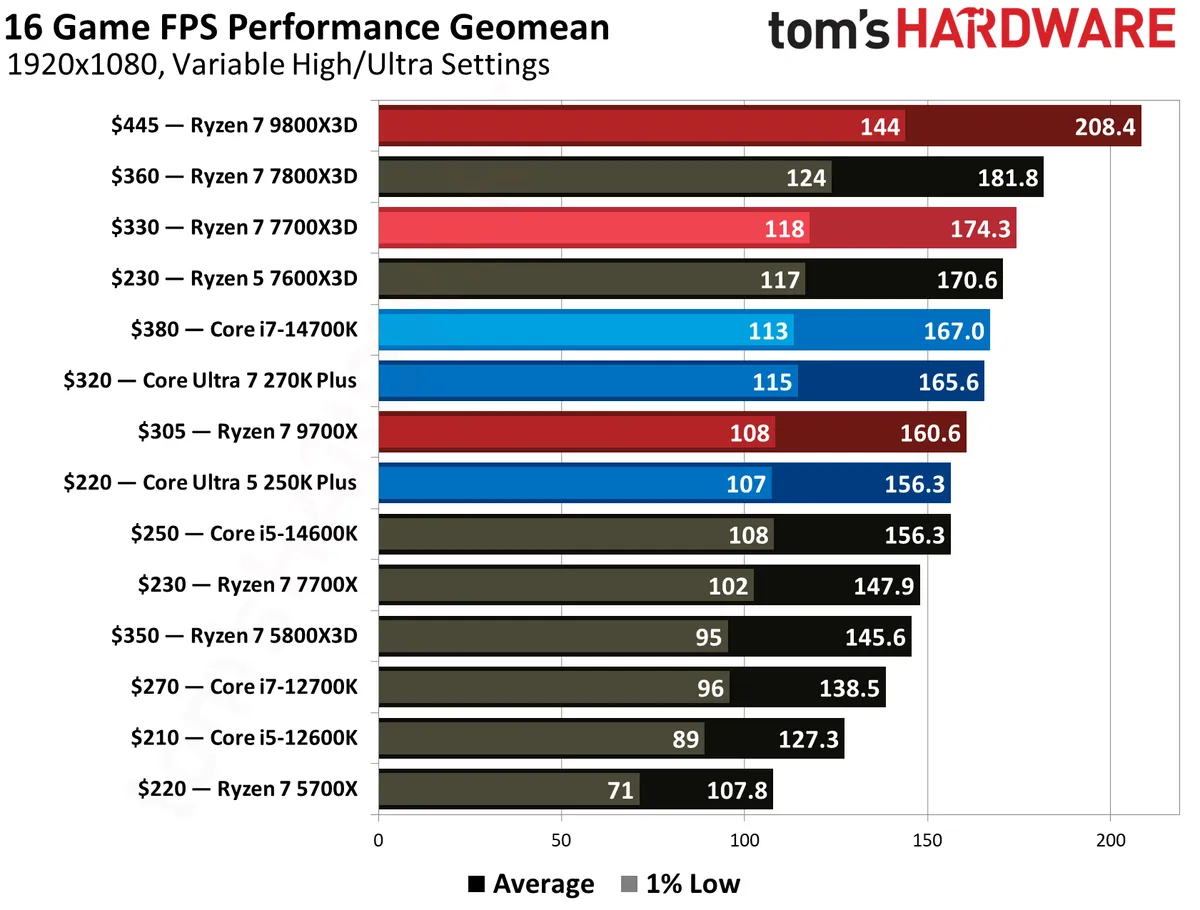
You can see that clearly in our gaming geomean. The 7600X3D is just 2% slower than the 7700X3D on average, and even in extreme situations, the performance gap between them never approaches double digits. The 7800X3D and 7700X3D offer a similar value at list price, which is about half a frame per dollar. Meanwhile, the 7600X3D offers three-quarters of a frame per dollar.
The value isn’t bad with the 7700X3D, make no mistake. It’s in line with the 270K Plus and 7800X3D, but it shouldn’t be. It’s a value-focused alternative to the 7800X3D, but it doesn’t provide much additional value. At around $280, it’d shoot up in the value rankings and become much easier to justify.

On the other end of the spectrum is Intel’s 270K Plus. It’s 5% slower in average gaming performance than the 7700X3D, but it makes up for that small gap with more than twice the multithreaded performance of the 7700X3D. Even if you only commonly use one non-gaming application, the performance uplift of the 270K Plus is large enough to justify a small hit to gaming performance.
With most 3D V-Cache CPUs, the drop-in application performance is easy to justify, even if the boost in gaming performance can’t keep pace. You buy an X3D chip primarily for playing games, not compiling code, running Fourier Transforms, or building a web server. Here, however, the margins in gaming are some of the smallest we’ve seen between X3D and non-X3D CPUs, while the margins in applications are some of the largest.
Get Tom's Hardware's best news and in-depth reviews, straight to your inbox.
There’s three paths away from the 7700X3D right now. The 270K Plus offers a much more well-rounded CPU around the same price. The 7600X3D delivers the gaming value that the 7700X3D is sorely lacking, and the 7800X3D is only slightly faster in games, but it’s also only slightly more expensive. Hopefully we’ll see the 7700X3D drop to between $250 and $280. At that price, it’s a CPU worth considering. At its current price, it’s hard not to go with another option.
- MORE: Best CPU for gaming
- MORE: CPU Benchmark Hierarchy
- MORE: Intel vs AMD
- MORE: How to Overclock a CPU
Current page: Waiting for a price cut
Prev Page AMD Ryzen 7 7700X3D power consumption, efficiency, test setup
Jake Roach is the Senior CPU Analyst at Tom’s Hardware, writing reviews, news, and features about the latest consumer and workstation processors.
-
usertests The market will correct the price... possibly by raising the 7800X3D price.Reply
It's good and efficient out of the box. -
-Fran- Another swing and miss from AMD!Reply
Like... Why even release this CPU in this market AMD? Why not just stock pile it and sell it later when it makes more sense?
You're barely moving the 7800X3D at really good prices, how do you expect to move this thing at a worse P/P ratio? HOW?
Regards. -
vinay2070 Reply
Maybe they were not clocking as good as a 7800X3D and AMD still wanted to sell them? So they waited till they had enough of them and then started selling?-Fran- said:Another swing and miss from AMD!
Like... Why even release this CPU in this market AMD? Why not just stock pile it and sell it later when it makes more sense?
Why sell later though, there would be 9700X3D piling up which AMD may want to sell later. -
Why_Me PCPartPicker Part ListReply
CPU: *AMD Ryzen 7 7700X3D 4 GHz 8-Core Processor ($279.99 @ Newegg)
Total: $279.99
Prices include shipping, taxes, and discounts when available
*Lowest price parts chosen from parametric criteria
Generated by PCPartPicker 2026-07-17 01:14 EDT-0400
PCPartPicker Part List
CPU: *AMD Ryzen 7 7800X3D 4.2 GHz 8-Core Processor ($348.99 @ Amazon)
Total: $348.99
Prices include shipping, taxes, and discounts when available
*Lowest price parts chosen from parametric criteria
Generated by PCPartPicker 2026-07-17 01:15 EDT-0400 -
ohio_buckeye What’s funny is they reference a potential future Ryzen 5 7500x3d in the future. However that cpu already exists and has for a while as that’s the cpu currently in my pc.Reply
Anyway what stands out to me at least is I was watching a video review on the 7700x3d and of course they were using a 5090 and had various x3d CPUs shown including the 7800x3d and 9800x3d etc.
As someone who already owns a 7500x3d I personally don’t see a need to even upgrade to a 9800x3d for example. I mean yeah I’d get a little better fps but when they’re showing these paired up to a 5090 and running at 1080p, who’s doing that unless you are benchmarking or you are a professional gamer with money to burn and that’s all you’re doing all day every day? If you are an average person with say a 9070xt and you’ve got say a 7500x3d, I don’t see that when a 9800x3d is a meaningful upgrade. Really in those conditions even a normal 7700x is likely plenty.
In my case a 7500x3d is pretty close to a 7600x3d which I think is nipping at the heels of this 7700x3d. With the current prices on ram and ssds and given the price of what you can get a 7800x3d for, and rumors of zen 6 right around the corner with zen 7 in a year or so possibly being on am5, I think personally I’m going to just hold where I’m at. I personally have the 7500x3d with 32gb ddr5 and an rx 6950xt at 3440x1440. So in my case I think I’m waiting for next gen gpus and see if there are any that are interesting enough to jump to. After that I think I may hold to see if zen 7 will be am5 compatible and if so then at sooner point grab one of the better x3d cpus from zen 7 and I’ll be set for another 2-3 years or more.
Seems like with the 7800x3d at the price it is they need to lower prices on the 7700x3d. If they were selling for $259 or $275 then yeah they’d have a winner. But the 7700x3d feels proved too closely to the faster cpu. Honestly, I think the 5800x3d is in the neighborhood of the 7500/7600x3d. If you’re someone on am4 still with 32gb or 64gb of ram or higher and gaming is your thing, you might be better off to bite the bullet and pick up the 5800x3d and call it a day as opposed to going for a 7700x3d at least at this price when you factor in memory etc. -
-Fran- Reply
Why ignore the paragraph where I explain the reasoning? It's ok to disagree with it, but don't omit it?vinay2070 said:Maybe they were not clocking as good as a 7800X3D and AMD still wanted to sell them? So they waited till they had enough of them and then started selling?
Why sell later though, there would be 9700X3D piling up which AMD may want to sell later.
Weird habit for some...
Regards. -
Neilbob Reply
Well put. When looking at these reviews, it's very important for people to remember that, in the vast majority of cases, these margins will not be applicable for the sorts of GPUs they are very likely to possess. I understand perfectly why the reviews are conducted this way, but they don't help at all to reflect a realistic setup or use case except for a token few.ohio_buckeye said:Good summary
Also applies to the 5800X3D, which I hope to one day acquire at a hopefully slightly lower price, then a new GPU would follow after, but one most likely in the 9060/5060 tier on the (seemingly remote) chance that those prices become a bit less insane too (no splurging right now). That combination would tide me over for a very long time, and might even be the last system I own before I check out. -
vinay2070 Reply
I didnt have to, the dude above your original post already gave the reason - the market will correct it. My main point was 9700X3D has to be released at some point in time. There is no point in releasing both the 7700X3D and 9700X3D at the same time as they are both on AM5.-Fran- said:Why ignore the paragraph where I explain the reasoning? It's ok to disagree with it, but don't omit it?
Weird habit for some...
Regards. -
helper800 My problem with the 7700X3D is that its barely a stones throw away from the 270k plus in gaming performance, and anything not gaming the 270K plus meets and likely beats it into the ground. At least with the 7800X3D there is a much higher performance uplift from the 270k plus, so its more understanding in the same price range. Add into that the much better for cost z890 motherboards, and I do not see this competing well until about 260 dollars.Reply -
usertests Phoronix got my attention:Reply
AMD Ryzen 7 7700X3D Linux PerformanceOn a geo mean basis, the AMD Ryzen 7 7700X3D was running at 97.8% the performance of the Ryzen 7 7800X3D. But its CPU power on average was at 89% that of the 7800X3D. Or on a cost basis, the Ryzen 7 7700X3D at $329 is about 78% the cost of the Ryzen 7 7800X3D cost today at around $419.
You can often get the 7800X3D much cheaper than that, but in general, you are getting much of the performance with a decent reduction in power.
If the 7700X3D needs to become cheaper to diverge from the 7800X3D, it actually can and will. Since it's not a GPU with expensive memory inside.