




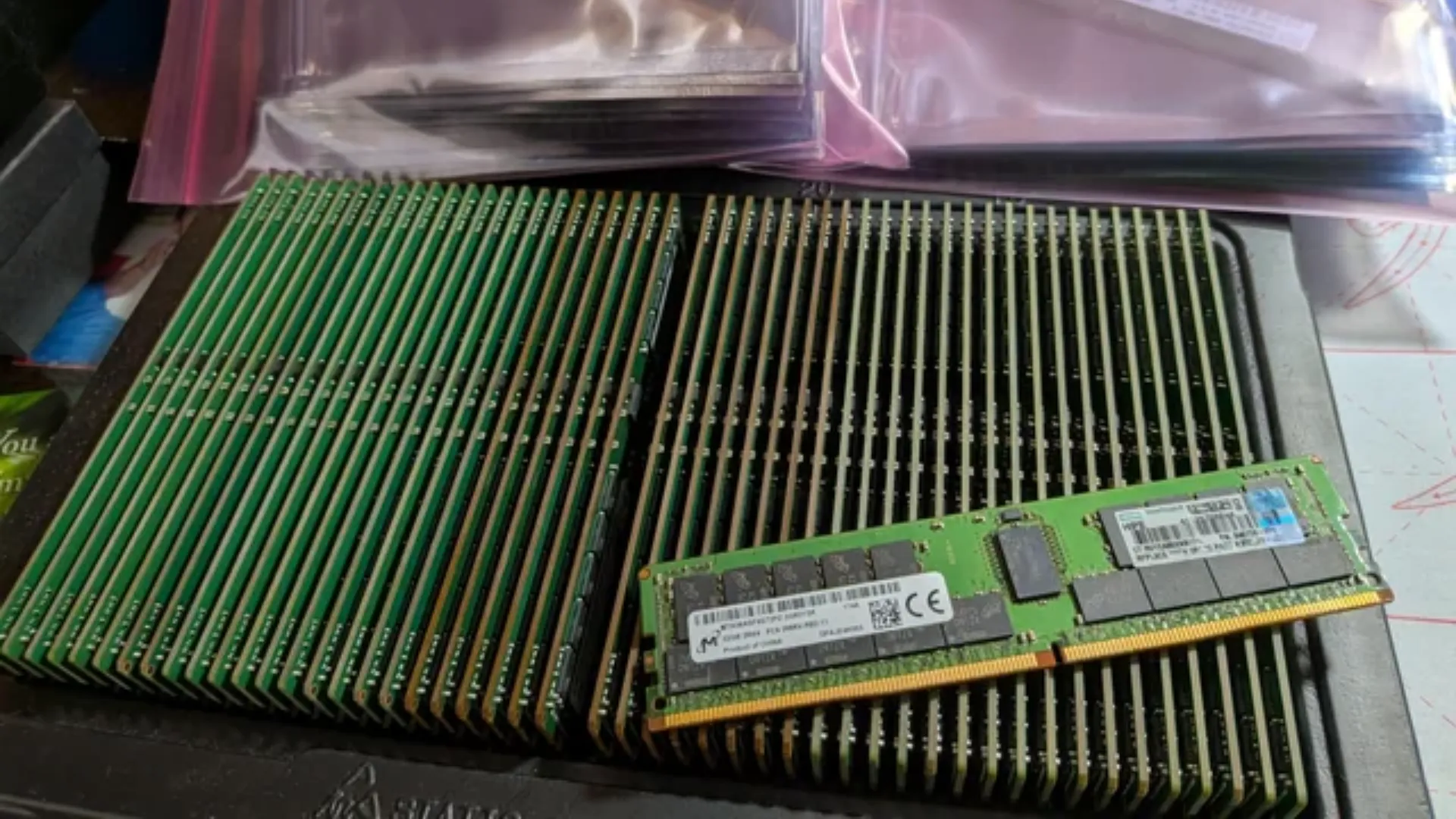
$20,000 in 32GB RAM sticks saved from the dumpster are now worth a fortune — seventy-two DDR4-2666 ECC RDIMMs were about to turn into e-waste
Too bad you can't plug this into your everyday gaming PC.
An employee saved 72 RAM sticks headed for the dumpster after their company’s new servers received a memory upgrade in 2024, as soon as they arrived. According to the Reddit poster, these memory modules were about to be turned into e-waste, so their father took them instead and gave the components to the poster.
While we cannot find an HP Enterprise module on Amazon, a similar memory module from SK hynix is currently priced at $287.95, meaning those 72 RAM sticks are valued at more than $20,000. When we checked CamelCamelCamel for the historical pricing of these components, they were approximately $35 in 2024, with a low of $29.02 in mid-2025.
This might seem like a massive waste for many enthusiasts, especially given the outrageous pricing that RAM has hit this year due to the massive demand for memory chips driven by the AI infrastructure build-out. However, other commenters on the Reddit post pointed out that many corporations don’t care about what happens to their old equipment. After all, once they’ve been depreciated, then they already have zero value, at least in their books.

pcmasterrace from r/pcmasterrace/comments/1sod8mr/2_years_ago_my_dads_company_bought_new_servers
“In many places where I worked, the sysadmins in charge of the servers were not hardware enthusiasts, had never built their own machines, and did not care what things cost as long as the infrastructure kept running,” ArcticCelt said under the post. “They constantly did things like that, throwing away perfectly good equipment instead of keeping it for test labs or anything useful. It was their budget to spend, and they simply did not give ------ because no one above them understood how any of it worked.”
Unfortunately, registered memory like this isn't supported by consumer-grade hardware, so the Redditor won’t be able to use it to upgrade their computer. These types of memory modules require server and HEDT motherboards and the corresponding CPU, like Intel Xeon and AMD EPYC chips. So, unless the original poster or their dad has a specialized build tucked away in their basement, their only option would be to resell these kits on the used market. Although we don’t expect these chips to fetch more than $20,000 on the used market, they could still probably sell them for more than the price of one of the best gaming PCs of 2026.

Follow Tom's Hardware on Google News, or add us as a preferred source, to get our latest news, analysis, & reviews in your feeds.

Get Tom's Hardware's best news and in-depth reviews, straight to your inbox.

Jowi Morales is a tech enthusiast with years of experience working in the industry. He’s been writing with several tech publications since 2021, where he’s been interested in tech hardware and consumer electronics.
-
ezst036 A lot of companies have that "write it off" mentality. They know they are not going to look backwards and know they shouldn't save shelf space for certain things so the trash is the inevitable answer to questions.Reply
But most companies don't have a designated ebay employee either.
The manager doesn't want to sell these in his spare time and it would be viewed as a waste of "on the clock"/productive time. And the manager isn't going to tell employee x to go ebay these either.
It's just an area that is simply unaccounted for, and it does have some negative impact for us all because the news story is a one-off, this situation does happen on occasion. -
TKPizze Reply
I also really hate this wasteful procedure. They'd rather destroy hard drives and get it certified instead of giving working hardware away. You can argue that hard drives are not worth the time because a proper wipe can take a few days. Just don't risk anything, right?ezst036 said:The manager doesn't want to sell these in his spare time and it would be viewed as a waste of "on the clock"/productive time. And the manager isn't going to tell employee x to go ebay these either.
But there's another problem: Laws. They call it non-cash benefit or other bureaucracy. My company refuses to sell the "outdated" or no longer supported hardware to the employees. They'd rather sell it to some used-hardware company or turn it into e-waste because selling it to employees would cause more trouble with warranty and cash handling.
These office people really don't know how much valuable stuff is thrown into these e-waste bins. I went dumpster diving when I got the chance, and saved some cables, power supplies and even docking stations. Not worth the hassle of selling it for a few bucks if there are companies buying such stuff based on weight I guess. Sure there's a lot of junk but hey, free stuff!
But the really interesting parts would be whole servers and stuff. A few years ago, before it became more common, I could buy a used 12 TB hard drive with "just" 40k operating hours for 115 Euro on ebay. At that time, you could buy maybe a brand new 4 TB drive for that price. The shop looked like one of these recyclers. And if that's the price they charge, I'd be really interested what they paid for the whole container of "junk".
I also had the chance to take a look at some used mini PC. I really have no clue HOW these people did that, but they ripped out the m.2 SSD and broke the whole m.2 slot. Like: Oh it's easier to break the slot than removing the screw. That breaks my heart.
Really sad, that the world has to work like this. -
timsSOFTWARE There was a point in time a few years ago, when a several-year-old used car was selling for more than it cost new. Obviously things changed, and this too will pass - I don't know if it will take all the way until new fab capacity comes online in 2029-2030 or not, but I suspect it will be before that. Like other industries that were pumped up, AI won't really find its stable footing/growth path until after the bubble pops.Reply
The dotcom bubble for example was driven by the internet - and the internet did eventually change everything. The bubble in the run-up to the market crash that started the Great Depression in 1929 was led by several key new technologies - automobiles, radio, and electricity. The funny thing about it is that in all of these cases, the thesis was 100% correct. The stock market is far higher today than it was in 1929, and all three of those technologies changed how people live. The internet has affected/become integrated into virtually everything. Housing does always (eventually) go up - home prices are higher now than they were in 2006. Electric cars probably will largely replace ICE vehicles sometime in the next 20 years (probably after solid-state becomes mainstream).
And AI will be a game-changer as well - but probably not in the way that investors currently envision, or on the timeframes that AI-focused companies currently claim - and fairly likely also not in the form that we're currently accustomed to. -
Air2004 Talk about click bait... This site is really starting to go down hill. Maybe time to move on.Reply -
ezst036 Reply
I do think the throwing away of this valuable RAM is wasteful and companies should try to avoid this,TKPizze said:I also really hate this wasteful procedure.
I do recognize the wastefulness on the other side.
Do employees sell this hardware on the side? Like on Amazon? Ebay? Or do they do it on company time? Are you selling spare memory while making $xx.00 per hour at a loss on labor time? If a manager sells the memory, that is even more wasteful.
What is waste? Who's waste? Which book does the waste reside?
It is ugly, unfortunately. There is no clean answer.
This one I actually agree with because I ask the first question: Is my PII on that hard drive?TKPizze said:They'd rather destroy hard drives and get it certified instead of giving working hardware away. You can argue that hard drives are not worth the time because a proper wipe can take a few days. Just don't risk anything, right?
All of us, every last person, would initiate a lawsuit if our PII was on that drive. You know you would. Every one would.
The wasting of memory, CPUs, GPUs, motherboards and more that don't persist data sure that all is worth getting upset over. Where data persists, the hardware itself is not the focus. It's the data. And I'm only getting at personal people's data. There's also company data, and it can get even more sensitive than that in regard to data.
Those drives ought to be destroyed and certified. PII alone justifies that.
Thank you for sharing your thoughts. I agree with most of the rest of this, It is frustrating for sure.TKPizze said:But there's another problem: Laws. They call it non-cash benefit or other bureaucracy. My company refuses to sell the "outdated" or no longer supported hardware to the employees. They'd rather sell it to some used-hardware company or turn it into e-waste because selling it to employees would cause more trouble with warranty and cash handling.
These office people really don't know how much valuable stuff is thrown into these e-waste bins. I went dumpster diving when I got the chance, and saved some cables, power supplies and even docking stations. Not worth the hassle of selling it for a few bucks if there are companies buying such stuff based on weight I guess. Sure there's a lot of junk but hey, free stuff!
But the really interesting parts would be whole servers and stuff. A few years ago, before it became more common, I could buy a used 12 TB hard drive with "just" 40k operating hours for 115 Euro on ebay. At that time, you could buy maybe a brand new 4 TB drive for that price. The shop looked like one of these recyclers. And if that's the price they charge, I'd be really interested what they paid for the whole container of "junk".
I also had the chance to take a look at some used mini PC. I really have no clue HOW these people did that, but they ripped out the m.2 SSD and broke the whole m.2 slot. Like: Oh it's easier to break the slot than removing the screw. That breaks my heart.
Really sad, that the world has to work like this.
I try to separate myself in these instances and ask what I would do if I ran the company. Unfortunately rationally I would do the same thing. I'm not going to pay someone thousands of dollars over the course of days worth of work to recoup hundreds of dollars. The most efficient method is what you had mentioned here, putting hardware on pallets and selling it bulk to someone paid less than my theoretical employees who its worth their time to scavenge.
I do recognize that depending on the industry, it may even be too expensive to palletize. Once various contracts are up or once its time to upgrade, no more cost justifications exist. It is just junk. I don't employ anybody in my fake organization who is paid "less enough" to justify the time to palletize the old computers. So they go in the trash.
We could resolve this though. Paycuts!
Which nobody would support. In the trash the old computers go. -
richardnpaul The sticks themselves are limited to RDIMM machines, however, as has been shown elsewhere, you can repurpose the module/memory chips onto UDIMMs; even better is that you have one extra set of chips on RDIMMs so you can actually make more UDIMMs memory modules from RDIMMs.Reply -
richardnpaul Replyezst036 said:I do think the throwing away of this valuable RAM is wasteful and companies should try to avoid this,
I do recognize the wastefulness on the other side.
Do employees sell this hardware on the side? Like on Amazon? Ebay? Or do they do it on company time? Are you selling spare memory while making $xx.00 per hour at a loss on labor time? If a manager sells the memory, that is even more wasteful.
What is waste? Who's waste? Which book does the waste reside?
It is ugly, unfortunately. There is no clean answer.
This one I actually agree with because I ask the first question: Is my PII on that hard drive?
All of us, every last person, would initiate a lawsuit if our PII was on that drive. You know you would. Every one would.
The wasting of memory, CPUs, GPUs, motherboards and more that don't persist data sure that all is worth getting upset over. Where data persists, the hardware itself is not the focus. It's the data. And I'm only getting at personal people's data. There's also company data, and it can get even more sensitive than that in regard to data.
Those drives ought to be destroyed and certified. PII alone justifies that.
Thank you for sharing your thoughts. I agree with most of the rest of this, It is frustrating for sure.
I try to separate myself in these instances and ask what I would do if I ran the company. Unfortunately rationally I would do the same thing. I'm not going to pay someone thousands of dollars over the course of days worth of work to recoup hundreds of dollars. The most efficient method is what you had mentioned here, putting hardware on pallets and selling it bulk to someone paid less than my theoretical employees who its worth their time to scavenge.
I do recognize that depending on the industry, it may even be too expensive to palletize. Once various contracts are up or once its time to upgrade, no more cost justifications exist. It is just junk. I don't employ anybody in my fake organization who is paid "less enough" to justify the time to palletize the old computers. So they go in the trash.
We could resolve this though. Paycuts!
Which nobody would support. In the trash the old computers go.
The answer is very large fines based on revenue as regulation making it worthwhile to have some kind of tracked recycling. I understand, to an extent, for persistent data storage that disposal rather than recycling is more definitively secure, but other components that have life in them shouldn't be disposed of when they likely have a decade if not decades more useful life. If the government has to be on the hook for the pickup and recycling then so be it, but you'd likely have businesses doing free recycling pickups, heck I'm surprised it doesn't exist already. -
bill001g There are a number of companies that take so called e-waste for free. They will attempt to recover anything that has value either through resale or scrap metal. They have a lot of expense for sorting though it all and the costs of reselling it. They also have large costs to dispose of the stuff that is not recyclable and many times is considered hazardous waste. These companies don't seem to last very long so it must not be as profitable as it seems.Reply
Why companies discard perfectly good equipment is extremely messy. Seem part of it is the tax laws where it makes more sense to toss something rather than attempt to sell it. It also likely is all the lawyers trying to find a way to sue these companies. This is why many grocery stores destroy outdated food before they put in the dumpster. They used to give it to homeless shelters until some lawyers decided they could sue for someone who claimed they go sick.